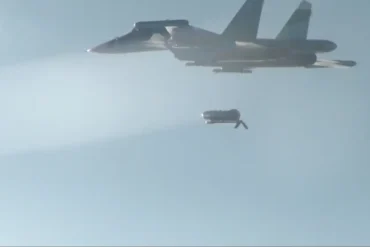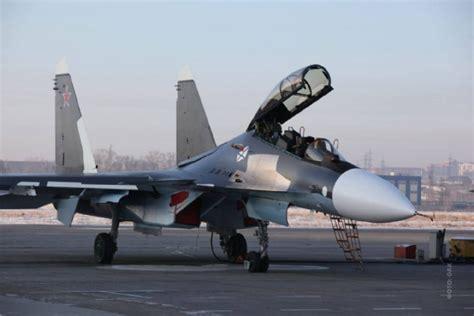
Russia has expanded its frontline airpower with a newly delivered batch of Su-30SM2 multirole fighters assigned to Naval Aviation, reinforcing long-range strike operations as the war over Ukraine enters a phase defined by heavy stand-off missile use and persistent pressure on Ukrainian air defenses. The delivery, confirmed by the United Aircraft Corporation on November 21, 2025, marks the first publicly acknowledged Su-30SM2 handover to the fleet this year, signaling both industrial stability and Moscow’s continued emphasis on high-end combat aviation as a strategic tool.
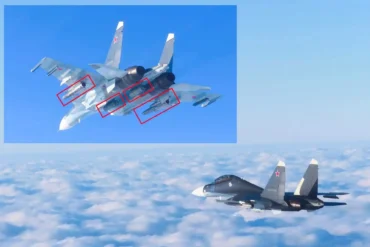
The newly fielded fighters, photographed in blue-gray naval camouflage with the St. Andrew’s flag, slot directly into Russia’s expanding maritime airpower structure. Their arrival coincides with a noticeable rise in Russian long-range strikes against Ukrainian infrastructure, a campaign increasingly supported by large twin-engine fighters acting as missile carriers within the protective envelope of Russian air defenses.
The Su-30SM2 represents Russia’s most advanced naval fighter variant, a deep modernization that fuses the proven Su-30 airframe with key systems drawn from the Su-35. Its upgraded AL-41F-1S engines, expanded sensor suite, and reinforced weapons management capabilities have been tailored for missions over the Black Sea, Baltic Sea, and contested airspace adjoining Ukraine.
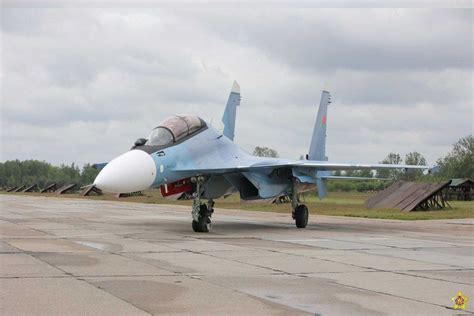
Su-30SM2 Modernization Brings Su-35-Level Capabilities to Naval Aviation
The Su-30SM2 retains the hallmark two-seat, canard-equipped design of earlier Su-30s but introduces a sweeping internal transformation. AL-41F-1S engines, shared with the Su-35, increase thrust, improve reliability, and allow the aircraft to carry heavy strike payloads over long distances—qualities that make it especially suitable for maritime patrols and stand-off strike missions.
The aircraft’s maximum takeoff weight of roughly 34.5 tons, internal fuel load near 9.6 tons, and an estimated 8-ton external weapons capacity place it firmly in the heavyweight class. While its top speed remains around Mach 2, the core leap lies not in aerodynamics but in its electronics.
Irbis-E Radar and EW Upgrades Sharpen Long-Range Engagement Profile
The radar centerpiece is the Irbis-E passive electronically scanned array (PESA), adapted from the Su-35. With detection ranges stretching into the hundreds of kilometers, the system allows the Su-30SM2 to manage multiple targets and prosecute long-range engagements even in cluttered maritime environments. Its modernized electro-optical sight and redesigned digital cockpit—with large-format color displays—enhance situational awareness during extended missions.
Electronic warfare enhancements, built around upgraded Khibiny-series jammers, bolster survivability against Western radar-guided missiles and advanced Ukrainian ground-based systems, including Patriot-class interceptors.
A Versatile Missile Carrier for Naval and Land Strike Operations
The aircraft’s weapons compatibility underscores its mission as a flexible strike and air-defense platform for Naval Aviation. In the air-to-air role, the Su-30SM2 can employ R-73, R-77-1, and reportedly the ultra-long-range R-37M, designed to threaten tankers and airborne early-warning aircraft operating far from Russian territory.
For strike missions, it carries Kh-31 anti-ship and anti-radar missiles, Kh-29 and Kh-59 tactical missiles, as well as KAB-250-series guided bombs. This arsenal enables everything from Black Sea drone patrols to deep stand-off attacks on infrastructure sites in Ukraine, all conducted while remaining inside Russian or Crimean airspace.
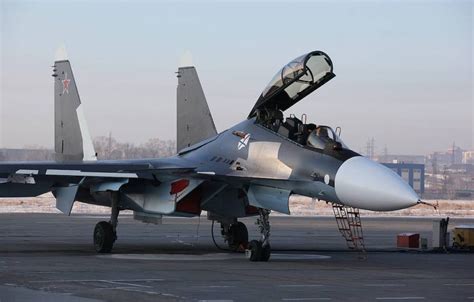
Expansion Comes as Maritime Flanks Grow More Contested
The reinforcement of Naval Aviation arrives at a sensitive moment. Russian forces in Kaliningrad and Crimea increasingly use Su-30-family fighters to patrol the Baltic and Black Sea approaches, escort maritime patrol assets, and launch precision strikes from mid-altitude. Western analysts note a growing pattern: heavy Russian fighters acting as long-range missile platforms, minimizing exposure by launching from protected airspace.
Additional Su-30SM2s translate into more radar coverage, more missile carriers, and greater pressure on Ukrainian F-16s, which must operate under the shadow of Russian long-range sensors once they enter service.
Fleet Modernization Under Sanctions: A Revealing Benchmark
The Su-30SM2 has become a symbol of Russia’s effort to rationalize its fighter fleet and maintain production despite sanctions. A contract signed around 2020 funded 21 Su-30SM2s alongside Yak-130 trainers, with plans to upgrade roughly 110 older Su-30SMs to the new standard by mid-decade.
The Irkutsk Aviation Plant, responsible for Su-30 production, has faced constraints on imported avionics and components. Continued deliveries in 2025 suggest that Russia has secured alternative supply lines for engines, computers, and radar subsystems—at least sufficiently to sustain slow but steady output.
How the Su-30SM2 Fits Into Global Naval Aviation
Unlike Western fighters such as the F/A-18E Super Hornet or Rafale M, designed for carrier operations, the Su-30SM2 operates almost exclusively from shore. This avoids carrier-related design compromises and allows larger fuel reserves and payloads, making the aircraft well-suited for policing enclosed seas like the Black Sea and Baltic.
Its PESA radar falls short of modern Western AESA systems in agility and low-probability-of-intercept performance, yet its power output, antenna size, and two-person crew give it a solid advantage in long-range engagements over water.
Export Prospects and Global Operator Landscape
Belarus has become the first confirmed external user of the Su-30SM2 standard, receiving upgraded aircraft derived from its earlier Su-30SM fleet. Other Su-30 operators—India, Algeria, Malaysia, and China—field localized variants with different radar and avionics configurations. While some components of the SM2 package could theoretically be exported, political, industrial, and operational differences make widespread adoption unlikely.
For now, the Su-30SM2 remains a Russia-centric modernization, tailored for high-tempo missions near NATO borders and the Ukrainian battlefield. As deliveries continue through 2025 and into 2026, both Kyiv and NATO maritime planners will face a denser network of Russian sensors, missile platforms, and long-range strike capabilities across the Baltic and Black Sea theaters.