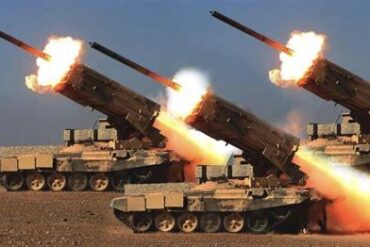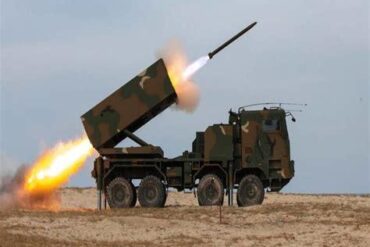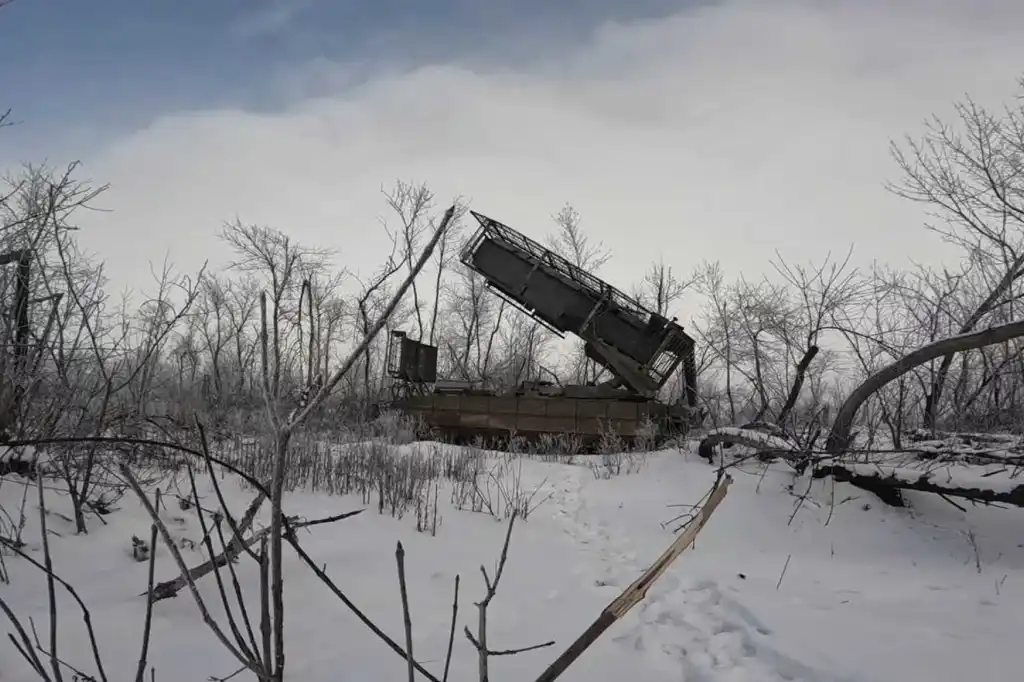
Russia has escalated its use of heavy thermobaric firepower in Ukraine with the confirmed combat deployment of the new TOS-3 Drakon heavy flamethrower system, a tracked rocket launcher designed to neutralize fortified positions and entrenched defenses. Official footage released by the Russian Ministry of Defense on February 4, 2026, shows the system conducting live combat operations, reportedly destroying a Ukrainian stronghold in the Krasnoarmeysk direction. The crew was identified as belonging to the 29th Separate Radiation, Chemical, and Biological Defense Brigade, a formation historically associated with operating the TOS family of thermobaric systems.
The appearance of the TOS-3 on the battlefield marks the latest stage in the evolution of Russia’s 220 mm thermobaric rocket artillery doctrine, a concept that blends artillery saturation with high-intensity blast physics. While thermobaric weapons have long been controversial for their devastating overpressure effects, their tactical purpose within Russian military structure has consistently focused on breaching defensive belts, trench systems, bunkers, and reinforced strongpoints that resist conventional shelling.
The footage confirms that the TOS-3 has transitioned from prototype to operational deployment, following its public unveiling in 2024 and the emergence of earlier combat imagery in late 2025. Unlike traditional multiple launch rocket systems, the TOS series is assigned to Russia’s NBC (Nuclear, Biological, Chemical) Protection Troops rather than standard artillery units, underscoring its specialized role in area denial and fortified position destruction.
The Evolution of Russia’s TOS Heavy Flamethrower Systems
The TOS (Tyazhyolaya Ognemyotnaya Sistema) lineage dates back to the Cold War era. The original TOS-1 Buratino, developed between 1971 and 1979, entered service in 1988 mounted on a modified T-72 tank chassis. Designed to attack fortified positions and light armored vehicles, it carried 30 launch tubes firing 220 mm thermobaric rockets. Early rockets had a relatively short maximum range of about 3 kilometers, forcing crews to operate near the front line.
Combat testing in Afghanistan’s Panjshir Valley during 1988–1989 revealed both the weapon’s destructive potential and its vulnerability due to limited range. The thermobaric blast was particularly effective in mountainous terrain, where pressure waves amplified within enclosed valleys and cave systems.
The TOS-1A Solntsepyok, introduced in 2001, refined the concept. Its launcher was reduced to 24 tubes arranged in three rows of eight, mounted on a reinforced tank chassis for improved survivability. Enhanced rockets extended the range to 6 kilometers and later to approximately 10 kilometers with upgraded munitions. Fire-control improvements included a ballistic computer, laser rangefinder, and improved observation systems. The TOS-1A saw deployment in multiple conflicts, including Syria and Ukraine.
By 2018, lessons from modern drone warfare prompted another shift. The TOS-2 Tosochka transitioned from a tracked tank base to a wheeled UralAZ-63704-0010 6×6 truck chassis, trading heavy armor for improved mobility and operational reach. The TOS-2 carried 18 rockets and integrated an onboard crane for autonomous reloading. Its TBS-M3 rocket reportedly achieved engagement distances of 10 to 20 kilometers, reflecting a steady expansion of standoff capability.
TOS-3 Drakon: Design, Range, and Tactical Shifts
The TOS-3 Drakon, sometimes referred to as “Dragon,” synthesizes elements from earlier variants while introducing a new launcher configuration and enhanced survivability features. Public records indicate that Omsktransmash registered the TOS-3 trademark in January 2024, with Rostec confirming prototype completion in April 2024. The system was unveiled publicly in Saratov in June of that year.
Unlike the 24-tube configuration of the TOS-1A or the 18 tubes of the TOS-2, the TOS-3 carries 15 launch tubes arranged in three rows of five. At first glance, fewer rockets may seem like reduced firepower. In reality, the reduction likely accommodates larger or longer 220 mm rockets with increased propellant capacity, extending effective range.
Estimates suggest engagement distances of 15 kilometers or more, with some assessments placing potential maximum range as high as 18 to 24 kilometers depending on configuration. Official figures remain undisclosed. What is clear is that the TOS-3 reflects a doctrinal adjustment: maximize destructive thermobaric effect while increasing survivability through greater standoff distance.
The tracked chassis, widely believed to derive from the T-72 or T-80 platform, provides armored protection comparable to earlier variants. However, design indications suggest a targeted combat weight of approximately 40 to 42 tonnes, lighter than the 46-ton TOS-1A when fully loaded. Reduced launcher mass improves mobility and decreases strain on drivetrain components.
Defensive Enhancements and Electronic Warfare Integration
Battlefield experience in Ukraine, particularly losses attributed to FPV (First-Person View) attack drones, has influenced the TOS-3’s defensive configuration. Imagery shows the launcher pod equipped with protective mesh screening, similar to field modifications seen across Russian armored vehicles.
Additionally, the system reportedly integrates the Volnorez electronic warfare system, intended to disrupt or jam hostile drone control frequencies. The incorporation of electronic countermeasures represents an acknowledgment that heavy artillery platforms now operate under persistent aerial surveillance and drone threat.
Digital fire-control and communications upgrades are also believed to support extended engagement distances. Earlier TOS crews relied on line-of-sight targeting with laser rangefinders. Modern iterations increasingly integrate data from reconnaissance drones and networked battlefield systems, shortening reaction time between target acquisition and launch.
Thermobaric Warheads: Mechanism and Battlefield Impact
The defining characteristic of the TOS family is its thermobaric munition. Unlike conventional high-explosive shells that rely solely on chemical detonation within a confined mass, thermobaric warheads disperse a cloud of aerosolized fuel before ignition. Upon detonation, the cloud ignites using atmospheric oxygen, generating a high-temperature fireball and a sustained overpressure wave.
The physics are stark. The initial dispersion phase spreads fine fuel particles across a target area. The subsequent ignition produces a prolonged pressure pulse that penetrates trenches, bunkers, and enclosed spaces more effectively than standard explosives of comparable mass. The resulting heat and pressure can collapse structures and neutralize personnel within fortified positions.
Thermobaric weapons are particularly effective against entrenched infantry and hardened defensive belts. Their extended pressure duration distinguishes them from conventional blast-fragmentation artillery, which emphasizes shrapnel over sustained overpressure. In dense trench networks or reinforced urban structures, the thermobaric effect can propagate through interconnected compartments, amplifying destructive reach.
Operational Context in Ukraine
The deployment of the TOS-3 occurs within a broader context of intensified positional warfare in eastern Ukraine. Both sides have constructed layered trench systems, reinforced bunkers, and hardened strongholds designed to absorb artillery bombardment. In such an environment, weapons optimized for area saturation and structural overpressure become tactically significant.
By extending engagement range, the TOS-3 reduces the exposure window that plagued earlier variants forced to operate within shorter firing distances. Greater standoff also complicates counter-battery targeting efforts. However, the platform remains high-value and conspicuous, requiring integrated air defense and electronic protection.
The assignment of the TOS-3 to NBC Protection Troops rather than conventional artillery units reinforces its doctrinal role as a specialized breaching system rather than general-purpose rocket artillery. It is deployed selectively, typically in support of offensive operations targeting fortified defensive nodes.
Strategic Implications of the TOS-3 Deployment
The introduction of the TOS-3 Drakon underscores the adaptive cycle of modern warfare, where battlefield losses drive rapid technological iteration. Each generation of the TOS series reflects a response to operational vulnerability: from limited range in Afghanistan, to armor reinforcement in the 2000s, to wheeled mobility in 2018, and now to drone countermeasures and extended-range munitions.
The TOS-3 does not fundamentally reinvent thermobaric doctrine. Instead, it refines it for an era defined by drone reconnaissance, electronic warfare, and layered fortifications. Its reduced tube count paired with likely higher-performance rockets signals a shift toward precision in destructive capacity rather than sheer salvo volume.
In Ukraine, where entrenched positions often define the tactical landscape, such systems are intended to create localized breakthroughs by overwhelming defensive infrastructure. Whether the TOS-3 achieves decisive impact will depend not only on its technical capabilities but on the evolving interplay between artillery, drones, electronic warfare, and counter-battery systems.
What remains evident is that the TOS-3 Drakon thermobaric rocket system represents the latest iteration in a specialized and formidable weapons family—one shaped by decades of operational feedback and accelerated by the demands of contemporary high-intensity conflict.