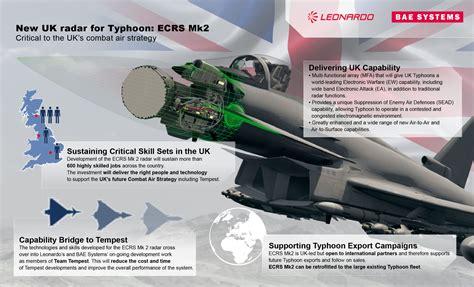
The United Kingdom has taken a decisive step to reinforce its air combat superiority with the approval of a £453.5 million contract for the production of 40 ECRS Mk2 active electronically scanned array (AESA) radars. This investment will fundamentally upgrade the Royal Air Force’s Eurofighter Typhoon Tranche 3 fleet, equipping it with one of the most advanced airborne radar and electronic warfare systems currently fielded by a NATO air force. More than a routine modernization, the programme reshapes how the Typhoon will fight, survive, and dominate in increasingly contested airspace.
The contract, confirmed by the UK Ministry of Defence on January 22, 2026, brings together BAE Systems, Leonardo UK, and Parker Meggitt in a full-rate production effort that follows years of development and flight testing. At its core, the ECRS Mk2 radar introduces a new philosophy of air combat for the RAF: a sensor that does not merely observe the battlespace but actively manipulates it. In an era defined by electronic attack, dense air defence networks, and near-peer adversaries, that distinction matters.
A Radar Designed for the Electromagnetic Battlefield
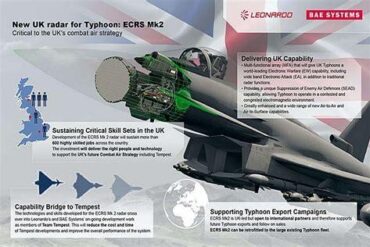
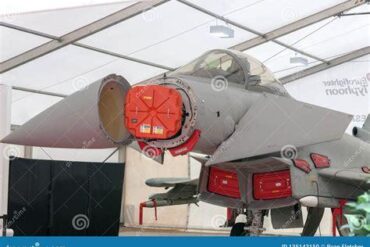
Traditional mechanically scanned radars operate by physically moving an antenna, a limitation that constrains speed, reliability, and flexibility. The ECRS Mk2 AESA replaces this paradigm with thousands of solid-state transmit/receive modules that steer radar beams electronically at near-instantaneous speeds. This allows RAF Typhoons to conduct simultaneous wide-area search, precision target tracking, and high-power electronic attack, all without sacrificing situational awareness.
Unlike earlier AESA upgrades focused primarily on detection range and tracking fidelity, the ECRS Mk2 was designed from inception to operate as a hybrid radar–electronic warfare system. It can jam or deceive hostile radars while continuing to provide pilots with a coherent tactical picture, a capability particularly valuable in suppression or destruction of enemy air defences. The result is a Typhoon that can penetrate defended airspace, disrupt adversary sensor networks, and engage threats long before being detected itself.
Strategic Context: Countering Near-Peer Air Threats
The Ministry of Defence has been explicit in framing the procurement as a response to a deteriorating security environment across Europe. Russian long-range aviation patrols, drone incursions, and electronic warfare activities along NATO’s eastern flank have underscored the vulnerability of airspace to sophisticated, spectrum-heavy threats. Defence Secretary John Healey described the ECRS Mk2 as essential to ensuring the RAF remains credible “at home and strong abroad,” particularly as electronic warfare becomes central to modern air combat doctrine.
This emphasis reflects a broader shift in Western air forces. Air superiority is no longer defined solely by kinematic performance or missile range, but by dominance of the electromagnetic spectrum. Sensors, datalinks, and jammers have become as decisive as engines and weapons. By embedding electronic attack functions directly into the Typhoon’s primary radar, the RAF is aligning its frontline fighter with this reality.
Industrial Impact and Sovereign Capability
Beyond operational benefits, the ECRS Mk2 programme carries substantial industrial significance. The contract is expected to sustain over 500 highly skilled jobs across sites in Edinburgh, Luton, and Lancashire, while supporting more than 1,300 additional roles throughout the wider UK defence supply chain over the next decade. Leonardo’s radar facility in Edinburgh, in particular, remains a cornerstone of Britain’s sovereign radar and electronic warfare expertise.
Maintaining domestic control over such technologies is strategically important. Advanced AESA radars sit at the intersection of defence, microelectronics, and software engineering, sectors where supply chain resilience has become a national security issue. By investing at scale, the UK ensures continued access to critical skills while preserving the option to evolve the system independently as threats change.
From Prototype to Production
The move to full-rate production follows an extensive test campaign conducted by the Defence Equipment and Support Typhoon Delivery Team, BAE Systems, and Leonardo UK. Test flights validated the radar’s high-power output, thermal management, and real-time data fusion, demonstrating that the system could perform both sensing and electronic attack roles without compromising reliability.
RAF Air Commodore Nick Lowe, Head of Capability for Combat Air, described the radar as a decisive enhancement, noting that it would allow Typhoon crews to “operate with confidence in the most heavily defended environments.” That confidence stems not just from raw performance, but from the system’s resilience against jamming and its ability to adapt waveforms dynamically in response to hostile emitters.
Elevating the Typhoon’s Role Within NATO
Within NATO, the upgraded Typhoon occupies a critical niche. While fifth-generation platforms such as the F-35 emphasize stealth and sensor fusion, the Typhoon with ECRS Mk2 offers a complementary capability: a powerful, high-energy electronic warfare asset capable of escort jamming, air defence suppression, and air dominance missions. RAF officials have highlighted that few allied fighters combine such performance with the Typhoon’s payload, speed, and altitude envelope.
This balance enhances interoperability. In coalition operations, ECRS Mk2-equipped Typhoons can act as force multipliers, degrading enemy sensors to open corridors for other aircraft while maintaining air superiority. The upgrade also strengthens the aircraft’s export appeal, with industry leaders expressing optimism that other Typhoon operators will adopt the radar as part of future modernization paths.
Economic and Export Momentum
The radar order arrives amid renewed momentum for the Typhoon programme. Just months earlier, the UK secured a major export agreement with Türkiye, reinforcing the aircraft’s relevance on the global stage. By pairing proven airframe performance with cutting-edge sensors, the ECRS Mk2 ensures the Typhoon remains competitive against newer designs well into the 2030s.
Mark Stead, Leonardo’s Senior Vice President for Radar and Advanced Targeting, characterized the system as an “electronic warfare powerhouse,” a description that underscores its dual-use nature. This versatility is particularly attractive to air forces seeking to maximize return on investment from existing fleets rather than commit entirely to new platforms.
A Bridge to Future Combat Air Systems
Looking beyond immediate operational needs, the ECRS Mk2 is widely viewed as a bridge to next-generation combat air programmes, including the UK-led Global Combat Air Programme (GCAP). As sixth-generation concepts emphasize networked sensors, distributed electronic warfare, and manned–unmanned teaming, experience gained from operating an integrated radar–EW system on Typhoon will be invaluable.
BAE Systems has emphasized that continuous investment in Typhoon capability accelerates the maturation of technologies relevant to future platforms. Software-defined architectures, adaptive waveforms, and advanced processing techniques developed for ECRS Mk2 are directly applicable to the combat air systems of the 2040s.
Sustaining Air Superiority Into the 2040s
With the RAF planning to keep the Typhoon in frontline service through the mid-2040s, the ECRS Mk2 radar upgrade is both a technological leap and a strategic statement. It signals that Britain intends not merely to maintain its fighter force, but to keep it relevant, resilient, and dominant in an era of rapid military innovation.
As production radars begin moving from Leonardo’s assembly lines to operational squadrons later this decade, the Typhoon will emerge as a more agile and electronically potent platform. In a security environment where control of the electromagnetic spectrum increasingly defines victory, the UK’s investment ensures that RAF pilots will continue to fly an aircraft designed not just to see the fight, but to shape it.