The United Kingdom has taken a deliberate and strategically loaded step to reinforce its undersea defenses, confirming a $54.8 million investment in new-generation sonobuoys for the Royal Navy’s Merlin Mk2 anti-submarine warfare helicopters. Announced on 2 February 2026, the contract signals that London views the underwater battlespace around the British Isles not as a distant contingency, but as an active and evolving front where sensing, classification, and speed of response matter as much as hulls and missiles.
This funding, awarded to Ultra Maritime, is not framed as routine sustainment. It is explicitly tied to deterrence: protecting the UK’s continuous at-sea nuclear deterrent, defending critical seabed infrastructure, and countering intensified Russian submarine operations in the North Atlantic and North Sea approaches. The figure reflects the conversion of a £40 million Ministry of Defence contract at prevailing exchange rates, but the strategic value is far larger than the headline number suggests.
At its core, the deal underscores a modern reality of anti-submarine warfare. Platforms get the attention, but acoustic sensors win the fight. Without fresh, capable sonobuoys, even the most sophisticated helicopter becomes a listener with no ears in the water.

Sonobuoys as the Fastest Way to Build an Underwater Picture
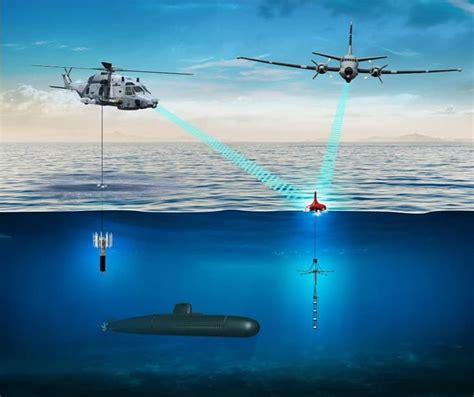
Sonobuoys are sometimes dismissed as expendable accessories, but in contemporary ASW they are decisive tools. Dropped from a helicopter at a precise location and time, a buoy immediately establishes an acoustic node in the ocean, lowering its hydrophone to a selected depth to listen passively or transmit sound actively. Within minutes, a commander gains insight into what is moving, where it is moving, and how it is behaving beneath complex layers of water.
For the Merlin Mk2, the advantage lies in integration. The helicopter blends data from buoy fields with its powerful dipping sonar, allowing crews to interrogate specific thermoclines and acoustic layers where submarines attempt to hide. This layered approach compresses the time between initial detection and confident classification, a critical factor when tracking fast, quiet nuclear-powered submarines operating close to strategic routes.
Inside the Ultra Maritime Sonobuoy Portfolio
The technical depth of the contract reflects the complexity of the undersea fight. Ultra Maritime’s portfolio includes a mix of passive, active, and multistatic systems designed to operate as a network rather than isolated sensors.
The SSQ-955 HIDAR passive directional sonobuoy is a key component. Compact and lightweight at roughly 5.6 kilograms, it digitizes acoustic data and transmits it back to the aircraft at high data rates, preserving detail in noisy littoral environments. Its directional capability allows operators to determine bearing, not just presence, while programmable depth and endurance settings enable tailored deployment depending on water conditions and mission duration.
Complementing this is the SSQ-906 LOFAR passive buoy, optimized for broad-area surveillance. Using omni-directional sensing and a wide acoustic band, it is designed to detect low-frequency signatures associated with modern submarines, even in shallow or low-salinity waters near coastlines and estuaries. Selectable endurance profiles allow crews to trade listening time against battery life based on tactical need.
Active systems complete the picture. The SSQ-926 ALFEA functions as a low-frequency projector in a multistatic setup, transmitting controlled acoustic energy that passive receivers can analyze from multiple angles. This geometry complicates a submarine’s evasion tactics, as the sound source and receiver are no longer co-located. The SSQ-963D CAMBS, a directional active buoy, adds precision localization options with adjustable power profiles, supporting either rapid prosecution or persistent monitoring.
Multistatic Warfare and the Merlin Mk2 Advantage
One of the most consequential aspects of this upgrade is how it aligns with the Merlin Mk2’s mission system evolution. The helicopter can now process data from more than 30 sonobuoys simultaneously, a leap that fundamentally changes ASW tactics. Instead of a narrow search corridor, crews can establish wide acoustic nets, rapidly refining contact positions and reducing uncertainty.
Multistatic operations, where multiple receivers listen to reflections from an active source, are especially effective against submarines optimized to defeat traditional monostatic sonar. Bearings converge faster, false contacts are discarded earlier, and the submarine commander faces a far more complex detection problem. In practical terms, this shortens the path from first contact to a firing-quality track, reinforcing deterrence by making detection more likely and escape less certain.
Industrial Strategy Beneath the Waves
Beyond capability, the contract carries an industrial message. Ultra Maritime’s scope includes design, engineering, manufacturing, and ongoing support, with investment flowing into its Greenford facility in west London. The company has described a £20 million expansion aimed at scaling production and strengthening domestic supply resilience.
This matters because sonobuoys are consumed at the pace of training and operations. In a crisis, inventories deplete quickly. Maintaining sovereign manufacturing capacity reduces dependence on fragile supply chains and ensures that surge demand can be met if undersea tensions escalate. The Ministry of Defence has also highlighted parallel work on miniaturized sonobuoys for uncrewed systems, pointing toward future integration with remotely piloted or autonomous platforms.
Countering Russian Submarine Operations Near the UK
The strategic driver behind the investment is clear. Russian submarines, including advanced nuclear-powered attack boats armed with long-range cruise missiles, have increased their operational tempo near the British Isles. These deployments are not limited to open-ocean patrols; they intersect with surveillance of undersea cables, energy pipelines, and other critical infrastructure that underpins both national security and economic stability.
In this environment, the Merlin Mk2 is more than an escort asset. It is a rapid-response sensor platform capable of investigating contacts, maintaining pressure, and coordinating with surface ships and allies across NATO. Sonobuoys provide the persistence that helicopters alone cannot, maintaining an acoustic presence long after the aircraft has moved on.
A Signal of Long-Term Undersea Commitment
This $54.8 million procurement fits into a broader pattern of sustained investment rather than a single corrective action. Over the past decade, the UK has repeatedly refreshed its sonobuoy inventory through follow-on contracts, ensuring compatibility with evolving mission systems and maintaining operational readiness.
The message is unambiguous. London expects the undersea environment around its waters to remain contested, crowded, and strategically significant. By investing in advanced sonobuoys, the UK is prioritizing first detection, confident classification, and credible deterrence, ensuring that its Merlin Mk2 crews retain a decisive edge in one of the most opaque and unforgiving domains of modern warfare.