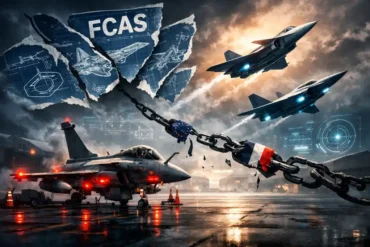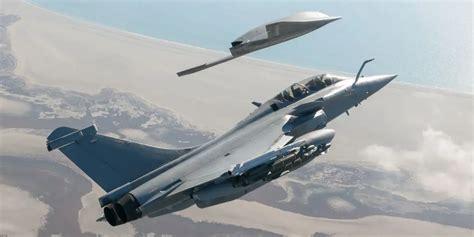
France’s combat aviation roadmap entered a decisive new phase in January 2026 as Dassault Aviation confirmed a $200 million Series B investment in Harmattan AI, a fast-rising defence artificial intelligence specialist. The move anchors autonomy not as an experimental add-on, but as a core, embedded capability shaping the future of the Rafale F5 standard and a new generation of manned–unmanned combat systems. At stake is nothing less than how France intends to fight, command, and control airpower in the most contested operational environments of the coming decades.
Rather than pursuing off-the-shelf or externally controlled AI solutions, the investment reflects a deliberate industrial and strategic doctrine: sovereign, human-supervised autonomy. For Dassault, the decision reinforces a long-held philosophy that advanced combat systems must remain fully understood, auditable, and controlled by national authorities, particularly when lethal effects are involved. The partnership with Harmattan AI positions France to compress decision timelines, manage battlefield complexity, and preserve human authority at the point of action.
This announcement also signals a broader inflection point for European air combat. As electronic warfare density increases and operational tempos accelerate, traditional platform-centric advantages are giving way to system-of-systems thinking, where intelligence fusion, coordination, and resilience under disruption matter as much as raw performance. Dassault’s investment is designed to pull that future forward, embedding autonomy into the architecture of aircraft now entering advanced development phases.
Strategic Investment Beyond Capital Injection
The $200 million commitment goes far beyond financial backing. It formalizes a deep industrial partnership intended to align Harmattan AI’s autonomy stack directly with Dassault’s aircraft architectures, certification standards, and operational concepts. This approach contrasts sharply with models where AI remains a loosely coupled software layer, bolted onto platforms late in development and constrained by limited authority or trust.
By investing at this scale during a Series B round, Dassault is effectively co-shaping Harmattan AI’s technical roadmap. The goal is to ensure that autonomy functions are designed from the outset to meet the realities of high-intensity air combat, including degraded communications, contested electromagnetic environments, and the need for predictable, explainable behavior under stress. In this framework, AI is treated as a mission system, not an experiment.
For the French defence ecosystem, the partnership also reinforces industrial sovereignty. Ownership of algorithms, training data, and decision-support logic remains national, avoiding reliance on foreign black boxes that could limit operational freedom or export flexibility. This dimension is particularly significant as France balances its national programs with multinational initiatives across Europe.
Rafale F5 as a Collaborative Combat Hub
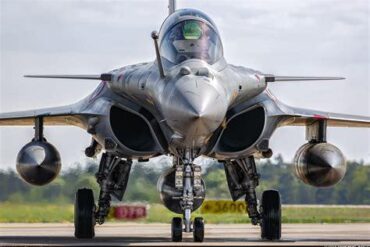
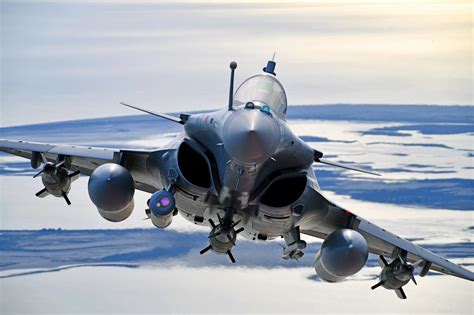
The Rafale F5 standard, expected to define the aircraft’s evolution into the 2030s, is increasingly framed as more than a mid-life upgrade. It is conceived as a collaborative combat node, capable of orchestrating effects across a distributed formation of crewed and uncrewed assets. Harmattan AI’s technologies are intended to be deeply embedded into this vision, acting as a cognitive layer that helps pilots manage complexity rather than adding to their workload.
In operational terms, this means AI-assisted functions that can filter and prioritize sensor data, recommend tactical options, and coordinate with accompanying unmanned systems in real time. The emphasis is on decision superiority rather than automation for its own sake. Human crews remain responsible for mission intent and weapons release, while AI accelerates the processes that lead up to those decisions.
Such capabilities are becoming indispensable as aircrews face unprecedented information density. Advanced sensors, networked platforms, and electronic warfare all generate vast data streams. Without intelligent mediation, pilots risk being overwhelmed. By embedding autonomy at the system level, Rafale F5 aims to turn that data into actionable insight within operationally relevant timelines.
Enabling Manned–Unmanned Teaming at Scale
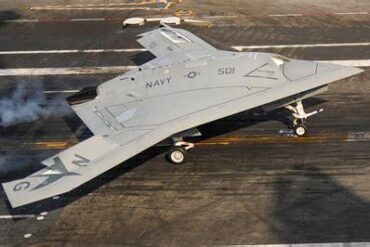
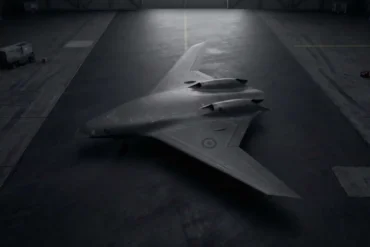
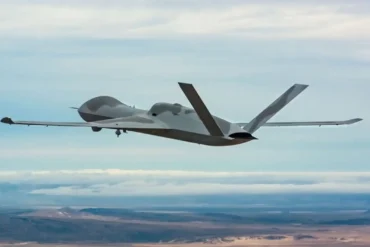
Central to the Dassault–Harmattan partnership is the development of a credible manned–unmanned teaming (MUM-T) capability. France’s future Unmanned Combat Aerial System (UCAS), launched under contract in late 2024, is designed to operate in close coordination with Rafale rather than as a standalone strike asset. Autonomy is the connective tissue that makes this relationship operationally viable.
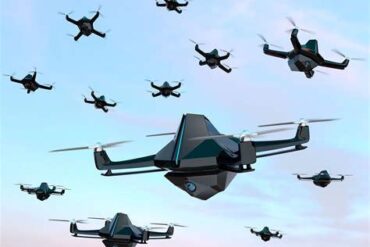
Harmattan AI’s role focuses on enabling unmanned platforms to operate with sufficient independence to be tactically useful, while remaining firmly under human supervision. This includes autonomous navigation, formation management, sensor tasking, and threat response, all governed by rules and intent set by the crewed aircraft. The objective is to allow a single pilot to command a small constellation of loyal wingmen without unsustainable cognitive burden.
Such systems promise tangible operational benefits. Unmanned assets can extend sensor reach, act as decoys, conduct electronic attack, or penetrate defended airspace ahead of crewed platforms. When coordinated effectively, they enhance survivability and mission effectiveness without requiring proportional increases in manpower or risk to pilots.
Harmattan AI’s Rapid Rise in Defence Autonomy
Founded in 2024, Harmattan AI has positioned itself as a defence-first autonomy company, developing vertically integrated systems rather than generic AI tools. Its portfolio spans coordinated ISR and strike UAV operations, layered air defence, electronic warfare applications, and command-and-control solutions designed for contested environments. According to the company, several of its systems are already produced at scale and deployed with NATO and allied partners.
This operational maturity was a key factor in Dassault’s decision. The aircraft manufacturer is not seeking experimental code, but field-proven autonomy capable of transitioning into certifiable, airworthy systems. The new funding round is intended to accelerate deployments, expand into additional domains, and scale industrial production for ISR, counter-drone, and electronic warfare platforms.
For Harmattan AI, alignment with Dassault provides access to one of the world’s most experienced combat aircraft integrators. This relationship bridges the gap between rapid AI innovation and the stringent safety, security, and export requirements that govern frontline military aviation.
Human Control as a Design Principle
A defining feature of the partnership is its explicit rejection of fully autonomous lethal decision-making. French doctrine has long emphasized human responsibility in the use of force, and this investment reinforces that stance. Autonomy is framed as a means to assist, inform, and accelerate human decisions, not to replace them.
This philosophy has practical implications for system design. Algorithms must be transparent, predictable, and capable of graceful degradation under uncertainty. Crews must understand not only what the system is recommending, but why. In high-intensity combat, trust in AI is inseparable from explainability and reliability.
By embedding these principles early, Dassault and Harmattan aim to avoid the pitfalls associated with opaque autonomy. The result is intended to be a combat system where AI enhances confidence rather than introducing doubt at critical moments.
Industrial Timing and Strategic Implications
The timing of the investment underscores its strategic weight. By committing significant resources in 2026, Dassault is effectively locking in autonomy as a foundational capability for platforms that will dominate French airpower into the 2040s. This early integration allows autonomy requirements to influence architecture, power management, cooling, and certification pathways from the outset.
At a strategic level, the move also strengthens France’s position within European defence debates. As multinational programs grapple with questions of sovereignty, data ownership, and control, the Dassault–Harmattan partnership offers a concrete model for how advanced autonomy can be developed without ceding authority or flexibility.
In an era defined by contested airspace, electronic warfare, and compressed decision cycles, the partnership illustrates how controlled combat autonomy is moving from concept to reality. For Rafale F5 and the future UCAS, autonomy will not be a buzzword, but a defining attribute—one designed to keep human judgment at the center of air combat while extending its reach through intelligent machines.