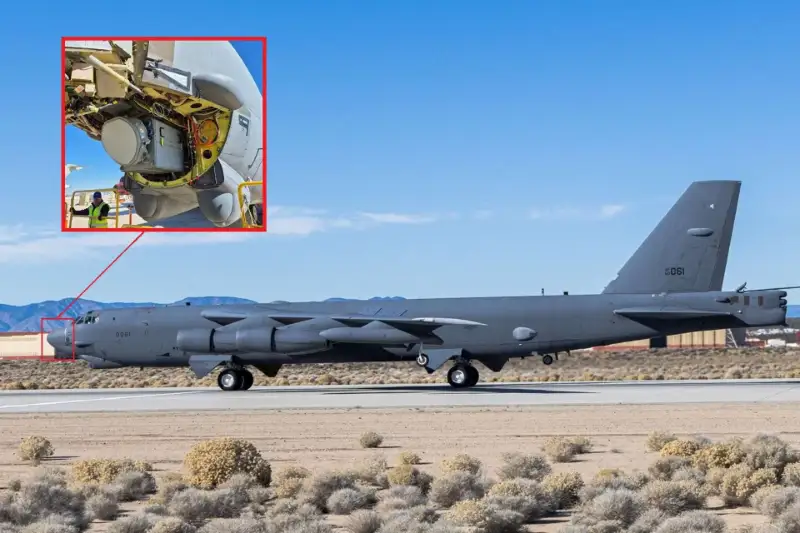
The legendary B-52 Stratofortress, the cornerstone of U.S. strategic airpower for over six decades, has embarked on a new phase of its evolution. On December 11, 2025, Boeing announced the successful delivery of the first Radar Modernization Program (RMP) flight-test aircraft to the U.S. Air Force, now undergoing intensive trials at Edwards Air Force Base. This marks the operational debut of the AN/APQ-188 Active Electronically Scanned Array (AESA) radar, a critical upgrade that aims to revolutionize the aircraft’s targeting precision, weather resilience, and mission survivability well into the mid-21st century.
The Transition from Legacy to Lethality
Unlike previous avionics upgrades, the AN/APQ-188 installation represents a leap in sensor architecture and airframe integration. Replacing the B-52’s decades-old mechanically scanned radar, the AESA suite introduces rapid beam steering, enhanced signal fidelity, and multi-target tracking — allowing crews to detect, track, and engage adversaries in hostile or degraded environments with unprecedented speed.
Boeing has emphasized that the modernization extends beyond the radar hardware itself. Crews will benefit from high-definition displays, fighter-style hand controllers, and increased processing capacity, transforming radar operation from a laborious analog experience to a streamlined digital interface. This modernization is essential to reduce cognitive workload during long-duration missions and to support advanced weaponry and mission planning tools.
From Factory Floor to Flight Testing: Why Edwards AFB Matters
After undergoing radar integration and systems checks in San Antonio, the upgraded B-52 successfully ferried to Edwards Air Force Base in California, marking the transition from engineering to real-world validation. Edwards will host both ground and flight testing throughout 2026, pushing the AN/APQ-188 to prove its capabilities under extreme operational conditions — from storm penetration to low-level targeting runs in electronic warfare scenarios.
Unlike simulations or lab trials, this testing phase evaluates how the radar performs under mission-realistic conditions. Engineers and pilots will measure:
- All-weather accuracy: Can the radar maintain high-resolution returns during heavy rain, snow, or turbulence?
- Survivability in contested airspace: How well does the radar support threat avoidance and rapid engagement?
- Maintainability: Can the system hold up during extended operations with limited downtime or support?
These metrics will determine not only whether the radar is effective but whether it is viable across the entire fleet of B-52s that remain active.
Strategic Implications: Beyond a Sensor Upgrade
While the technical performance of the AN/APQ-188 is the immediate focus, its strategic implications are far-reaching. This radar upgrade is a foundational pillar in the U.S. Air Force’s plan to keep the B-52 operational into the 2050s, aligning it with newer platforms like the B-21 Raider. But doing so requires balancing modernization costs with fleet sustainability.
This is not merely about improving mission performance. It is also about:
- Budget predictability: The radar’s success will shape future procurement timelines and cost trajectories.
- Contractual accountability: Boeing oversees full integration, while Raytheon supplies the radar — making collaboration and technical synergy essential.
- Fleet composition strategy: If the AN/APQ-188 proves too costly or complex to scale, it may influence decisions on retiring or scaling down the B-52 fleet.
Legacy Reinvented: B-52’s Continued Relevance
Few aircraft have maintained relevance like the B-52. In late 2025, B-52 missions near Venezuela highlighted its enduring role in strategic messaging and regional deterrence. In such missions, radar fidelity is not just important — it is central to success. Precision navigation, long-range targeting, and crew situational awareness depend heavily on sensor reliability, especially in distant or geopolitically sensitive theaters.

The radar modernization effort helps ensure that these iconic bombers can continue projecting power across the globe, not as aging relics, but as capable, resilient, and modern weapons platforms. If successful, the AN/APQ-188 will allow the B-52 to bridge the gap between Cold War-era engineering and cutting-edge combat capability, securing its place as a key node in the U.S. strategic strike triad.
The Road Ahead: 2026 as the Deciding Year
The coming year will be the critical test of whether the AN/APQ-188 fulfills its promise. Should trials demonstrate consistent, measurable improvements in target acquisition speed, operational flexibility, and system dependability, the Air Force is expected to approve fleetwide retrofits. However, any failure to meet key thresholds could lead to delays, redesigns, or re-evaluation of the long-term modernization roadmap.
Ultimately, this radar upgrade is more than an engineering milestone — it is a litmus test for the broader feasibility of maintaining legacy platforms in a modern threat environment. The B-52 may have been born in the age of slide rules and riveted steel, but with the AN/APQ-188, it is aiming to fly confidently into the networked, high-threat battlespaces of the 21st century.