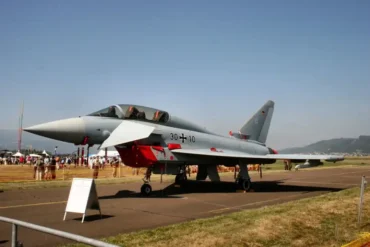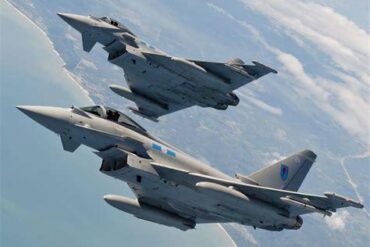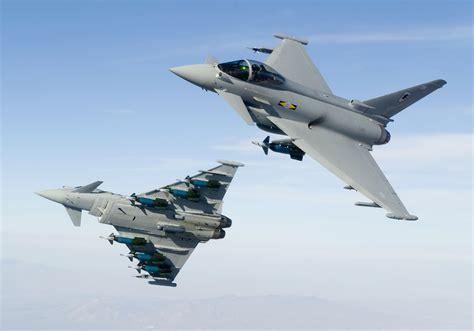
The Eurofighter Typhoon stands as one of the most advanced multirole fighters ever produced outside the stealth domain. Despite being conceived in the late Cold War era, the Typhoon has undergone relentless modernization, evolving into a potent force in contemporary air combat. Yet, in a world increasingly dominated by stealth aircraft and network-centric warfare, we must rigorously assess whether the Typhoon’s capabilities still meet modern operational demands.
Kinematic Excellence and Core Design Strengths
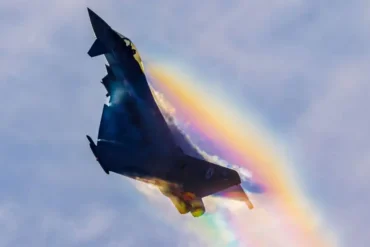
At its core, the Eurofighter Typhoon remains one of the most aerodynamically sophisticated fighters ever built. Its delta-canard configuration delivers exceptional agility, especially in close-range engagements. The Typhoon’s thrust-to-weight ratio surpasses many peers, allowing it to sustain high energy states and recover speed rapidly after hard maneuvers—a critical edge in within-visual-range (WVR) dogfights.
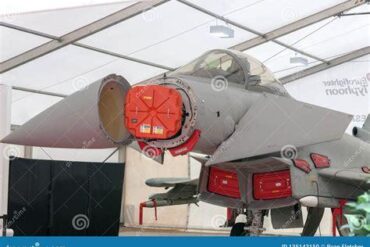
Equipped with one of the most advanced Infrared Search and Track (IRST) systems among Western fighters, the Typhoon can passively detect and track targets without emitting radar signals, preserving its own survivability in high-threat environments. Coupled with high off-boresight infrared imaging missiles like the IRIS-T and ASRAAM, the aircraft holds a formidable advantage in short-range combat scenarios.
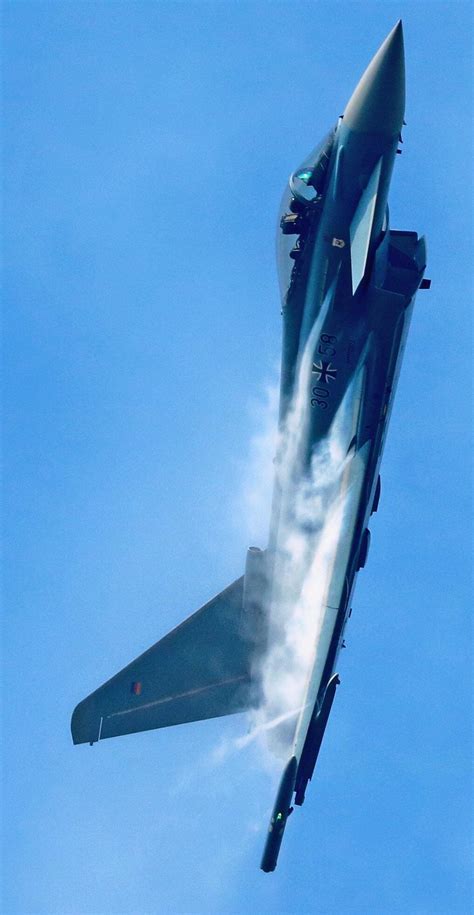
While it lacks the radar cross-section minimization of stealth platforms like the F-35 Lightning II or F-22 Raptor, the Typhoon’s clean airframe and electronic countermeasures suite mitigate detection risks in less contested environments. The Defensive Aids Sub-System (DASS) integrates radar warning, missile approach warning, and active jamming, enabling the Typhoon to survive and fight even without the protective veil of stealth.
Radar Evolution: From Mechanical to AESA Dominance
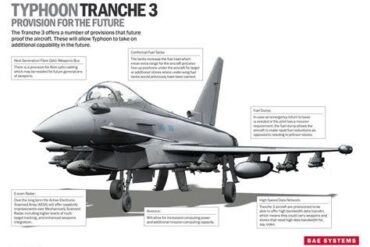
A pivotal transformation in the Typhoon’s viability comes from its radar upgrades. Early Tranche 1 airframes relied on mechanically scanned radars, limiting detection ranges and target tracking flexibility. However, newer Tranche 3 and Tranche 4 variants—the true 4.5-generation iterations—feature the E-Scan Mk-0 AESA radar, bringing the platform into alignment with the latest non-stealth competitors.
This radar leap grants the Typhoon significantly improved target tracking, electronic warfare resistance, and multirole functionality. Even more promising is the development of the ECRS Mk2 AESA radar, boasting over 1,600 transmit/receive modules, positioning it to rival the F-35’s APG-81 and far surpassing older systems like the Rafale’s RBE2-AA. This radar evolution underscores the Typhoon’s capacity for growth and technological refresh, an essential trait as electronic warfare and sensor fusion become defining elements of air superiority.
Weapons Integration: Meteor and Beyond
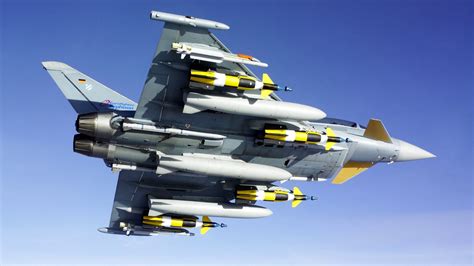
Perhaps the Typhoon’s most significant combat enhancement is its integration of the MBDA Meteor beyond-visual-range air-to-air missile (BVRAAM). With a ramjet propulsion system, the Meteor sustains energy across its entire flight envelope, allowing it to engage maneuvering targets at extreme distances. No equivalent missile is operational aboard American fighters, granting the Typhoon a distinct BVR reach advantage over platforms like the F-15EX or F-16V in non-stealth encounters.
In addition to the Meteor, the Typhoon can employ an array of precision-guided munitions, including Brimstone, Storm Shadow, and Paveway IV bombs, reinforcing its credentials as a multirole strike fighter. Continuous software updates through the P3Eb and forthcoming P4E upgrade packages ensure seamless integration of next-generation weaponry, electronic warfare pods, and targeting systems.
Comparative Analysis: Standing Against Rivals
When benchmarked against other 4th and 4.5-generation fighters, the Eurofighter Typhoon holds firm in several dimensions. It outpaces the F-15EX in kinematic agility and BVR missile technology, though it falls behind in payload flexibility and lacks the robust air-to-ground radar modes inherent in American strike fighters. Against the Dassault Rafale, debates center on trade-offs: while the Rafale boasts greater combat radius, payload flexibility, and a faster AESA rollout, the Typhoon counters with superior thrust-to-weight ratio, energy maneuverability, and longer-term growth potential.
Against fifth-generation adversaries like the F-35, Su-57, and J-20, however, the Typhoon’s deficiencies in stealth and sensor fusion become insurmountable in highly contested airspace. In Beyond Visual Range engagements where detection equates to survival, stealth platforms dominate by denying engagement opportunities to legacy radar-visible aircraft like the Typhoon.
Nevertheless, in WVR engagements, where agility and missile cueing dominate, the Typhoon remains surprisingly competitive—even capable of threatening a F-22 Raptor through superior turn rates and off-boresight missile employment. This nuanced performance split affirms the Typhoon’s ongoing utility in permissive or moderately contested environments, while underscoring its limits against peer stealth platforms in high-end wars.
Operational Longevity and Future Prospects
Far from approaching obsolescence, the Eurofighter Typhoon is poised to remain a frontline air combat platform well into the 2040s and 2050s. Recent procurements by Kuwait, Qatar, Germany, Spain, and pending contracts with Turkey and Saudi Arabia extend production timelines and sustain its industrial base. Meanwhile, its planned role as a partner and testbed for technologies under the Future Combat Air System (FCAS) program ensures its continuous adaptation to emerging doctrines.
The development of an electronic warfare (EW) variant, analogous to the EA-18G Growler or J-16D, reflects Eurofighter’s response to the expanding role of electronic attack in modern air combat. Such an adaptation would transform the Typhoon from a purely kinetic fighter into a critical enabler of multi-domain operations, capable of disrupting enemy air defenses and supporting stealth assets.
Cost-Effectiveness and Strategic Relevance
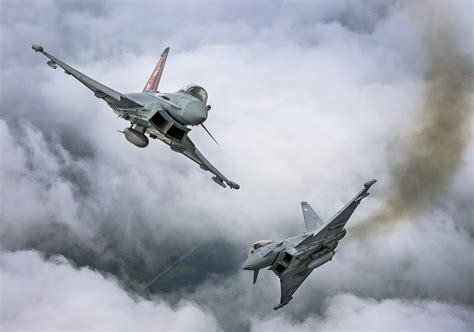
A key pillar in the Typhoon’s ongoing relevance is its operational cost efficiency. Estimates suggest the Typhoon’s cost per flight hour is roughly one-tenth that of an F-35, making it a far more sustainable option for nations prioritizing non-stealth roles, air policing, and regional deterrence. This affordability widens its operational utility across a spectrum of missions where stealth’s advantages are unnecessary or where maintaining high sortie rates is critical.
As a backbone of the Luftwaffe and other European air forces until the FCAS or NGF systems mature, the Typhoon ensures NATO-aligned nations retain a high-end air combat capability without full reliance on American platforms. Its continued upgrades, flexible mission sets, and industrial relevance further solidify its place in the evolving air power equation.
Conclusion: A Fighter That Holds Its Own—With Limits
In summation, the Eurofighter Typhoon remains a formidable combat aircraft by modern standards, particularly in air superiority missions outside of heavily contested stealth-dominated battlespaces. Its continuous evolution through radar upgrades, weapons integration, and planned electronic warfare variants underscores a platform with enduring growth potential.
Yet, the Typhoon’s inherent lack of stealth ensures it cannot substitute for true fifth-generation fighters in penetrating anti-access/area denial (A2/AD) environments. Its optimal employment lies in complementing stealth assets, dominating airspace in permissive theaters, and providing multirole flexibility at a sustainable operational cost.
As air combat evolves toward greater sensor fusion, electronic warfare, and low observability, the Typhoon’s strengths in agility, upgradeability, and BVR lethality keep it relevant—but not irreplaceable—in the emerging air dominance landscape.