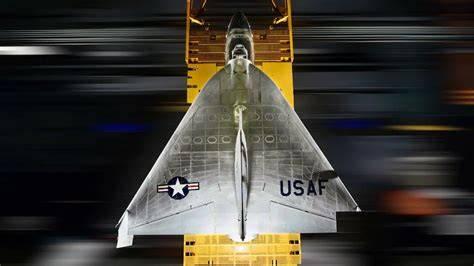
The Ryan X-13 Vertijet was one of the Cold War’s strangest aircraft, combining a powerful turbojet engine, a tiny airframe, and an extraordinary landing method that required the pilot to recover the aircraft vertically onto a cable. It looked almost more like a missile than a conventional fighter, yet it accomplished something that had challenged aviation engineers for years: it demonstrated that a pure jet aircraft could take off vertically, transition into normal horizontal flight, and return to a vertical landing.
The achievement was significant because the strategic environment of the 1950s made conventional airfields increasingly vulnerable. The United States and its allies feared that Soviet forces could destroy runways and major airbases during the opening stages of a conflict. A tactical aircraft that did not need a conventional runway could potentially survive by operating from dispersed locations, roads, small clearings, ships, or other improvised sites. That promise made vertical takeoff and landing (VTOL) more than an engineering curiosity. It was a potential answer to one of the Cold War’s most important military problems.
Yet proving that something could be done was not the same as proving that it was useful. The X-13’s flight-test program was remarkably successful from a technical perspective, but its unusual configuration exposed a fundamental weakness. The aircraft could perform its extraordinary maneuver, but the pilot had to complete a difficult, essentially blind landing onto a suspended cable. In a peaceful test environment with an experienced pilot, the procedure worked. In combat, it was another matter entirely.
Why the U.S. Wanted a Vertical Takeoff Jet
The origins of the X-13 can be traced to the immediate post-World War II period, when the United States Navy began investigating turbine-powered VTOL aircraft. The experience of the Second World War had demonstrated the importance of airfields, but the emerging Cold War created a new vulnerability. Fixed bases were valuable targets, and an aircraft dependent on a long runway could become useless if that runway were cratered, blocked, or destroyed.
For the Navy, the attraction was particularly obvious. A compact VTOL aircraft could potentially operate from small ships or other platforms that could never accommodate conventional fighters. It might provide local air defense, support amphibious operations, or attack nearby targets without requiring a large carrier or permanent land base. The idea was ambitious: instead of bringing the aircraft to a massive airfield, the aircraft could bring its combat capability almost anywhere.
The Ryan Aeronautical Company became involved in this effort in 1947. Engineers began developing a concept that eventually became the X-13, with the aircraft designed around an unusually simple but extreme solution. Rather than using rotors, tilt engines, or separate lift machinery, the aircraft would point its entire fuselage upward during takeoff and landing. It became known as a tailsitter, because the aircraft effectively rested vertically on its tail when parked.
This configuration created a major engineering challenge. Conventional aircraft are designed around a pilot sitting upright relative to the ground during takeoff and landing. The X-13 demanded something very different. During a vertical landing, the pilot’s normal forward view would disappear, while the aircraft would have to descend backward toward a landing device positioned behind the pilot’s field of vision.
Six Years of Development Before a Manned Flight
For approximately six years, the Navy and Ryan worked on the concept using ground-based test equipment. The emphasis was on the difficult problem of controlling an aircraft at extremely low speeds and during the transition between horizontal and vertical flight. A jet aircraft normally relies on aerodynamic surfaces for much of its control authority, but those surfaces become far less effective as airspeed approaches zero.
The X-13 therefore required specialized control techniques. Its jet thrust provided the primary vertical force, while smaller aerodynamic and reaction-control systems helped the pilot maintain attitude during hovering and low-speed flight. The aircraft’s compact dimensions were also deliberate. It measured only 23.5 feet (7.16 meters) in length, with a wingspan of approximately 21 feet (6.40 meters).
The project nearly ended before its most important achievements could occur. Following the Korean War, Navy research and development funding was reduced, and the program ran out of money in 1953. At that point, the X-13 might easily have disappeared into the long list of promising experimental aircraft that never reached flight.
Instead, the United States Air Force became interested in the concept. The USAF assumed responsibility for the project and provided the funding necessary to continue development. Ryan subsequently produced two X-13 prototypes, carrying USAF serial numbers 54-1619 and 54-1620.
The Ryan X-13 Finally Takes to the Air
The first X-13 prototype began flight testing on December 10, 1955, with Ryan chief test pilot Peter F. Girard at the controls. The initial seven-minute flight was deliberately conventional. Before asking the aircraft to perform its spectacular vertical maneuvers, engineers needed to understand how it behaved as a normal jet.
Those early tests revealed areas requiring further refinement, but the basic concept remained promising. The second prototype arrived at Edwards Air Force Base in 1956, where the development team intensified testing. The aircraft was repeatedly connected to its vertical platform through a hook mounted beneath the nose, allowing engineers to study the unusual relationship between the aircraft and its recovery system.
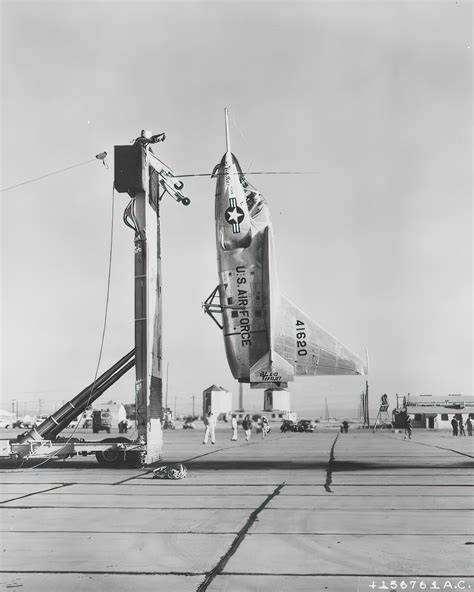
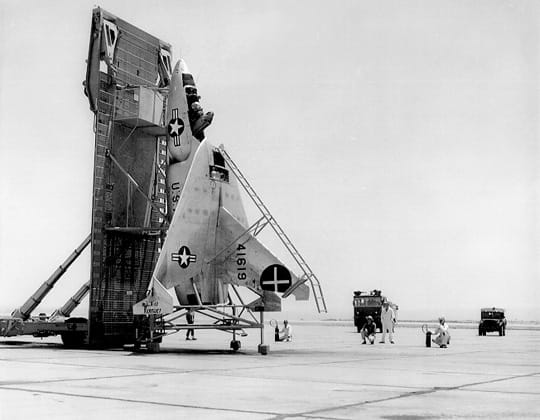
The X-13’s landing arrangement was unlike anything normally associated with a jet fighter. A vertical platform supported a horizontal cable, and the aircraft had to approach the cable with its nose pointed upward. A hook attached to the aircraft would catch the cable, after which the machine could be secured to the platform.
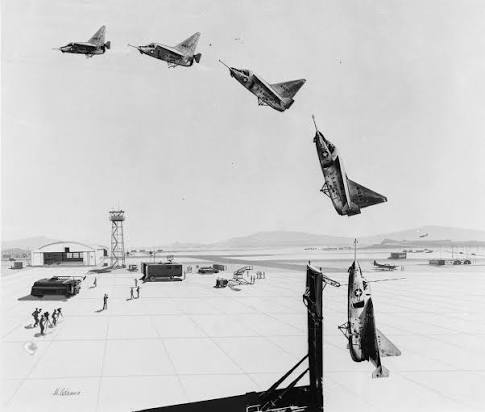
The process became even more impressive when the aircraft demonstrated its full transition capability. On November 28, 1956, Girard climbed to approximately 6,000 feet before gradually rotating the aircraft from horizontal flight into a vertical attitude. The X-13 entered a hover, demonstrating that a jet-powered aircraft could maintain controlled flight while pointing almost directly upward.
The maneuver was then reversed. Girard rotated the aircraft back toward horizontal flight and accelerated normally. The significance was difficult to overstate. The X-13 had shown that a jet could perform the complete transition between conventional and vertical flight without relying on a helicopter rotor.
A Historic Vertical Landing
The ultimate test came in April 1957, when the X-13 successfully combined its vertical flight capabilities with its unusual recovery system. After completing the necessary transitions, the aircraft returned to the vertical position and landed on its trailer using the nose hook and cable.
The aircraft had achieved the essential technical objective. Jet-powered VTOL was no longer merely a theoretical possibility. A real aircraft had demonstrated it repeatedly.
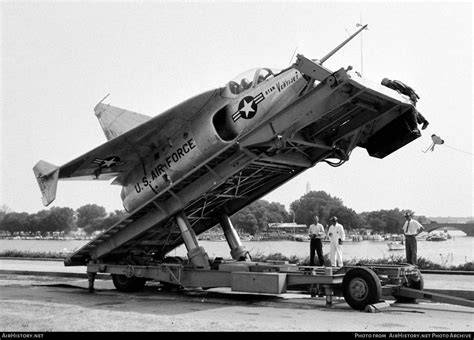
The achievement attracted considerable attention, and the Air Force wanted to showcase the aircraft to senior officials and the public. In July 1957, the X-13 was transported to Washington National Airport. Girard launched the aircraft, flew over the Potomac River, transitioned into a hover, and recovered the aircraft onto its trailer near the Pentagon.
More than 3,000 military officers, Pentagon personnel, and members of the press reportedly witnessed the demonstration. The sight was extraordinary for its time: a small jet appeared to hang almost motionless in the sky before descending vertically onto a ground platform.
Why the X-13 Was Too Difficult for Combat
The X-13’s greatest strength was also its greatest weakness. Its vertical landing system worked, but it placed an enormous burden on the pilot.
During a conventional landing, the pilot approaches a runway with a clear forward view and has numerous visual references for judging altitude, speed, alignment, and descent rate. The X-13 offered none of those advantages during the final stage. The pilot had to approach the recovery cable while the aircraft was nearly vertical, meaning the landing target was effectively behind the aircraft from the pilot’s normal perspective.
The maneuver could be accomplished by a highly trained test pilot under carefully controlled conditions. But military aircraft are not designed solely for demonstrations. They must function when weather is poor, visibility is limited, the pilot is exhausted, the aircraft is damaged, or the surrounding environment is chaotic.
That distinction proved decisive. The X-13’s cable-and-hook landing system was mechanically workable but operationally awkward. A successful test flight proved that the maneuver could be performed. It did not prove that an ordinary squadron pilot could execute it repeatedly under combat conditions.
Performance limitations also worked against the aircraft. The X-13’s maximum speed was approximately 350 mph (563 km/h), while its range was only around 192 miles (307 kilometers). Its Rolls-Royce Avon turbojet generated approximately 10,000 pounds of thrust, giving the aircraft an impressive thrust-to-weight ratio of about 1.48.
Those figures were remarkable for a compact experimental VTOL aircraft, but they were less attractive when viewed against the requirements of a practical tactical aircraft. A military customer would have to accept restricted range and speed in exchange for eliminating the runway requirement.
The X-13 Was Canceled Despite Proving Its Point
The X-13’s final public flight took place on September 30, 1957, only months after its highly publicized Pentagon demonstration. The aircraft had completed the central mission of the program, but there was no compelling path toward production.
The problem was not that the X-13 failed. In a narrow technical sense, it succeeded spectacularly. It demonstrated vertical takeoff, hovering, transition to conventional flight, reverse transition, and vertical landing. The problem was that the solution created too many operational compromises.
This is an important distinction in aviation history. Experimental aircraft frequently exist to answer a question rather than to become production machines. The X-13 answered one of the most important questions of its era: Can a jet aircraft operate vertically without a runway? The answer was yes.
But another question followed immediately: Can it do so conveniently, safely, and effectively enough to justify replacing conventional aircraft? For the X-13, the answer was much less convincing.
The program therefore ended after only two prototypes. There was no operational X-13 squadron, no production order, and no long-term role for the aircraft within the Air Force. Its cancellation could easily be interpreted as failure, but that would miss the larger technological story.
How the Ryan X-13 Influenced Later VTOL Aircraft
The most important legacy of the X-13 was not a particular component or mechanical system. It was the understanding of what not to do.
The tailsitter concept placed the aircraft itself at the center of the landing problem. The pilot had to rotate with the aircraft, producing an awkward cockpit orientation during vertical operations. Later VTOL designers increasingly looked for ways to keep the pilot in a more conventional upright position, improving visibility and reducing the workload associated with vertical flight.
That philosophy helped guide the development of aircraft such as the Hawker Siddeley Harrier. Rather than turning the entire aircraft vertically, the Harrier used vectored thrust, allowing the aircraft to remain broadly conventional in its cockpit orientation while directing engine thrust downward for vertical or short takeoff and landing operations.
The Harrier eventually entered operational service in 1969 and demonstrated that VTOL could be transformed from an experimental curiosity into a useful military capability. Its ability to operate from dispersed locations became particularly valuable to forces that could not guarantee access to large, secure airfields.
Decades later, the same broad operational objective remained relevant in the Lockheed Martin F-35B Lightning II. The aircraft uses a fundamentally different system, combining a shaft-driven lift fan with a swiveling rear exhaust nozzle to generate vertical lift. The technology is vastly more sophisticated than anything available to the X-13’s engineers, but the underlying military requirement remains recognizable.
The F-35B can operate from amphibious assault ships and other relatively constrained environments, giving the U.S. Marine Corps an organic fixed-wing strike capability without requiring a conventional runway. In that sense, the strategic problem that motivated the X-13 never completely disappeared.
Why the X-13 Still Matters
The Ryan X-13 occupies a fascinating position in aviation history because its cancellation does not erase its achievement. The aircraft proved that a pure jet could accomplish something that initially seemed almost impossible. It also demonstrated why successful engineering requires more than making a machine function once.
The X-13’s test record exposed the gap between technical feasibility and operational practicality. Engineers could build a jet with enough thrust to rise vertically. They could control it in a hover. They could transition between vertical and horizontal flight. They could even land it on a cable. But making every part of that process practical for military pilots was another challenge altogether.
That lesson influenced subsequent generations of VTOL development. Successful aircraft moved away from the X-13’s extreme tailsitter arrangement and toward systems that gave pilots better visibility, more intuitive control, and greater flexibility during landing. The Harrier and F-35B ultimately demonstrated that vertical flight could be made operationally useful rather than merely spectacular.
The Ryan X-13 Vertijet therefore deserves to be remembered as more than a Cold War oddity. It was a technological bridge between the experimental aviation of the late 1940s and the operational VTOL aircraft that followed. Its two prototypes never entered combat, but their flights established an important fact that changed military aviation: a jet did not necessarily need a runway to become a useful aircraft.
The irony is that the aircraft proved its central idea so convincingly that its failure became part of its success. The X-13 showed engineers that vertical jet flight worked—and then showed them exactly why the next generation needed to find a better way to do it.