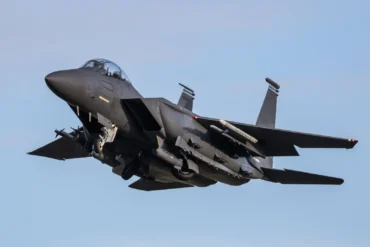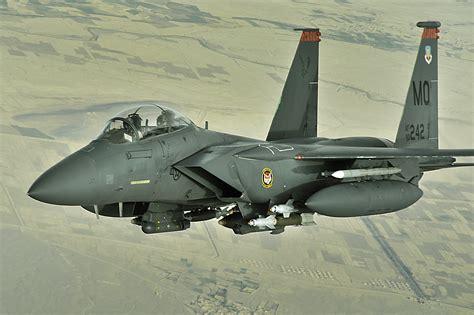
The F-15E Strike Eagle has long been a workhorse for the United States Air Force, a trusted fighter jet that has proven its capabilities in countless missions. However, as warfare evolves, so too must the aircraft that engage in it. The battlefield has changed significantly, and with the growing prevalence of drones in modern conflicts, the F-15E is undergoing critical updates that make it far more effective at combating these threats. This article delves into the major enhancements to the F-15E Strike Eagle, highlighting the cutting-edge technology that has transformed it into a formidable drone-hunting machine.
The Changing Threat Landscape: Why Drones Matter
For decades, the F-15E Strike Eagle was known for its exceptional range, payload, and ability to deliver precision strikes deep into enemy territory. However, recent shifts in military tactics have introduced a new kind of enemy: drones. These small, inexpensive unmanned aerial vehicles (UAVs) can be deployed in swarms, overwhelming even the most advanced defense systems. The sheer number of drones in the air, often coordinated in tight formations, poses a serious challenge to traditional military aircraft.
In regions like the Middle East, where drone attacks have become a near-daily occurrence, air forces are constantly looking for ways to counter this growing threat. As a result, the F-15E has undergone a significant upgrade, enabling it to hunt drones with incredible precision and effectiveness.
Introducing the APKWS II System: A Game-Changer for Drone Defense
The APKWS II system is at the heart of the F-15E’s transformation into a drone-hunting powerhouse. This revolutionary upgrade consists of laser-guided rockets that are specifically designed to engage smaller, faster targets like drones. Unlike traditional air-to-air missiles, which can be prohibitively expensive, the APKWS II rockets offer a far more cost-effective solution to the problem of drone swarms.
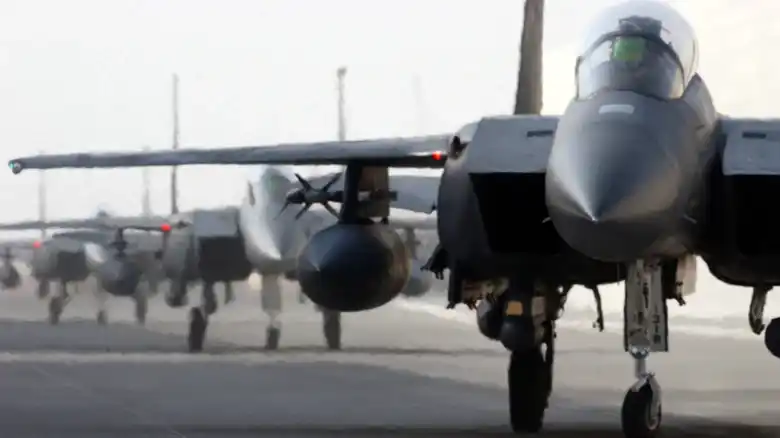
A single F-15E can now carry up to 42 APKWS II rockets at a time, allowing it to engage multiple drone threats in a single mission. These rockets are far cheaper than conventional missiles, costing only a fraction of what it would take to fire high-end munitions like the AIM-120 missile. This means that the F-15E can take on more targets while keeping costs down and maintaining its operational efficiency.
The ability to carry such a large number of rockets not only makes the F-15E a more effective drone killer, but it also allows it to handle larger swarms of drones in combat scenarios. With this upgrade, the F-15E can now respond faster to evolving threats, taking out multiple drones per mission and ensuring air superiority over the battlefield.
How the F-15E Strike Eagle is Built for Success
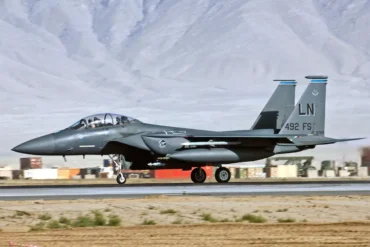
The F-15E’s design is a crucial element in its success as a drone-fighting machine. Unlike newer stealth aircraft, the F-15E Strike Eagle is built for payload and power, not necessarily low radar visibility. This makes it particularly well-suited for carrying a wide array of weapons, including the new APKWS II rockets. The jet’s rugged airframe, its ability to carry heavy loads, and its two-person crew—a pilot and a weapons officer—allow for high flexibility in complex combat scenarios.
In addition, the F-15E comes equipped with midair refueling capabilities, which extend its mission endurance for hours, allowing it to remain on station and respond to threats quickly. This feature, combined with the aircraft’s long operational history, makes the F-15E highly reliable in a variety of combat situations, even in unpredictable conditions.
Cost-Effective Upgrades for a Changing World
One of the most impressive aspects of the F-15E’s transformation is how the U.S. Air Force has managed to upgrade its aging fleet without breaking the bank. Rather than investing billions into entirely new aircraft, the military has made smart decisions in upgrading existing platforms. The F-15E was an obvious candidate for this kind of overhaul due to its proven track record, rugged design, and versatility in various combat roles.
By integrating the APKWS II system, the F-15E has gained a significant capability boost without the massive costs associated with purchasing new, specialized aircraft. This approach ensures that the F-15E Strike Eagle remains at the forefront of the U.S. Air Force’s arsenal, even as threats evolve and new challenges emerge.
The Future of Drone Warfare: F-15E as a Model for Adaptation
As drones become an increasingly central feature of modern warfare, the F-15E Strike Eagle’s upgrade could serve as a model for other military aircraft facing similar challenges. The addition of laser-guided rocket systems like the APKWS II could provide a cost-effective, scalable solution for air forces looking to tackle the growing threat of drones without over-relying on expensive high-end missiles.
In regions like the Middle East, where drone warfare is already a daily reality, the F-15E‘s enhanced capabilities could significantly alter the tactical landscape. By adopting advanced systems like the APKWS II, air forces could take on more enemies at once, maintain air superiority, and reduce operational costs at the same time.
Conclusion: The F-15E Strike Eagle’s Future as a Drone Hunter
In conclusion, the F-15E Strike Eagle has undergone a remarkable transformation, turning it into one of the most effective platforms for combating the drone threat. With the integration of the APKWS II system, the aircraft can now engage multiple drones per mission, with significant cost savings compared to traditional air-to-air missiles. This upgrade ensures that the F-15E remains relevant and highly effective, even as drone warfare continues to shape the future of combat. The F-15E is no longer just a strike jet; it is now a drone-hunting powerhouse, ready to tackle the challenges of modern warfare head-on.