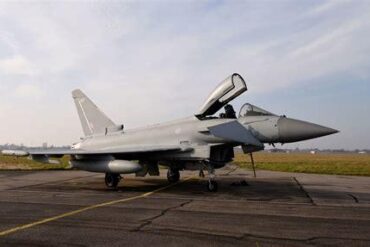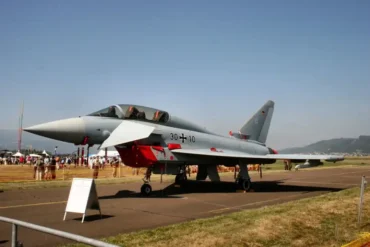
Italy’s Leonardo has formally offered the Eurofighter Typhoon Tranche 5 to the Philippine Air Force, marking a pivotal moment in Manila’s long-running Multi-Role Fighter (MRF) acquisition program and intensifying competition among Western aerospace primes for a contract that will shape Philippine airpower for decades. The proposal, disclosed ahead of World Defense Show 2026, frames the Typhoon not merely as an aircraft purchase but as a long-term strategic partnership combining aircraft delivery, industrial cooperation, and structured financing tailored to the Philippines’ fiscal planning. The bid arrives as the Philippines accelerates its transition into the Armed Forces of the Philippines Modernization Program’s later phases, with air defense credibility now a national priority amid persistent pressure in the West Philippine Sea.
The Philippine Air Force’s operational gap is a matter of record. Since retiring the Northrop F-5A/B Freedom Fighter fleet in 2005, the service has lacked a true air superiority platform. The induction of the FA-50PH restored supersonic flight and basic air policing, yet its radar reach, weapons carriage, endurance, and electronic warfare depth remain limited compared to heavy, twin-engine fighters. The MRF project is designed to end this strategic shortfall by fielding a fleet capable of beyond-visual-range air combat, maritime strike, and networked operations with allied forces. Leonardo’s offer of 32 aircraft targets precisely that ambition, promising sufficient mass to sustain quick-reaction alert across the archipelago while supporting training pipelines and maintenance cycles without hollowing out readiness.
Leonardo’s Eurofighter Offer and the Stakes for Philippine Air Defense
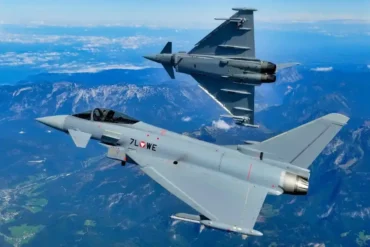
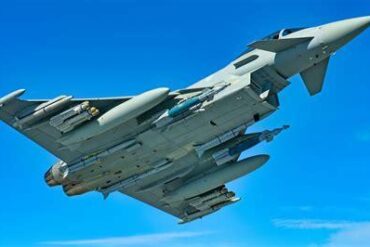
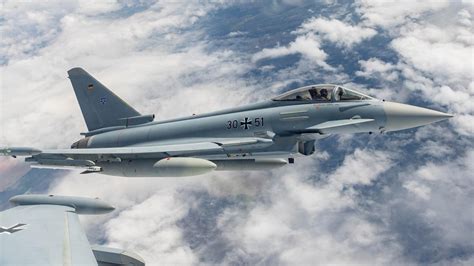
The Eurofighter Typhoon proposed for Manila is the platform’s most advanced production standard, widely known in export discussions as Tranche 5. This configuration integrates the E-Scan Mk1 Active Electronically Scanned Array (AESA) radar, a step change in detection range, multi-target tracking, and resistance to electronic attack compared with older mechanically scanned systems. The Tranche 5 upgrade path also strengthens the Typhoon’s digital Defensive Aids Sub-System, improving survivability against modern surface-to-air missiles and hostile fighters in contested airspace. For the Philippines, which must secure long maritime approaches and protect dispersed airfields, survivability and situational awareness are not luxuries; they are the currency of deterrence.
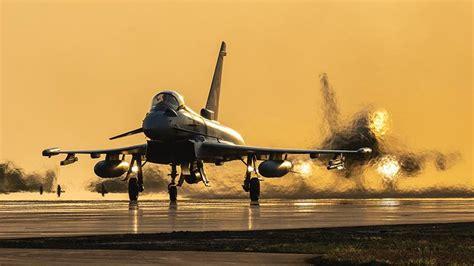
The Typhoon’s performance envelope fits the archipelago’s geography and operational tempo. Powered by two Eurojet EJ200 turbofan engines, the aircraft exceeds Mach 2 and sustains rapid climb rates, enabling fast intercepts over wide oceanic spaces. Its sensor-fusion architecture blends radar, infrared search and track, and secure data links into a single tactical picture, compressing the time between detection and engagement. Weapons compatibility with the Meteor long-range air-to-air missile brings a credible beyond-visual-range punch, while precision-guided munitions and stand-off weapons enable maritime strike and deep interdiction. The result is not a boutique interceptor but a true multirole workhorse built for high-end conflict and day-to-day air policing alike.
Why Tranche 5 Matters for a Maritime Archipelago
The Philippines is a nation of long coastlines, narrow air corridors, and forward bases exposed to weather and distance. Tranche 5’s AESA radar and electronic warfare suite directly address the tyranny of distance by extending detection and engagement ranges, buying time in the air defense timeline where seconds decide outcomes. The Typhoon’s endurance and payload allow mixed mission loads—air-to-air missiles paired with anti-ship or precision strike weapons—so a single sortie can shift from patrol to deterrent strike without reconfiguration. This flexibility matters in peacetime gray-zone pressure as much as in high-intensity conflict, where aircraft must pivot between roles as the battlespace evolves.
Sustained operations demand more than raw performance. A 32-aircraft fleet size allows the Philippine Air Force to field continuous alert coverage while rotating squadrons through maintenance and training without degrading frontline readiness. The scale supports a pilot conversion pipeline, simulator-based training, and depth in spare parts provisioning. Leonardo’s proposal reportedly embeds local maintenance, repair, and overhaul (MRO) capacity, which would shorten turnaround times, anchor skills in the domestic workforce, and reduce long-term sustainment risk. Industrial cooperation of this kind is how air forces avoid becoming tenants of foreign depots for decades.
Financing, Industrial Cooperation, and the Politics of Sustainment
The inclusion of structured financing is not window dressing. Budget cycles and procurement law have delayed Philippine fighter acquisition before, even when the strategic case was uncontested. Financing aligned with Manila’s fiscal framework reduces the risk that capability arrives in dribs and drabs, undermining readiness. Industrial cooperation extends that logic beyond the delivery ceremony into the everyday grind of sustainment. Technology transfer, training of engineers and avionics technicians, and the establishment of MRO nodes are force multipliers that quietly determine whether aircraft availability remains high five and ten years into service.
The geopolitical undertones are unavoidable. A Typhoon purchase would deepen European defense ties in Southeast Asia, adding a new vector to the Philippines’ security partnerships alongside the United States. The Eurofighter consortium—Italy, the United Kingdom, Germany, and Spain—brings diversified supply chains and political backing, which can hedge risks in turbulent global markets. That diversity also complicates decision-making and spares provisioning unless contracts lock in long-term guarantees. The Philippines will weigh these trade-offs carefully, because sustainment politics outlive ribbon-cutting.
The Competitive Field: Typhoon vs F-16 Block 70 and Gripen
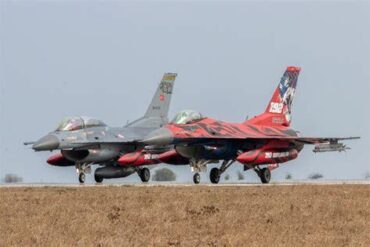
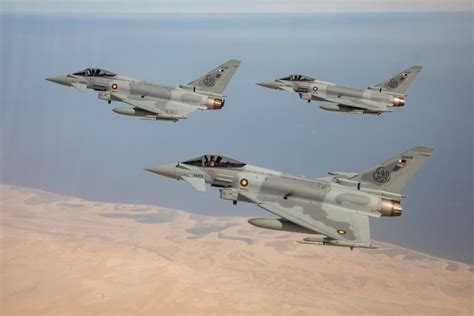
Leonardo’s bid faces muscular competition. The F-16 Block 70 offers proven interoperability with U.S. forces, the AN/APG-83 AESA radar, and access to a global logistics ecosystem shaped by decades of coalition operations. For a treaty ally operating alongside U.S. forces in exercises and contingencies, that ecosystem lowers integration friction. Sweden’s JAS 39 Gripen counters with a doctrine of dispersed basing, lower lifecycle costs, and rapid turnarounds—appealing traits for a country with austere forward strips and frequent weather disruptions. Each aircraft brings a distinct philosophy of airpower: the Typhoon emphasizes high-end air dominance with heavyweight performance; the F-16 Block 70 balances multirole capability with scale and alliance plumbing; the Gripen prizes operational economy and resilience.
Capability alone will not decide the contest. Training ecosystems, munitions access, software sovereignty, and the tempo of upgrades matter just as much. The Philippines is choosing an aircraft that will shape its tactics, maintenance culture, and coalition posture for a generation. The winner will set the rhythm of Philippine air operations long after the procurement headlines fade.
Strategic Consequences for the Western Pacific
Airpower is the visible grammar of deterrence in the Western Pacific. The Philippines’ selection will signal how Manila intends to posture its sovereignty claims, how quickly it can respond to airspace incursions, and how tightly it plans to knit its air defenses with partners. A Typhoon fleet equipped with Meteor and modern electronic warfare would raise the cost of coercion in contested airspace, complicating any calculus that assumes the Philippines lacks reach or persistence. It would also demand investments in basing resilience, hardened shelters, and integrated air and missile defense to protect high-value assets—capabilities that tend to cascade into broader modernization.
Leonardo’s confirmation of the Typhoon offer underscores Europe’s growing engagement in Indo-Pacific security markets, not as a cameo but as a sustained presence. For Manila, the choice is about more than speed, radar, or missile range. It is about locking in a sustainment philosophy, an industrial pathway, and a strategic network that can endure geopolitical weather. The aircraft will age; the partnerships it creates will determine whether the Philippine Air Force ages well with it.