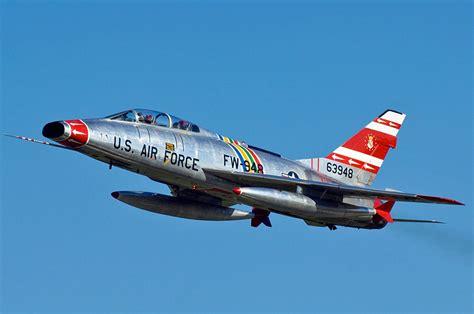
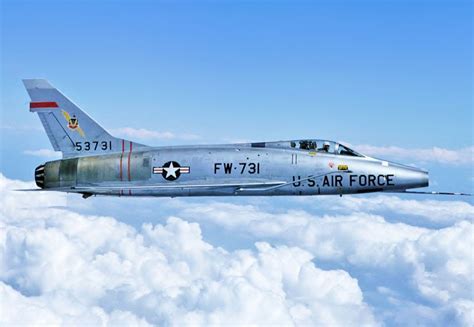
The North American F-100 Super Sabre was a pioneering aircraft that revolutionized air combat and performance during its service in the 1950s and 1960s. Developed to be the first fighter capable of supersonic flight in level flight, it became a key player in the United States Air Force’s arsenal, setting several records and proving its mettle in combat. The aircraft’s rich history, marked by innovation, setbacks, and eventual triumphs, has cemented its place as a significant part of aviation history.
The Birth of the F-100 Super Sabre: Vision and Design
In the post-World War II era, the United States military sought to enhance its air superiority and strike capabilities. The North American Aviation company, known for producing the successful F-86 Sabre, was tasked with creating a fighter that could exceed the performance limits of its predecessors. The F-100 was born from this desire to create a supersonic jet capable of providing both air superiority and ground-attack roles.
The design process of the F-100 began in the early 1950s, with the aircraft being initially referred to as the “Sabre 45” due to its 45-degree wing sweep. This innovative feature was a result of lessons learned from the F-86 Sabre, designed to make the F-100 more maneuverable and capable of high-speed flight. The F-100 was intended to be the first U.S. Air Force fighter capable of level supersonic flight, a significant milestone in aviation history. It was also one of the first combat aircraft to feature a stabilator, a fully moving tailplane that allowed for more precise control at high speeds.
Development Challenges and Early Struggles
Despite its ambitious design and groundbreaking features, the F-100 faced numerous challenges during its development. The aircraft’s initial flight tests revealed significant issues, particularly with yaw instability and inertia coupling. These flight characteristics caused severe control problems, leading to several fatal accidents. In response to these shortcomings, the F-100 was grounded in 1954, prompting a series of design modifications aimed at improving its stability and safety.
After months of rigorous testing and redesign, the F-100 returned to flight in 1955, and the issues that plagued the early models were addressed. However, its reputation had already been affected by the accidents, and it took time for the aircraft to regain the confidence of the U.S. Air Force.
The F-100’s Role in the U.S. Air Force
The F-100A, the first variant to enter service, was introduced to the U.S. Air Force in 1954. While initially plagued by technical issues, it was clear that the aircraft had significant potential. The F-100 was the first fighter capable of achieving Mach 1 in level flight, and it set several speed records, including a world speed record of 755.149 mph (1,215 km/h) set by the YF-100A prototype.
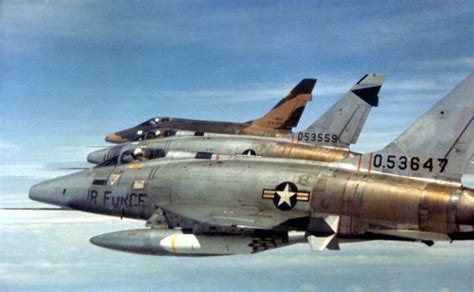
The F-100 was designed to be a versatile aircraft, capable of both air-to-air and air-to-ground combat. As the Cold War tensions escalated, the aircraft was quickly put to work in various combat theaters. It played a significant role in the Vietnam War, where it was used extensively for close air support missions and fighter-bomber roles. The aircraft proved highly effective in bombing runs, delivering precise strikes on enemy positions, and providing aerial superiority during key battles.
The F-100 in Vietnam: Combat and Challenges
During the Vietnam War, the F-100 earned a reputation as a reliable workhorse, though not without its difficulties. The aircraft was frequently tasked with escort missions for bombers, ground attack, and MiG combat air patrols. In 1965, the F-100 was involved in the first U.S. aerial combat mission over Vietnam, engaging in a dogfight with North Vietnamese MiG-17s.
Despite its impressive performance, the F-100 was ultimately replaced by more advanced aircraft like the F-4 Phantom II, which offered better capabilities in high-speed combat and air-to-air engagements. However, the F-100 remained in active service throughout the war, performing a variety of roles, including forward air control and wild weasel missions, designed to suppress enemy air defense systems.
Variants and Modifications: Adapting to Changing Needs
Throughout its service life, the F-100 underwent several modifications and improvements to meet evolving combat needs. The F-100C and F-100D variants were developed to enhance its ground-attack capabilities and provide greater versatility. These versions were equipped with more advanced avionics, increased fuel capacity, and the ability to carry a wider range of munitions, including nuclear bombs.
The F-100F, a two-seat version, was developed as a trainer aircraft and was also adapted for electronic warfare missions. Several F-100F aircraft were modified to carry the AGM-45 Shrike anti-radiation missile, allowing them to target enemy radar sites and other air defense systems.
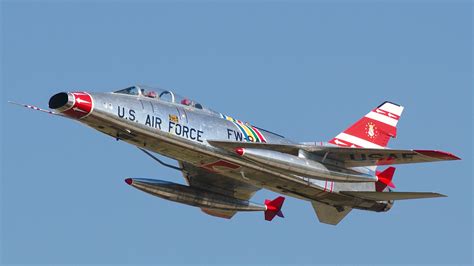
Despite the challenges and modifications, the F-100 remained in service until the late 1970s, with the U.S. Air Force gradually replacing it with more modern aircraft.
International Service and Legacy
The F-100 Super Sabre was not only a key component of the U.S. Air Force but also saw service in several foreign air forces, including those of France, Turkey, and Taiwan. These countries used the aircraft in a variety of combat scenarios, including the Turkish invasion of Cyprus in 1974 and the Algerian War. The aircraft’s speed, maneuverability, and combat effectiveness made it a valuable asset for NATO and other U.S. allies.
In addition to its combat roles, many F-100 aircraft were converted into drone targets after being retired from active service. These drones were used for missile testing and training purposes, extending the F-100’s legacy in the defense industry.
The F-100’s End of Service and Replacement
By the late 1970s, the F-100 Super Sabre was being phased out of service as newer, more advanced aircraft took its place. The introduction of the F-4 Phantom II and other advanced jets marked the end of the F-100’s long and storied career. While the aircraft had a relatively short active service life, its impact on the development of supersonic jet fighters and its role in several key conflicts ensured that it would remain an important chapter in aviation history.
Achievements and Records
The F-100 left a lasting legacy with several notable achievements, including:
- World Speed Records: The F-100 set a world speed record of 822 mph in 1955, showcasing its incredible speed and performance.
- First Supersonic Flight: The F-100 was the first fighter to achieve Mach 1 in level flight, a milestone that marked the dawn of the supersonic era for combat aircraft.
- Combat Records: The F-100 was involved in the first U.S. aerial combat in Vietnam, engaging enemy aircraft and providing critical support during the war.
The F-100 Super Sabre was not just a military aircraft but a symbol of technological progress and innovation, paving the way for future generations of supersonic combat jets.
Conclusion: The F-100 Super Sabre’s Enduring Legacy
The F-100 Super Sabre was a groundbreaking fighter aircraft that left an indelible mark on aviation history. Its role in the Vietnam War, its speed records, and its innovative design made it a significant achievement in military aviation. Though it was eventually replaced by more advanced aircraft, the F-100 set the stage for future supersonic fighters and remains an iconic aircraft in the history of aviation.
From its early development struggles to its service in multiple international conflicts, the F-100 Super Sabre demonstrated resilience, adaptability, and performance. Its legacy continues to influence aircraft design and development, making it a key figure in the evolution of modern air combat.