Korean Air Lines Co., Ltd., operating globally as Korean Air (KE/KAL), stands as the distinguished flag carrier of South Korea and its largest airline by virtually every metric: fleet size, the breadth of its international destinations, and the sheer volume of international flights it operates. As a pivotal entity within the formidable Hanjin Group, Korean Air’s journey from a government-owned entity to a global aviation leader is a compelling narrative of ambition, resilience, and strategic evolution. The airline’s modern iteration traces its origins to March 1, 1969, when the Hanjin Group acquired the state-run Korean Air Lines, which itself had been operational since June 1962. This acquisition marked the true beginning of Korean Air as a privately-owned, dynamic force in international aviation.
Deeply integrated into the global airline network, Korean Air is a founding member of the prestigious SkyTeam alliance and its cargo counterpart, SkyTeam Cargo, underscoring its commitment to seamless international travel and logistics. This commitment to quality and service excellence has been consistently recognized, with Korean Air earning the coveted 5-star airline rating from Skytrax as of 2024. It consistently ranks among the top 20 airlines worldwide for passenger volume and is a dominant player in the international air cargo market. The airline’s extensive network, managed from its global headquarters in Seoul, South Korea, connects 126 cities across 44 countries through its international passenger division and subsidiary cargo operations, complemented by robust domestic services to 13 destinations within South Korea. With a dedicated workforce of approximately 20,000 employees, Korean Air continues to shape the future of air travel.
However, the airline’s ascent was not without significant challenges. Around the late 1990s, Korean Air grappled with a reputation marred by a poor safety record and a series of high-profile incidents. This period necessitated a profound transformation, leading to substantial investments in safety protocols, fleet modernization, advanced technology adoption, and a comprehensive overhaul of its corporate culture. This included seeking expert consultancy from industry giants like Boeing and Delta Air Lines. These concerted efforts dramatically improved its safety standing by the late 2000s. More recently, in a landmark move for the Korean aviation industry, it was announced in November 2020 that Korean Air would acquire its primary domestic competitor, Asiana Airlines. After navigating complex regulatory approvals, this strategic acquisition, which saw Korean Air take a majority stake rather than a full merger due to monopoly concerns raised by authorities like the United States Department of Justice, was completed on December 12, 2024, reshaping the competitive landscape and positioning the unified entity for greater global reach.
A Storied History: From National Carrier to Global Powerhouse
The genesis of Korean Air lies in the Korean National Airlines (KNA), founded in 1946. In 1962, the South Korean government acquired KNA, rebranding it as Korean Air Lines (KAL) and establishing it as a state-owned enterprise. The pivotal moment in its trajectory occurred on March 1, 1969, when the Hanjin Group, a major South Korean conglomerate, acquired the airline, laying the foundation for the Korean Air we know today. This privatization injected new vigor and commercial acumen into its operations.
Charting New Territories: Early Expansion and Fleet Modernization
Under Hanjin’s stewardship, Korean Air Lines embarked on an ambitious expansion. Long-haul trans-pacific freight operations commenced on April 26, 1971, a significant step that quickly established its cargo prowess. This was followed by the inauguration of passenger services to Los Angeles International Airport (LAX) on April 19, 1972, marking its entry into the lucrative North American market. The airline initially utilized Boeing 707s for its international routes, connecting Seoul with key Asian destinations like Hong Kong, Japan, and Taiwan, alongside the new Los Angeles service. The introduction of the iconic Boeing 747 in 1973 was a game-changer, allowing KAL to significantly upgrade its trans-Pacific routes with increased capacity and range. European services were also launched during this period, with Paris being a key early destination, initially served by the 707 and later by the McDonnell Douglas DC-10. A testament to its growing cargo focus, Korean Air opened its dedicated cargo terminal at Los Angeles International Airport in 1981. A unique operational challenge during this era was the geopolitical landscape; South Korean aircraft were prohibited from flying through North Korean and Soviet airspace. Consequently, European routes had to be routed eastbound from South Korea, often involving a stopover in Anchorage, Alaska, such as the Seoul-Anchorage-Paris route.
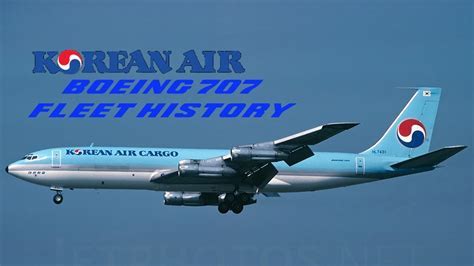
In 1975, Korean Air Lines demonstrated its forward-thinking approach to fleet development by becoming one of the earliest Asian airlines to operate Airbus aircraft. The acquisition of three Airbus A300s provided modern, efficient capacity for its burgeoning Asian routes, showcasing a willingness to diversify its fleet beyond American-made aircraft.
A New Identity: The Birth of ‘Korean Air’
On March 1, 1984, a significant rebranding initiative transformed Korean Air Lines into Korean Air. This change was accompanied by a striking new livery: a sophisticated blue-top design with a silver underbelly, prominently featuring a redesigned corporate logo. The new logo incorporated a stylized Taegeuk design – the central symbol of the South Korean flag – representing balance and harmony. This modern livery was first introduced on its McDonnell Douglas MD-80s and new Boeing 747-300s and was the result of a collaborative design effort between Korean Air and Boeing. The airline’s headquarters during this period was situated in the KAL Building on Namdaemunno, Jung District, Seoul. The 1990s saw further fleet evolution as Korean Air became one of the first airlines to operate the McDonnell Douglas MD-11. Intended to supplement its new fleet of Boeing 747-400 aircraft, the MD-11 ultimately did not meet the airline’s specific performance requirements for passenger operations and these aircraft were later converted to freighters. Reflecting a strategy to maximize asset utilization, some older Boeing 747 passenger aircraft were also converted for dedicated freight services during this time.
Navigating Turbulence: Addressing a Checkered Safety Record
The late 20th century was a challenging period for Korean Air regarding its safety reputation. The airline experienced a series of serious incidents and accidents, leading to a perception of it being, as described by some media around 1999, “an industry pariah, notorious for fatal crashes.” Between 1970 and 1999, Korean Air tragically wrote off 16 aircraft in incidents that resulted in the loss of over 700 lives. The gravity of the situation was such that in 1999, then-President of South Korea, Kim Dae-jung, publicly described the airline’s safety record as “an embarrassment to the nation,” even opting to fly with Korean Air’s smaller rival, Asiana Airlines, for a state visit to the United States. The crash of Korean Air Flight 801 in Guam in 1997, where the U.S. National Transportation Safety Board (NTSB) concluded that inadequate pilot training contributed to pilot error, was a particularly damaging event. Following the fatal crash of Korean Air Cargo Flight 6316 in Shanghai in 1999, Delta Air Lines took the unprecedented step of suspending its code-sharing relationship with Korean Air, explicitly citing its poor safety record. This was a significant blow, as it marked one of the first instances where safety concerns directly led to the dissolution of a major airline alliance partnership. Other partners, including Air Canada and Air France, soon followed suit, further isolating the airline. In 2001, the Federal Aviation Administration (FAA) downgraded South Korea’s aviation safety rating, effectively blocking South Korean carriers, including Korean Air, from expanding their services into the United States. This action was prompted by concerns over lax oversight of its carriers by South Korean authorities. Faced with this existential crisis, Korean Air embarked on a comprehensive and costly overhaul. Billions of dollars were invested in improving safety standards, upgrading its fleet with modern aircraft, installing new safety technologies, and fundamentally reforming its corporate culture. Crucially, the airline engaged external consultants from Boeing and Delta Air Lines to guide this transformation. By 2002, publications like The New York Times noted a significant shift, observing that Korean Air had been removed from many “shun lists,” signaling a successful turnaround in its safety perception and operational reality.
Resurgence in the 21st Century: Growth and Innovation
The dawn of the 21st century marked a period of renewal and strategic growth for Korean Air. On June 23, 2000, Korean Air, alongside Aeroméxico, Air France, and Delta Air Lines, became a founding member of the SkyTeam alliance, one of the world’s three major airline alliances. This was followed by the establishment of SkyTeam Cargo on September 28, 2000, further cementing its global network capabilities. Responding to the changing domestic travel landscape and the rise of high-speed rail, Korean Air launched its own low-cost carrier, Jin Air, on June 5, 2007. Jin Air commenced scheduled passenger services on July 17, 2008, initially utilizing Boeing 737s and Airbus A300s transferred from Korean Air’s fleet. In a unique marketing move, Korean Air partnered with Blizzard Entertainment in mid-2010, wrapping a Boeing 747-400 and a Boeing 737-900 in StarCraft II branding to promote the popular video game. Despite record-high revenue, the airline reported heavy second-quarter losses in August 2010, reflecting the volatile nature of the airline industry. Also in August 2010, Hanjin Group inaugurated a new cargo terminal at Navoiy International Airport in Uzbekistan, establishing it as a strategic cargo hub with regular flights connecting Seoul, Navoi, and Milan. Further expanding its European footprint, Korean Air acquired a 44% stake in Czech Airlines in 2013, though it later divested this stake in October 2017. A significant strategic development occurred on May 1, 2018, with the launch of a trans-Pacific joint venture partnership with Delta Air Lines, deepening cooperation and offering enhanced connectivity for passengers traveling between Asia and the Americas. In 2019, Korean Air collaborated with the K-pop supergroup SuperM for a new in-flight safety video, featuring their song “Let’s go everywhere.” This innovative approach garnered global attention, and a Boeing 777-300ER (registration HL8010) was adorned with a special SuperM livery. These efforts culminated in Korean Air being certified as a 5-Star Airline by Skytrax in 2023, a testament to its sustained commitment to quality and service.
The ‘Nut Rage’ Incident: A Corporate Crisis
In late 2014, Korean Air faced a significant public relations crisis due to the “nut rage” incident involving Cho Hyun-ah (also known as Heather Cho), then a vice president and the daughter of the airline’s chairman at the time, Cho Yang-ho. On a flight preparing to depart from New York’s JFK Airport, Cho Hyun-ah became enraged over being served macadamia nuts in a bag instead of on a plate. She ordered the aircraft, already taxiing, to return to the gate so that the chief flight attendant could be removed. The incident sparked widespread outrage in South Korea and internationally, highlighting concerns about the conduct of powerful chaebol families. Cho Hyun-ah subsequently resigned from her executive positions and was later arrested and convicted for violating South Korean aviation safety laws, though her prison sentence was eventually suspended on appeal. The incident brought intense scrutiny upon Korean Air’s corporate culture and the behavior of its owning family.
A New Era: The Asiana Airlines Acquisition
Amidst the unprecedented challenges posed by the COVID-19 pandemic to the global aviation industry, the South Korean government announced in November 2020 a landmark decision: Korean Air would acquire its main domestic rival, Asiana Airlines. This move was aimed at stabilizing the Korean airline industry and creating a stronger, more competitive global player. The plan also involved the integration of the two airlines’ low-cost subsidiaries – Asiana’s Air Busan and Air Seoul, and Korean Air’s Jin Air – into a single, consolidated LCC entity focused on regional routes. The merger process, however, proved to be complex and lengthy, primarily due to the need for approvals from anti-trust authorities in multiple international jurisdictions. In March 2021, Korean Air announced a delay in the merger timeline as these foreign regulatory reviews were still pending. Some essential countries approached the deal with skepticism, raising concerns about potential market dominance. After a protracted period of negotiation and regulatory scrutiny, which included divestitures of certain routes and airport slots to address competition concerns, Reuters reported on December 12, 2024, that Korean Air had successfully completed the acquisition of the debt-laden Asiana Airlines. The deal, valued at 1.5 trillion won (approximately USD 1.6 billion), saw Korean Air acquire a 63.88% stake in Asiana. This monumental acquisition positions the newly enlarged Korean Air as the 12th largest airline in the world by international capacity, heralding a new chapter for South Korean aviation.
A Fresh Look for a Unified Future: The 2025 Rebranding
Following the strategic acquisition of Asiana Airlines, with the Asiana brand set to be fully absorbed by 2027, Korean Air unveiled a major corporate rebrand on March 11, 2025. This was its first significant visual identity overhaul since 1984, developed in partnership with the renowned design agency Lippincott. The centerpiece of the rebrand is a modernized Taegeuk symbol. While retaining its iconic shape, the familiar blue and red color palette has been replaced with an elegant, outlined monochromatic dark blue. The wordmark “KOREAN AIR” also underwent a transformation, moving from a modified Cooper Black typeface to a new, contemporary sans-serif font named “Hanjin Group Sans,” specially designed by Dalton Maag. For aircraft liveries, the wordmark will simply be “KOREAN.” Lippincott highlighted that reinterpreting the Taegeuk symbol and separating it from the logotype enhances its visibility, while its calligraphic brush-stroke style injects an element of refined elegance into the new identity. Signifying the unification of the two airline giants, new uniforms for both Korean Air and former Asiana employees under the single “Korean Air” brand are slated for introduction in 2027, symbolizing a cohesive future.
Corporate Affairs and Identity: The Pillars of Korean Air
Korean Air’s corporate structure and identity are deeply intertwined with its parent company, the Hanjin Group, one of South Korea’s largest chaebols (family-controlled conglomerates). The airline is majority-controlled by Hanjin KAL Corporation, with Walter Cho, the current Chairman and CEO, representing the third generation of the Cho family to lead the airline. As of June 5, 2020, Hanjin KAL held 29.27% of Korean Air’s shares. Notably, Delta Air Lines is a significant shareholder in Hanjin KAL, holding a 14.90% stake.
Hubs, Headquarters, and Operational Nerve Centers
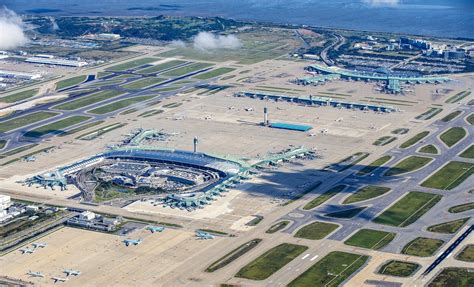
Incheon International Airport (ICN) Terminal 2 serves as Korean Air’s primary international hub, a state-of-the-art facility designed to handle its vast global operations. The airline’s official headquarters, the Korean Air Building (대한항공 빌딩), is strategically located on the grounds of Gimpo International Airport (GMP) in Gonghang-dong, Gangseo District, Seoul. Gimpo primarily handles domestic flights and some short-haul international routes. Korean Air also maintains a significant satellite headquarters campus at Incheon. Beyond Seoul, Jeju International Airport (CJU) on Jeju Island and Gimhae International Airport (PUS) in Busan function as important focus cities and secondary hubs, particularly for domestic and regional connectivity. The airline’s main aircraft maintenance facilities are located at Gimhae International Airport, supporting its extensive fleet. The majority of Korean Air’s pilots, ground staff, and flight attendants are based in Seoul and Busan, the airline’s key operational centers.
The Chaebol Context: Influence and Scrutiny
Korean Air’s history and operations are emblematic of the South Korean “chaebol” system. These large, family-controlled industrial conglomerates were often established with significant government support and have historically dominated diverse sectors of the South Korean economy. For a considerable period, from its effective founding as Korean National Airlines until the establishment of Asiana Airlines in 1988, Korean Air enjoyed a monopoly as South Korea’s sole airline. The privatization process in 1969, when Hanjin Group acquired the airline, was supported by Park Chung Hee, the then-military general turned president. This monopoly was secured for two decades. The Hanjin Group, through Korean Air and its other subsidiaries, has diversified interests spanning marine and overland transportation, hotels, real estate, and previously, heavy industry, passenger transportation, construction, and stockbroking. A characteristic often associated with the chaebol system is nepotism, and various incidents involving Korean Air’s founding family in the 2000s and 2010s brought public scrutiny to this aspect of chaebol culture, highlighting governance challenges within these powerful conglomerates.
Diversification: Hotel Ownership
As part of its diversified business portfolio, Korean Air owns and operates several high-profile hotel properties. These include two KAL hotels on Jeju Island, a popular tourist destination, and the Grand Hyatt Incheon, strategically located near its primary hub. Perhaps its most prominent international real estate venture is the Wilshire Grand Center in downtown Los Angeles. This landmark skyscraper, the tallest building in Los Angeles, houses the largest InterContinental Hotel in the Americas, showcasing Korean Air’s global business interests beyond aviation.

Korean Air Aerospace Division (KAL-ASD): A Leader in Aerospace Manufacturing and Technology
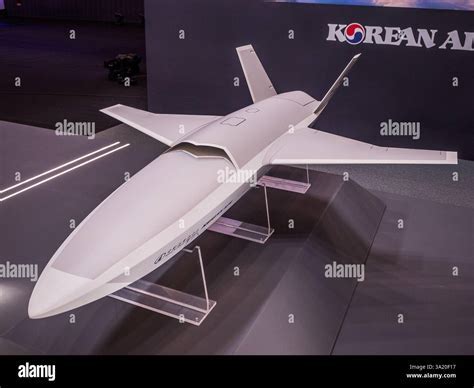
Beyond its core airline operations, Korean Air is a significant player in the aerospace manufacturing and research sector through its Korean Air Aerospace Division (KAL-ASD). This division boasts impressive capabilities, including the licensed production of military aircraft such as MD Helicopters MD 500 and Sikorsky UH-60 Black Hawk helicopters, as well as the Northrop F-5 E/F Tiger II fighter aircraft. KAL-ASD also manufactures critical components for commercial aircraft, including the aft fuselage and wings for the KF-16 fighter aircraft (produced by Korea Aerospace Industries), and structural parts for various Boeing models like the 737, 747, 777, and the 787 Dreamliner, as well as for the Airbus A330 and A380. In 1991, the division designed and successfully flew the Korean Air Chang-Gong 91, a light aircraft, demonstrating its indigenous design capabilities. Furthermore, KAL-ASD provides essential aircraft maintenance, repair, and overhaul (MRO) support for the United States Department of Defense in the Asian region. Its research division is actively engaged in developing technologies for launch vehicles, satellites, next-generation commercial and military aircraft, helicopters, and advanced simulation systems. While a 2012 development deal with Bombardier Aerospace for a 90-seat turboprop regional airliner did not materialize, it highlighted KAL-ASD’s ambitions in aircraft development.
Global Reach: Destinations and Partnerships
Korean Air’s international passenger division and its cargo operations collectively serve an impressive 126 cities in 44 countries, complemented by services to 13 domestic destinations within South Korea. This extensive network is further amplified by a wide array of codeshare and interline agreements.
Codeshare Agreements: Expanding Connectivity
Korean Air maintains codeshare agreements with a multitude of international airlines, significantly broadening its network reach and offering passengers more seamless travel options. These partners include:
- Aerolíneas Argentinas
- Aeroméxico
- Air Europa
- Air France
- Air Tahiti Nui
- Air New Zealand
- Alaska Airlines
- Aurora
- China Airlines
- China Eastern Airlines
- China Southern Airlines
- Delta Air Lines (Joint Venture Partner)
- Emirates
- Etihad Airways
- Garuda Indonesia
- Gol Linhas Aéreas Inteligentes
- Hainan Airlines
- Hawaiian Airlines
- ITA Airways
- Japan Airlines
- Jin Air (Subsidiary)
- Kenya Airways
- KLM
- LATAM Brasil
- LATAM Chile
- LATAM Perú
- Malaysia Airlines
- MIAT Mongolian Airlines
- Myanmar Airways International
- Rossiya Airlines
- Royal Brunei Airlines
- Saudia
- Scandinavian Airlines
- Shanghai Airlines
- SriLankan Airlines
- TAROM
- Uzbekistan Airways
- Vietnam Airlines
- Virgin Atlantic
- WestJet
- XiamenAir
Interline Agreements
In addition to codeshares, Korean Air has interline agreements with airlines such as Air Astana, Air Premia, and JetBlue, facilitating baggage transfers and ticketing across different carriers. Korean Air is also an airline partner of Skywards, the frequent-flyer program for Emirates, allowing Skywards members to earn and redeem miles on Korean Air flights.
The Korean Air Fleet: Modern, Diverse, and Evolving
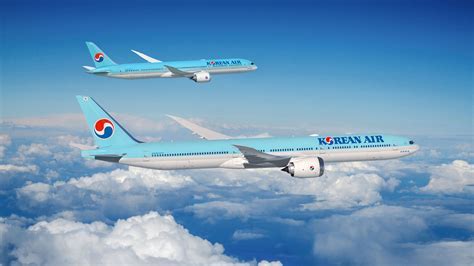
As of May 2025, Korean Air operates a large and diverse fleet of modern aircraft, reflecting its commitment to efficiency, passenger comfort, and operational capability. The airline is continuously updating its fleet with new-generation aircraft while strategically managing its existing assets.
Current Passenger Fleet
- Airbus A220-300: 10 aircraft in service. These regional jets are configured with 140 seats in an all-economy layout, ideal for domestic and short-haul international routes. The order includes 10 options and 10 purchase rights.
- Airbus A321neo: 16 aircraft in service, with 40 more on order. These narrow-body aircraft feature a two-class configuration with 8 Prestige Class (Business) seats and 174 Economy Class seats, totaling 182. The order comes with 20 options.
- Airbus A330-300: 19 aircraft in service. These versatile wide-body jets are deployed on medium to long-haul routes and feature various configurations, typically around 24 Prestige seats and 248-260 Economy seats.
- Airbus A350-900: 2 aircraft in service, with 4 more on order. Deliveries for this new-generation wide-body commenced in January 2025, configured with 28 Business Class seats and 283 Economy seats for a total of 311 passengers.
- Airbus A350-1000: 27 aircraft on order. This larger variant of the A350 will further modernize Korean Air’s long-haul fleet.
- Airbus A380-800: 7 aircraft in service. The superjumbo features a luxurious three-class layout with 12 First Class suites, 94 Prestige Class seats, and 301 Economy Class seats, totaling 407. While originally planned for retirement by 2026, this has been postponed.
- Boeing 737-800: 2 aircraft in service, typically configured with 12 Prestige seats and 126 Economy seats.
- Boeing 737-900: 9 aircraft in service, with 8 Prestige seats and 180 Economy seats.
- Boeing 737-900ER: 6 aircraft in service, offering 8 Prestige seats and 165 Economy seats.
- Boeing 737 MAX 8: 5 aircraft in service, with 24 more on order. These fuel-efficient narrow-bodies are configured with 8 Prestige seats and 138 Economy seats (or 150/158 in other layouts). The order includes 20 options. One VIP-configured 737 MAX 8 is leased to the Republic of Korea Air Force for government transport.
- Boeing 747-8I: 5 passenger aircraft in service. This latest iteration of the “Queen of the Skies” features 6 First Class suites, 48 Prestige Class seats, and 314 Economy Class seats (total 368). Korean Air operates HL7644, the last passenger Boeing 747 ever built. One VIP-configured 747-8I is also leased to the Republic of Korea Air Force.
- Boeing 777-300: 4 aircraft in service, typically with around 41 Prestige seats and 297 Economy seats.
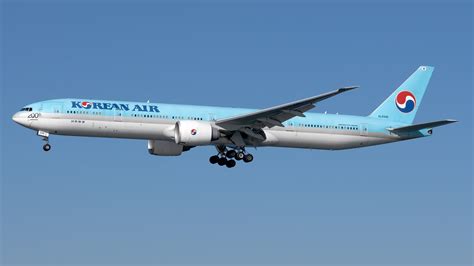
- Boeing 777-300ER: 25 aircraft in service. These long-range workhorses are configured with 8 First Class Kosmo Suites, 42 or 56 Prestige Class seats, and 227 or 291 Economy Class seats. All are slated to be retrofitted with new Prestige Suites 2.0, with Kosmo Suites being removed from some configurations.
- Boeing 777-9: 20 aircraft on order, with deliveries expected from 2028. This next-generation wide-body will be a cornerstone of the future long-haul fleet.
- Boeing 787-9 Dreamliner: 14 aircraft in service, with 6 more on order. These fuel-efficient aircraft feature 24 Prestige seats and 245 or 254 Economy seats. The order includes 10 options and was converted from an earlier Boeing 787-8 order.
- Boeing 787-10 Dreamliner: 8 aircraft in service, with 32 more on order. The stretched version of the Dreamliner offers 36 Prestige seats and 289 Economy seats, totaling 325. The order includes 10 options.
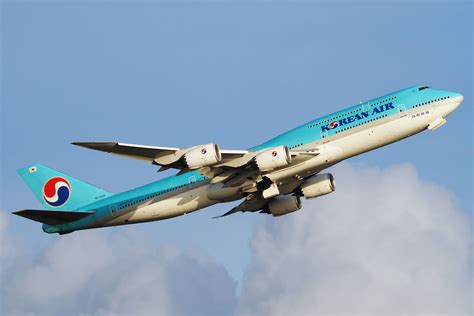
Korean Air Cargo Fleet
Korean Air Cargo is a major global player, operating a dedicated fleet of freighters:
- Boeing 747-400ERF: 4 aircraft
- Boeing 747-8F: 7 aircraft
- Boeing 777F: 12 aircraft
Korean Air Business Jet Fleet
For private and corporate charter services, Korean Air maintains a specialized business jet fleet:
- AgustaWestland AW139: 4 helicopters (8-14 passengers)
- Airbus Helicopters H160-B: 1 helicopter (6 passengers)
- Boeing 737-700/BBJ1: 1 aircraft (16-26 passengers)
- Boeing 787-8/BBJ: 1 aircraft (39 passengers)
- Bombardier Global Express XRS: 1 aircraft (13 passengers)
- Gulfstream G650ER: 1 aircraft (13 passengers)
- Sikorsky S-76C+: 1 helicopter (5-6 passengers)
Fleet Development Strategy
Korean Air is actively engaged in a fleet modernization program. At the 2018 Association of Asia Pacific Airlines Assembly, the airline announced considerations for a new large wide-body aircraft order to replace older Airbus A330s, Boeing 747-400s, and earlier Boeing 777 variants. The Boeing 777X and Airbus A350 XWB were identified as key candidates, and subsequent orders for both types have confirmed this strategy. Chairman Walter Cho also indicated at an IATA AGM in Seoul that Korean Air was considering an additional order for Airbus A220 aircraft, potentially including developing versions like the A220-500, to further enhance its regional fleet. In 2022, with strong global cargo demand, Chairman Cho stated that Korean Air was evaluating options for ordering new freighter aircraft to sustain its cargo market leadership.
Retired Fleet Highlights
Over its long history, Korean Air has operated a wide variety of aircraft types. Notable retired aircraft include:
- Airbus A300B4/A300-600R: A workhorse on Asian routes for many years.
- Boeing 707: Instrumental in launching early long-haul services.
- Boeing 727: Served domestic and regional routes.
- Boeing 747-200/300/400/SP: Various classic 747 models that formed the backbone of its long-haul fleet for decades.
- McDonnell Douglas DC-9/DC-10/MD-11/MD-80 series: A mix of narrow-body and wide-body aircraft from McDonnell Douglas.
- Fokker F27/F28/F100: Utilized for shorter domestic and regional flights.
Distinguished In-Flight Services: Comfort and Cuisine
Korean Air is renowned for its high standards of in-flight service, offering distinct cabin classes designed to cater to diverse passenger needs.
Cabin Classes: A Spectrum of Choices
Korean Air currently offers three types of First Class, four types of Prestige Class (Business Class), and a standard Economy Class.
- First Class: Available on all Airbus A380-800s, Boeing 747-8Is, and select Boeing 777-300ERs. Passengers experience the pinnacle of luxury, with some aircraft featuring Kosmo Suites 2.0 or other private suites, often equipped with sliding doors for enhanced privacy, lie-flat beds, large entertainment screens, and premium amenities.
- Prestige Class: Korean Air’s Business Class product offers a superior level of comfort and service. Configurations vary by aircraft, including Prestige Suites (Apex Diamond seats offering direct aisle access), Prestige Sleeper seats (lie-flat or angled lie-flat), and the newer Prestige Suite 2.0. These seats provide ample space, enhanced privacy, and upgraded dining and entertainment options.
- Economy Class: Provides comfortable seating with personal entertainment screens, meal service, and amenities designed for a pleasant journey. Seat pitch and width are competitive.
Korean Air briefly introduced a Premium Economy cabin marketed as “Economy Plus” in 2017, primarily on its Airbus A220-300 (then Bombardier CS300) aircraft. This product offered slightly more legroom and recline. However, it was discontinued in 2019 due to a perceived discordance of service levels for the price point and challenges in profitability for that specific cabin class on those routes.
In-Flight Catering: A Culinary Journey
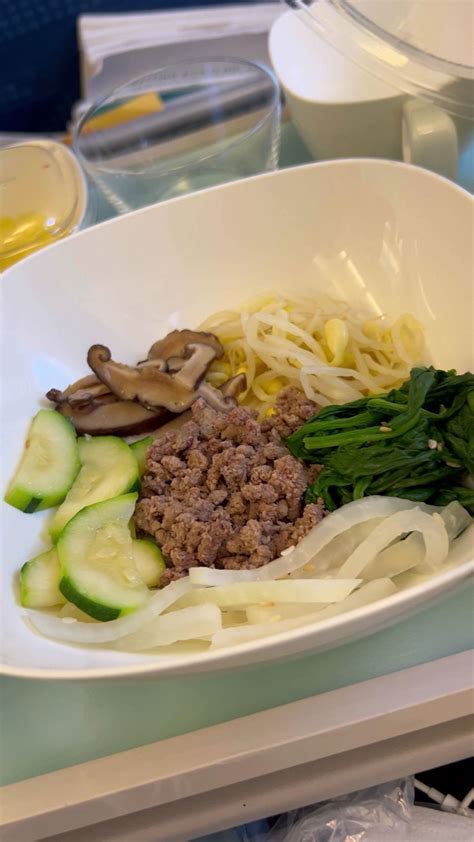
Korean Air’s in-flight catering is a highlight of its service, offering a delightful fusion of traditional Korean cuisine and diverse Western and Chinese meal options. The menu varies based on the flight route, duration, and class of service.
- Economy Class passengers can often choose from signature Korean dishes like bibimbap (rice mixed with meat, vegetables, and gochujang – chili pepper paste), served with sesame oil, or bulgogi (marinated grilled beef) with rice. Western options typically include choices like chicken, beef, or pasta dishes. On flights to and from China, Chinese options such as stir-fried snapper with chili sauce may be available.
- Prestige Class elevates the dining experience with more elaborate presentations, premium ingredients, and a wider selection. Options might include tuna bibimbap, Korean spicy seafood stew, upgraded Western meals like grilled beef tenderloin or roasted cod, and enhanced Chinese dishes like stir-fried ling fish with oyster sauce. Meals are typically served on fine china with proper cutlery.
- First Class offers a truly gourmet experience, with menus curated by renowned chefs. Passengers can indulge in premium Korean specialties like spicy beef short ribs with bulgogi sauce, braised pork belly, or elaborate Korean royal court cuisine (Hanjeongsik). Western selections may feature items such as veal chop with madeira sauce, seared monkfish with orange teriyaki sauce, or perfectly cooked sirloin steak, often accompanied by fine wines and champagne.
Previously, Korean Air offered instant cup noodles as a popular mid-flight snack in Economy Class. However, this option was discontinued due to safety concerns related to potential burns from hot water during turbulence. Instead, alternative snacks like pizza slices, sandwiches, corn dogs, or hot pockets are now often available at a self-service snack bar on long-haul flights for Economy passengers. The option to request instant noodles generally remains available in Prestige and First Class cabins.
In-Flight Entertainment: Engaging and Diverse
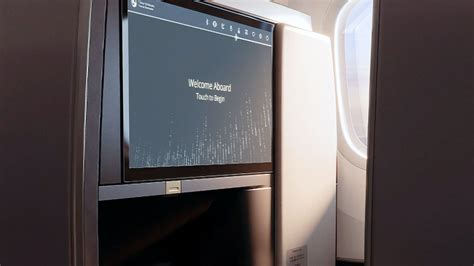
Korean Air provides a comprehensive in-flight entertainment (IFE) system across its fleet, with personal screens available at every seat on most international aircraft. The system, often branded as “Beyond”, features a wide selection of movies (including Hollywood blockbusters, international films, and Korean cinema), TV shows, documentaries, music albums spanning various genres (including a strong K-pop selection and classical music), and interactive games.
Screen sizes and features vary by aircraft and cabin class. For instance, Prestige Class on the Boeing 787-10 Dreamliner boasts impressive 23.8-inch UHD monitors, while the Airbus A321neo features 24-inch 4K screens with Bluetooth audio support. Other aircraft like the Boeing 777 and 787-9 typically have screens ranging from 15.4 to 18 inches in Prestige Class. Economy Class screens are also generously sized. Some newer aircraft offer Bluetooth connectivity, allowing passengers to use their personal wireless headphones. Wi-Fi connectivity is increasingly available across the fleet, allowing passengers to stay connected or stream content, usually for a fee.
Accolades and Recognition: A Commitment to Excellence
Korean Air’s dedication to service quality, operational efficiency, and innovation has been consistently recognized through numerous prestigious international awards. Some notable accolades include:
- 2020 Skytrax Awards: Achieved a coveted 5-Star Airline Rating.
- 2021 Airline of the Year: Awarded by Air Transport World (ATW).
- 2022 Cargo Airline of the Year Award: Presented by AirlineRatings.com.
- 2022 Cargo Operator of the Year: Recognized by Air Transport World (ATW).
- 2023 Best Business-Class Seat Design: Honored in Global Traveler’s Tested Reader Survey Awards.
- 2023 Best Airline Cuisine: Awarded by Global Traveler’s Tested Reader Survey Awards.
- 2023 Best Frequent-Flyer Redemption Award (SKYPASS): Recognized by Global Traveler’s Tested Reader Survey Awards.
- 2024 Best Airline Onboard Service award: Received from Global Traveler’s Tested Reader Survey Awards.
- 2025 Airline of the Year: Named by AirlineRatings.com, highlighting its continued industry leadership.
A Legacy of Safety Transformation: Learning from the Past
While Korean Air today boasts a strong safety record and adheres to the highest international standards, its history includes a challenging period where safety was a significant concern. Between 1970 and 1999, the airline experienced 17 aircraft write-offs in serious incidents and accidents, resulting in over 700 fatalities. Two particularly tragic events involved Soviet military actions: Korean Air Lines Flight 902 in 1978, which was forced down after straying into Soviet airspace, and the infamous Korean Air Lines Flight 007 in 1983, which was shot down by a Soviet interceptor after veering off course, tragically killing all 269 people on board, including U.S. Congressman Larry McDonald. This incident became a major international flashpoint during the Cold War.
The last fatal passenger accident involving Korean Air was the crash of Korean Air Flight 801 in Guam on August 6, 1997. The Boeing 747-300 crashed on approach to A.B. Won Pat International Airport, resulting in 229 fatalities among the 254 people aboard. The NTSB investigation cited the captain’s poor decision-making during a non-precision approach and inadequate crew resource management (CRM) as primary causes. The last incident involving crew fatalities was the crash of Korean Air Cargo Flight 8509, a Boeing 747-200F, shortly after takeoff from London Stansted Airport on December 22, 1999, attributed to instrument malfunction and pilot disorientation.
These events spurred a profound and comprehensive safety overhaul within Korean Air during the early 21st century. The airline invested heavily in new aircraft, advanced training programs (with a strong emphasis on CRM), Westernized cockpit culture, and operational oversight. These efforts led to a dramatic improvement in its safety performance. The FAA upgraded South Korea’s air-safety rating in 2001, and Korean Air successfully passed the IATA Operational Safety Audit (IOSA) in 2005. The last aircraft write-off occurred in October 2022, when Korean Air Flight 631, an Airbus A330-300, overran the runway at Mactan-Cebu International Airport in the Philippines during an attempted landing in poor weather conditions; fortunately, there were no fatalities. In a notable 2023 ruling, the state-affiliated Korea Worker’s Compensation and Welfare Service recognized the cancer death of a long-serving flight attendant as an industrial accident, linking it to prolonged exposure to cosmic radiation on polar routes. Korean Air stated it monitors and limits individual radiation exposure, but the ruling highlighted ongoing concerns about occupational health in aviation.
Korean Air’s journey reflects a remarkable transformation, evolving from a national carrier with a troubled past into a globally respected, 5-star airline known for its service excellence, modern fleet, and significantly improved safety culture. The recent acquisition of Asiana Airlines and the bold 2025 rebranding signal a new era of ambition and leadership on the world aviation stage.