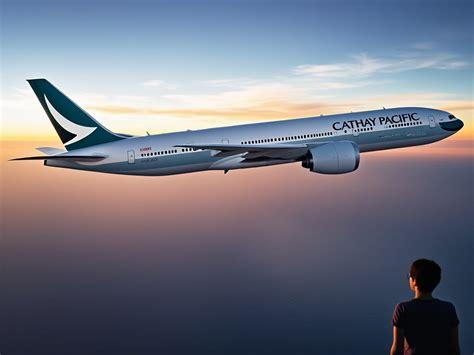
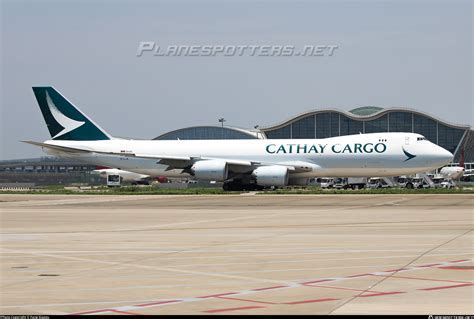
Cathay Pacific Airways Limited (國泰航空公司), commonly known as Cathay Pacific, stands as the esteemed flag carrier of Hong Kong. With its operational heart and primary hub strategically located at Hong Kong International Airport (HKIA), the airline has woven itself into the fabric of global aviation, renowned for its service excellence and extensive network. Cathay Pacific, along with its subsidiaries, orchestrates a complex web of scheduled passenger and cargo services, reaching over 190 destinations across more than 60 countries worldwide, a figure bolstered by codeshare agreements and joint ventures. The airline’s modern fleet is a testament to its commitment to efficiency and passenger comfort, primarily comprising advanced aircraft such as the Airbus A321neo, Airbus A330, Airbus A350, and the venerable Boeing 777. Complementing its passenger operations, Cathay Cargo utilizes the formidable Boeing 747 freighters, specifically the 747-400F and 747-8F models, to maintain Hong Kong’s status as a leading global air freight hub. The airline celebrated its 78th anniversary in 2024, a journey marked by significant milestones and unwavering resilience.
Founded on 24 September 1946, Cathay Pacific’s genesis is a story of post-war entrepreneurial spirit. The visionaries behind its establishment were Australian Sydney H. de Kantzow and American Roy C. Farrell, both ex-Air Force pilots with invaluable experience flying “The Hump” – the perilous air route over the Himalayas during World War II. Their initial venture, the Roy Farrell Import-Export Company, based in Shanghai, laid the groundwork for what would become a global airline. Farrell acquired the airline’s very first aircraft, a Douglas DC-3 affectionately nicknamed “Betsy”, from Bush Field, New York City, in 1945. The company commenced freight services on 28 January 1950, flying from Sydney to Shanghai, after securing a license to carry freight. However, mounting operational challenges in Shanghai prompted a strategic relocation to the more stable and promising environment of Hong Kong on 11 May 1946. It was here, on 24 September 1946, that Cathay Pacific Airways Limited was officially registered.
The name “Cathay Pacific” itself is evocative and aspirational. “Cathay” is an ancient, poetic name for China, reflecting the airline’s regional roots, while “Pacific” embodied Farrell’s ambitious vision of one day spanning the vast ocean – a dream realized in the 1970s. Legend has it that the name was conceived during a brainstorming session among Farrell and foreign correspondents at the bar of the Manila Hotel, carefully chosen to avoid “Air Cathay,” which was already in use in a popular comic strip. The Chinese name, 國泰 (Guótài), meaning “Peace and Prosperity,” was adopted in the 1950s, further cementing its identity. Initial shareholders included Neil Buchanan, Donald Brittan Evans, and Robert “Bob” Stanley Russell, who had previously worked with de Kantzow and Farrell. Early operations saw Cathay Pacific plying routes between Hong Kong, Sydney, Manila, Singapore, Shanghai, Saigon, and Bangkok, alongside chartered flights to various other destinations.
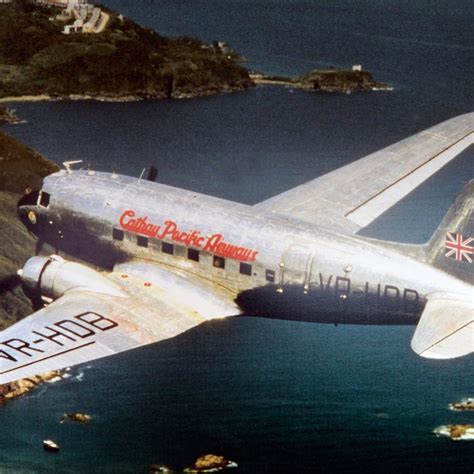
The Swire Era and Early Expansion (1948–1960s)
A pivotal moment in Cathay Pacific’s early history occurred in 1948 when John Swire & Sons (now the Swire Group), along with China Navigation Company and Australian National Airways, became new shareholders, acquiring assets from the original entity. This restructuring was reportedly influenced by the colonial British government of Hong Kong, which required the airline to be majority-British owned. While de Kantzow was an Australian British subject, Farrell’s American citizenship necessitated the sale of their majority stake. Under Swire’s astute management, de Kantzow remained with the airline until 1951, while Farrell sold his shares shortly after the takeover in 1948. The Swire Group would go on to become the dominant shareholder, maintaining a significant stake (45% through Swire Pacific Limited as of March 2024) and shaping the airline’s corporate culture and strategic direction for decades. Concurrently, in 1950, Swire established the Hong Kong Aircraft Engineering Company (HAECO), which evolved into a major aircraft maintenance and repair service provider.
During the late 1940s, the Hong Kong Government demarcated the local aviation market, allocating southern routes (Southeast Asia and Australia) to Cathay Pacific and northern routes (mainland China, Korea, Japan) to its competitor, Hong Kong Airways, owned by Jardine Matheson. However, geopolitical shifts, including the establishment of the People’s Republic of China and the Korean War, diminished the viability of northern routes. This culminated in Cathay Pacific’s acquisition of Hong Kong Airways on July 1, 1959, establishing it as the preeminent airline in Hong Kong. The 1960s heralded a period of robust growth, with the airline consistently recording double-digit expansion annually between 1962 and 1967. It became one of the first international carriers to serve Fukuoka, Nagoya, and Osaka in Japan. A significant milestone was reached in 1964 when Cathay Pacific carried its one-millionth passenger and acquired its first jet-engine aircraft, the Convair 880. By 1967, with the phasing out of its last Lockheed L-188 Electra, Cathay Pacific transitioned to an all-jet fleet.
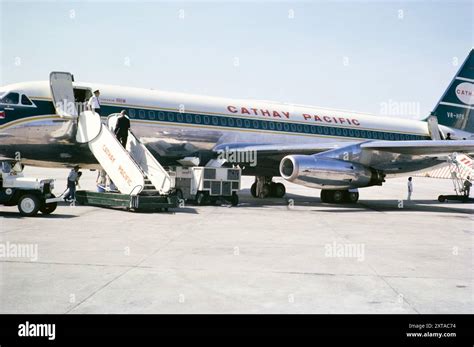
Technological Advancements and Global Reach (1970s–1980s)
The 1970s saw Cathay Pacific embrace technological innovation, implementing a computerised reservation system and sophisticated flight simulators to enhance operational efficiency and training standards. In 1971, the airline welcomed its first Boeing 707-320B, and by 1972, its fleet included five of these iconic long-haul jets, sporting a distinctive Brunswick green livery. The airline’s cargo operations also expanded, with a Boeing 707 freighter service commencing in July 1976, linking Hong Kong with Seoul, Bangkok, and Singapore. A defining moment came in 1979 with the acquisition of its first Boeing 747, the “Queen of the Skies.” This paved the way for the launch of highly sought-after traffic rights to London, with the inaugural flight taking place on 16 July 1980, marking a significant step in its intercontinental expansion.
The 1980s were characterized by further ambitious growth. In 1982, Cathay Pacific Cargo was formally introduced, playing a crucial role in Hong Kong’s ascent as a major global re-export trading hub. Dedicated long-haul cargo services commenced with a twice-weekly Hong Kong-Frankfurt-London route, operated jointly with Lufthansa. Passenger services expanded across the Pacific, with Vancouver added in 1983, followed by San Francisco in 1986. An industry-wide boom fueled further route development into numerous European and North American cities, including Brisbane, Frankfurt, Amsterdam, Rome, Paris, Zurich, and Manchester. This period of dynamic expansion was underscored by Cathay Pacific’s public listing on the Main Board of the Stock Exchange of Hong Kong on 15 May 1986, a move that provided capital for continued growth and modernization.
Rebranding, Renewal, and Strategic Alliances (1990s)
The 1990s brought strategic acquisitions and a refreshed brand identity. In January 1990, Cathay Pacific and its parent, Swire Pacific, acquired a significant shareholding in Dragonair (later Cathay Dragon), a regional airline with a strong focus on mainland China. This was followed by the acquisition of a 75% stake in cargo airline Air Hong Kong in 1994, further consolidating Cathay’s air freight capabilities. The airline embarked on a comprehensive passenger service upgrade program in 1994, including a HK$23 million initiative to modernize its image. This period saw the introduction of the iconic “Brushwing” logo, a calligraphic stroke resembling a bird’s wing, which replaced the previous green and white striped livery. This logo was updated again in 2014 for a more contemporary feel. A massive fleet replacement program, costing US$9 billion, was also initiated in the mid-1990s to ensure a modern and fuel-efficient fleet.
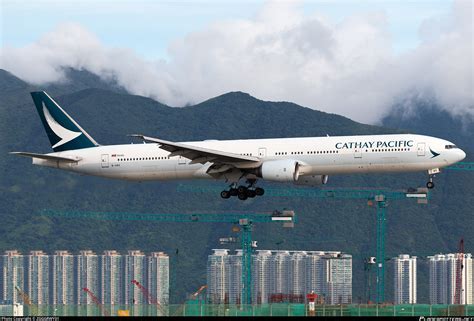
Shareholding structures also evolved during this decade. In 1996, CITIC Pacific increased its stake in Cathay Pacific from 10% to 25%, while two other Chinese entities, China National Aviation Corporation (Group) Limited (CNAC(G)) and China Travel Service (CTS), also acquired substantial holdings. Consequently, the Swire Group’s holding was reduced to 44%. This strategic move was widely interpreted as a demonstration of China’s commitment to maintaining Hong Kong’s prosperity post-handover. The handover of Hong Kong from the United Kingdom to China in 1997 prompted updates to the registration numbers and flags on its fleet, with aircraft subsequently carrying the Brand Hong Kong logo. On 21 May 1998, Cathay Pacific celebrated the delivery of its first Boeing 777-300. A landmark event occurred on 21 September 1998, when Cathay Pacific, alongside American Airlines, British Airways, Canadian Airlines, and Qantas, co-founded the Oneworld alliance, significantly expanding its global network reach through partner airlines. The decade concluded with Cathay Pacific navigating the Asian financial crisis, yet it managed to post a record HK$5 billion profit in 2000. A significant operational shift occurred on 6 July 1998, with the closure of Hong Kong’s legendary Kai Tak International Airport and the seamless transition of operations to the new Hong Kong International Airport at Chek Lap Kok. Cathay Pacific’s flight from New York JFK to the new airport was notably the world’s first nonstop transpolar flight on that route.
Navigating Turbulence: Industrial Disputes and Acquisitions (2000s)
The early 2000s presented Cathay Pacific with significant industrial relations challenges, most notably the “49ers” employment dispute. In 2001, the Hong Kong Aircrew Officers Association (HKAOA) initiated a “work-to-rule” campaign advocating for improved pay and roster scheduling. This action, combined with pilots calling in sick, led to flight cancellations. Cathay Pacific responded by dismissing 49 of its 1,500 pilots on 9 July 2001, a group that became known as “the 49ers.” Many of those dismissed were senior captains and union officials. The HKAOA condemned the firings as union-busting. The ensuing legal battles were protracted. While the airline later offered the dismissed pilots opportunities to reapply for cargo positions, the dispute left a lasting scar. In 2010, the Hong Kong Court of Appeal upheld a ruling that Cathay Pacific had wrongly sacked 18 of the pilots due to their union activities and upheld a defamation claim, albeit with reduced damages. The Court of Final Appeal in 2012 largely sided with the pilots on key issues of breach of contract and employment ordinance violations.
Amidst these internal challenges, Cathay Pacific pursued strategic growth. On 28 September 2006, a major shareholding realignment saw Dragonair become a wholly-owned subsidiary, though it continued to operate under its own brand. This acquisition provided Cathay Pacific with significantly enhanced access to the burgeoning mainland China market. As part of the deal, CNAC and its subsidiary Air China increased their stake in Cathay Pacific, while Cathay Pacific reciprocally increased its holding in Air China. Dragonair’s planned international expansion was subsequently rationalized to align with Cathay Pacific’s network. In January 2016, Dragonair was rebranded as Cathay Dragon, aiming to more closely align the two brands. However, the severe impact of the COVID-19 pandemic led to the cessation of Cathay Dragon’s operations on 21 October 2020, with its routes and resources absorbed by Cathay Pacific and its low-cost subsidiary HK Express.
The decade also brought economic headwinds. In June 2008, Cathay Pacific agreed to a US$60 million fine in a plea bargain with the United States Department of Justice regarding air cargo price-fixing. The global financial crisis of 2008 hit hard, impacting premium travel demand. In March 2009, the airline reported a staggering full-year loss of HK$8.56 billion for 2008, largely due to fuel-hedging losses of HK$7.6 billion. This necessitated cost-saving measures, including frequency reductions, deferred capital expenditure, and voluntary unpaid leave schemes for staff.
A Decade of Transformation and Unforeseen Challenges (2010s)
The 2010s began on a high note, with Cathay Pacific achieving a record profit of HK$14.05 billion in 2010, driven by a recovery in passenger and cargo demand. The airline continued to modernize its fleet with new deliveries of Airbus A330-300s and Boeing 777-300ERs. Leadership transitions saw Tony Tyler depart as CEO in March 2010, succeeded by Chief Operating Officer John Slosar. The airline expanded its network, adding destinations like Manchester, Zurich, and Boston. A poignant moment came on 8 October 2016, with the retirement of its last passenger Boeing 747-400, B-HUJ, after over 35 years of iconic service. However, by the mid-2010s, increased competition from mainland Chinese carriers offering direct flights to Europe and the US began to erode Cathay Pacific’s passenger yields, leading to profit warnings and the reintroduction of fuel surcharges.
Facing consecutive losses, Cathay Pacific initiated a three-year transformation program starting in 2017. This strategy focused on five key pillars: Places (network development), Planes (fleet optimization), Product (service enhancements), People (workforce engagement), and Productivity. The airline launched 13 new routes, reintroduced popular services like hot meals on the busy Hong Kong-Taipei route, featured celebrated Hong Kong dishes in its inflight menus, and revamped its Business Class offering. Significant investments were made in ground services, including new and refurbished lounges, such as The Pier – Business in Hong Kong, which featured the first airline lounge yoga studio. Wi-Fi connectivity was progressively rolled out across the fleet. Early signs of the transformation’s success emerged in February 2019, with a profit alert indicating a HK$2.3 billion profit for 2018.
However, the decade was also marked by significant non-operational challenges. In 2018, Cathay Pacific disclosed a major data breach that compromised the personal information of approximately 9.4 million passengers, including passport numbers and some credit card details. The breach, suspected in March 2018 but confirmed in May, resulted in a £500,000 fine from the UK’s Information Commissioner’s Office in March 2020. On 27 March 2019, Cathay Pacific announced the acquisition of HK Express, Hong Kong’s sole low-cost carrier, for HK$4.93 billion, a move aimed at tapping into a different market segment and enhancing competitiveness. The latter part of 2019 was overshadowed by the 2019–2020 Hong Kong protests. The involvement of some Cathay Pacific employees in the protests led to intense pressure from Beijing, resulting in the resignation of CEO Rupert Hogg and Chief Customer and Commercial Officer Paul Loo, and the termination or forced resignation of several staff members.
Pandemic, Recapitalization, and Path to Recovery (2020s – Present)
The onset of the COVID-19 pandemic in early 2020 delivered an unprecedented blow to Cathay Pacific and the global aviation industry. Widespread travel bans and a collapse in demand forced drastic flight reductions; at one point, 96% of flights were cancelled, and subsidiary HK Express suspended all operations for a period. The financial impact was severe, leading to a HK$39 billion recapitalization plan announced on 10 June 2020, which included a significant investment from the Hong Kong Government, giving it a 6% stake and the right to appoint two board observers. Despite these measures, the airline posted a record annual loss of US$2.8 billion for 2020 and announced 8,500 job cuts, along with the closure of overseas pilot bases, including Canada and Frankfurt.
As travel restrictions gradually eased, Cathay Pacific embarked on a slow and challenging recovery. In 2023, the airline participated in the Airport Authority Hong Kong’s “World of Winners” campaign, offering free air tickets to stimulate tourism. However, the recovery path was not smooth. From December 2023 to January 2024, Cathay Pacific faced mass flight cancellations due to a significant pilot shortage, a consequence of workforce reductions during the pandemic. The airline had to preemptively trim schedules to stabilize operations during the peak Lunar New Year period. Despite these setbacks, by December 2024, Cathay Pacific reported meeting its target of hiring pilots to reach a strength of 3,400, nearing its pre-pandemic level of 3,800, with plans to add more in early 2025. Looking ahead, Cathay Pacific has announced new routes, including a return to Rome in June 2025, and new services to Munich, Brussels, and Dallas/Fort Worth slated for 2025, with the Dallas route set to be its longest.
Corporate Structure and Identity
Cathay Pacific’s nerve center is Cathay City, its impressive headquarters located at Hong Kong International Airport, which opened in 1998. Prior to this, the airline was headquartered at Swire House in Central Hong Kong. The airline’s financial performance has seen significant fluctuations, reflecting the volatile nature of the aviation industry. For instance, revenue stood at HK$105 billion in 2014, dipped during challenging years, and recovered to HK$94.4 billion in 2023. Net profit also varied, from HK$3.1 billion in 2014 to a substantial loss of HK$21.6 billion in 2020 during the pandemic, before rebounding to a profit of HK$9.7 billion in 2023. Employee numbers also mirrored these trends, decreasing from over 25,000 pre-pandemic to around 16,000-18,000 in the early 2020s, with rebuilding efforts underway.
As of early 2024, the major shareholders of Cathay Pacific are Swire Pacific (45%), Air China (29.99%), Qatar Airways (9.61%), and the HKSAR Government (6.08%). The Cathay Pacific Group encompasses a diverse range of subsidiaries and associates in related sectors, including:
- AHK Air Hong Kong Limited (100%): Cargo airline.
- HK Express Airways (100%): Low-cost carrier.
- Cathay Cargo Terminal (100%): Airline cargo handling.
- Cathay Dining (100%): Airline catering.
- Hong Kong Airport Services Limited (100%): Ground handling.
- Asia Miles Limited (100%): Travel rewards program.
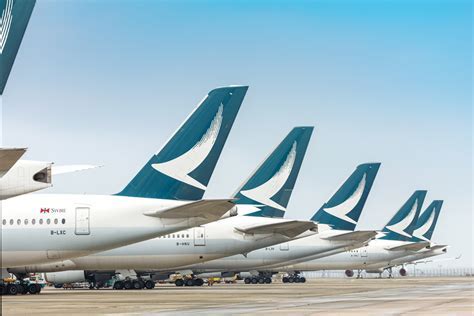
The airline’s livery has evolved over the years. From June 1971 to November 1994, aircraft featured a “lettuce leaf sandwich” design in Brunswick green and white over bare metal, with the British Union Flag on the tail. Post-1997 handover, the Brand Hong Kong logo was added. The most recognizable livery element is the “Brushwing” logo, introduced in the early 1990s. On November 1, 2015, a refreshed, simpler livery was unveiled, retaining the Brushwing on an all-green tail, first appearing on a Boeing 777-300ER (B-KPM). In June 2023, the freighter livery was updated to feature larger “Cathay Cargo” text.
Senior leadership (as of early 2024) includes Patrick Healy as Chairman (since November 2019) and Ronald Lam as Chief Executive (since January 2023).
Global Network and Partnerships
Cathay Pacific serves 83 destinations (including cargo) in 46 countries and territories across five continents, with a particularly strong network throughout Asia. Key gateway cities in North America and Europe are well-served, facilitated by connections through its Oneworld alliance partners such as American Airlines (via Los Angeles) and British Airways (via London). The airline also maintains codeshare agreements with numerous carriers, expanding its reach significantly. These partners include Air Canada, Air China, Air New Zealand, Alaska Airlines, British Airways, Finnair, Iberia, Japan Airlines, Lufthansa, Malaysia Airlines, Qantas, Qatar Airways, and S7 Airlines, among others. Beyond airlines, Cathay Pacific has innovative codeshare agreements with the French national rail operator SNCF for high-speed train connections from Paris-Charles de Gaulle Airport to ten French cities, and with local ferry operators Cotai Water Jet and Chu Kong Passenger Transport Co., Ltd to connect passengers between Hong Kong and destinations in the Greater Bay Area like Macau, Zhuhai, Shenzhen, and Guangzhou.
Modern Fleet
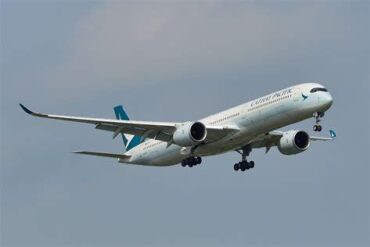
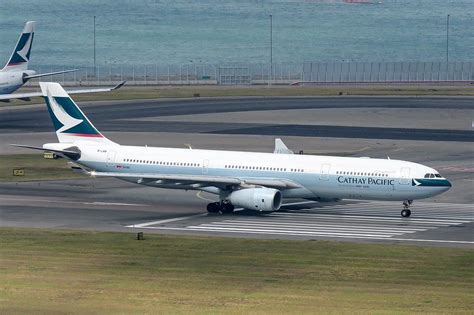
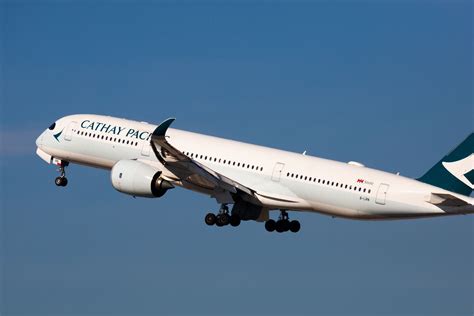
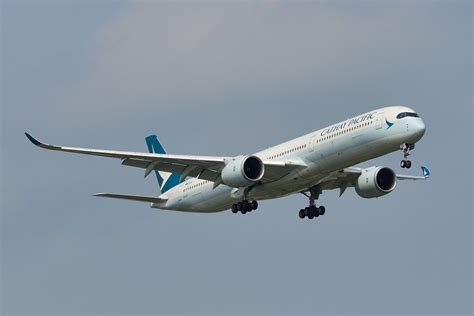
Cathay Pacific operates a sophisticated fleet of primarily wide-body aircraft for its passenger services, emphasizing fuel efficiency and passenger comfort. The backbone of its long-haul fleet includes the Airbus A350 (both -900 and -1000 variants) and the Boeing 777 (primarily the -300ER variant, with older -300s used regionally). For regional and medium-haul routes, the Airbus A330-300 remains a workhorse, complemented by the newer, fuel-efficient Airbus A321neo for shorter routes. The cargo division, Cathay Cargo, relies on a fleet of dedicated Boeing 747 freighters, including the Boeing 747-400ERF and the more advanced Boeing 747-8F, underscoring Hong Kong’s role as a premier global logistics hub.
Loyalty and Passenger Services
Cathay Membership Program
In August 2022, Cathay Pacific consolidated its loyalty offerings by merging its frequent flyer program, the Marco Polo Club, and its travel rewards program, Asia Miles, into a single, integrated program known simply as “Cathay”. Existing members of either program were transitioned to this new unified structure. The Cathay membership program features four tiers: Green (entry-level), Silver, Gold, and Diamond. Members earn Asia Miles (the loyalty currency) and Status Points on eligible Cathay Pacific and Oneworld partner airline flights. Status Points determine membership tier renewal, upgrades, or downgrades annually.
- Green: Basic benefits including dedicated service lines and redemption options for extra baggage and lounge access. A Business Class lounge voucher is issued upon reaching 200 Status Points.
- Silver: Achieved with 300 Status Points. Benefits include advance seat reservation, priority wait-listing, Business Class check-in, priority baggage, and Business Class lounge access on Cathay Pacific flights. Equivalent to Oneworld Ruby.
- Gold: Achieved with 600 Status Points. Benefits include guaranteed Economy seat (72hrs advance booking), increased baggage allowance, Business Class lounge access with a guest on Cathay Pacific and Oneworld flights, and arrival lounge access. Equivalent to Oneworld Sapphire.
- Diamond: The highest tier, achieved with 1200 Status Points. Benefits include top priority waitlisting, guaranteed Economy or Business seat (24hrs advance booking), First Class check-in, highest baggage allowance, First Priority baggage, and First Class lounge access with guests. Equivalent to Oneworld Emerald.
Asia Miles can be earned through flights and spending with a wide array of partners, and redeemed for flights, upgrades, hotel stays, and other lifestyle rewards.
Cabin Experience
Cathay Pacific is renowned for its high-quality cabin products across all classes:
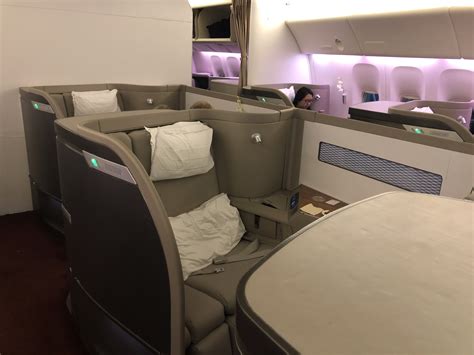
- First Class: Offered on select Boeing 777-300ERs, featuring six spacious suites in a 1-1-1 layout. Seats convert to fully flat beds (36×81 inches) and include massage functions, personal closets, and 18.5-inch HD PTVs.
- Business Class: Available on all internationally configured aircraft (A350s, 777-300ERs, select A330s). Features reverse herringbone seats in a 1-2-1 configuration, converting to fully flat beds (82 inches long). The new “Aria Suite” is being rolled out on Boeing 777-300ERs since 2024, offering enhanced privacy and amenities, including wireless charging and 4K PTVs. Regional Business Class on A321neos, A330s, and 777-300s offers comfortable recliner seats.
- Premium Economy Class: Offered on A350s, 777-300ERs, and select A330s. Provides increased seat pitch (38-40 inches), wider seats, greater recline, larger meal tables, and 10.6-12.1-inch PTVs in a separate cabin.
- Economy Class: Features various seat types depending on the aircraft. Newer versions on A350s and retrofitted 777s offer improved ergonomics, larger PTVs (up to 11.6 inches), USB ports, and AC power. The A321neo Economy Class, originally for Cathay Dragon, features distinct Cordova red HAECO Vector Y+ seats with 4K resolution screens.
In-Flight Services
Complimentary food and beverages, including alcoholic drinks, are provided on all flights. Meals are catered by Cathay Pacific Catering Services (CPCS) in Hong Kong and other reputable caterers worldwide. The StudioCX in-flight entertainment system offers a vast selection of movies, TV shows, music, games, and a moving map. Newer iterations on the A350 and A321neo feature high-definition or even 4K screens, live TV (on A350s), and extensive content libraries. Wi-Fi is available across most of the long-haul fleet.
Safety and Recognition
Cathay Pacific maintains a strong safety record and is consistently ranked among the world’s safest airlines. While it has experienced incidents over its long history, the last fatal accident resulting in passenger fatalities and a hull loss occurred in 1972 (Flight 700Z, a Convair 880, due to a bomb). Notable non-fatal incidents include Flight 780 in 2010 (Airbus A330), where pilots successfully landed the aircraft after dual engine failure due to contaminated fuel, earning them the Polaris Award for heroism. More recently, Flight 383 in September 2024 (Airbus A350-1000) experienced an engine fire post-takeoff; the aircraft returned safely to Hong Kong with no casualties, leading to fleet-wide engine inspections.
The airline has received numerous awards and accolades for its service quality. For instance, on 24 June 2024, Cathay Pacific was voted as providing the World’s Best Economy Class by Skytrax, a testament to its ongoing commitment to passenger experience even in its largest cabin.
Cathay Pacific’s journey from a small regional carrier to a global aviation leader is a story of ambition, strategic acumen, and resilience. Navigating geopolitical shifts, economic downturns, industrial disputes, and an unprecedented pandemic, the airline continues to adapt and evolve, striving to maintain its position as “Asia’s world city” carrier and a symbol of Hong Kong’s international connectivity.