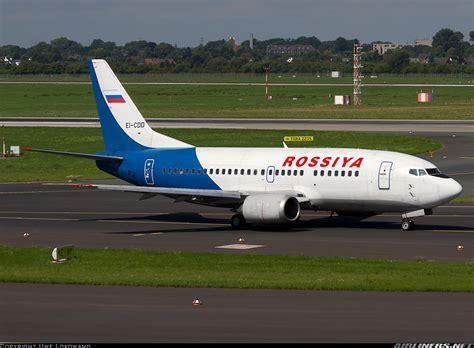
Rossiya Airlines, officially AO Aviakompaniya «Rossiya», stands as a monumental figure in the landscape of Russian civil aviation. With a heritage stretching back to its foundation on 7 May 1934 as Pulkovo Aviation Enterprise, it is not merely an airline but a significant chapter in Russia’s aeronautical history. As a prominent member of the Aeroflot Group, Rossiya has evolved into one of the nation’s largest air carriers, headquartered in the historic city of Saint Petersburg and operating with Moscow–Sheremetyevo, Saint Petersburg’s Pulkovo Airport, Krasnoyarsk, and Sochi as its primary hubs. Pulkovo Airport, in particular, benefits from Rossiya being its largest and base carrier, underscoring the airline’s deep connection to the cultural capital of Russia. Despite facing contemporary challenges, including a ban from European Union airspace, Rossiya continues to navigate the complexities of modern aviation, managed by CEO Jan Burg and supported by a dedicated workforce of approximately 6,797 employees as of 2024.
The airline’s journey is one of transformation and strategic consolidation. Its roots as Pulkovo Aviation Enterprise laid a strong foundation in Leningrad (now Saint Petersburg), focusing on regional connectivity and gradually expanding its operational scope. The formal commencement of operations as Rossiya Airlines on 3 April 1992 marked a new era, aligning with the significant geopolitical shifts occurring at the time. This period saw the airline begin to carve out its distinct identity, separate from its Soviet-era predecessor, yet building upon its established operational expertise. The airline’s head office remained firmly planted in Saint Petersburg, a testament to its origins and its enduring importance to the region.
A pivotal moment in Rossiya’s modern history was the merger with Pulkovo Aviation Enterprise, a process that culminated in November 2006. Rossiya Airlines was officially registered in Saint Petersburg on 9 October 2006, solidifying its legal and operational framework. This strategic move was not just a name change but a comprehensive integration that aimed to create a more robust and competitive entity. The merged airline established a significant branch in Moscow, further extending its reach, and boasted an impressive network of 54 offices across Russia and internationally, signaling its ambitions for broader market penetration and enhanced service delivery. This consolidation was a critical step in streamlining operations and leveraging the combined strengths of the two entities to better serve the Russian aviation market.
Integration into Aeroflot Group and Strategic Realignment
The early 2010s brought further significant changes to Rossiya’s corporate structure, driven by a broader governmental strategy to consolidate state-owned aviation assets. In February 2010, the Russian government announced plans to merge all regional airlines managed by the state holding company Rostec into the national flag carrier, Aeroflot. This initiative was aimed at bolstering the financial viability and operational efficiency of these regional carriers. Consequently, on 16 November 2011, a controlling stake of 75% minus one share of Rossiya Airlines JSC was transferred to Aeroflot. This move effectively brought Rossiya under the umbrella of Russia’s largest airline group, setting the stage for deeper integration and strategic alignment. Shortly thereafter, in December 2011, the remaining 25% plus one share were thoughtfully donated to the Government of Saint Petersburg. This transfer, formalized by a city government decree on 23 December 2011, was intended to ensure that the executive bodies of Saint Petersburg could actively participate in and influence the development of the city’s vital transport complex. The city received 229,726 ordinary registered non-documentary shares, each with a nominal value of 1,000 rubles, thereby securing a blocking stake and a significant voice in the airline’s governance.
By 2014, the commercial management of Rossiya Airlines JSC was fully transferred to its parent company, Aeroflot. This integration meant that from the spring-summer schedule of that year, Rossiya’s flights began operating under a unified code shared across the Aeroflot Group. A significant benefit for passengers was Rossiya Airlines’ inclusion in the Aeroflot Bonus frequent-flyer program, allowing for seamless accrual and redemption of miles across the expanded network, enhancing customer loyalty and providing greater value to its travelers.
Consolidation and Rebranding: The Modern Rossiya
The mid-2010s witnessed another major consolidation phase for the Aeroflot Group’s regional operations. In December 2015, Aeroflot announced a strategic decision to unify three of its regional airline affiliates – Rossiya (the largest of the three), Donavia (based at Rostov-on-Don Airport), and Orenair (operating from Orenburg Tsentralny Airport and Moscow’s Domodedovo International Airport) – under the single, strengthened brand of Rossiya. This merger, which notably excluded Aurora, a smaller airline based in Yuzhno-Sakhalinsk, was designed to streamline operations, reduce redundancies, and create a more powerful regional carrier. At the time of the announcement, Rossiya, Donavia, and Orenair collectively served an extensive network of 48 domestic and 42 international destinations. The newly enlarged Rossiya was also poised to absorb some routes previously operated by Transaero Airlines, which had ceased operations in October 2015, further expanding its market presence. The integration of these three airlines was meticulously planned and completed by the end of February 2016, with unified flight operations commencing on 27 March 2016. This marked the birth of the modern Rossiya Airlines as a significantly larger and more influential player in the Russian aviation sector.
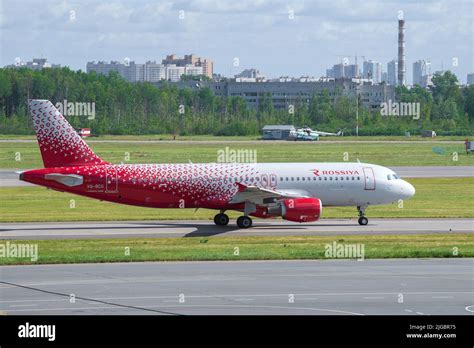
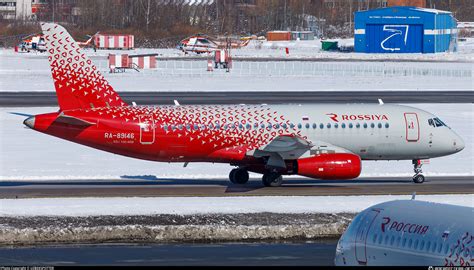
Coinciding with this significant operational merger, Rossiya Airlines embarked on a comprehensive rebranding initiative to reflect its new scale and forward-looking vision. The centerpiece of the new corporate identity is a distinctive livery pattern featuring an element that resembles a dynamic blade or feather. This design’s fluid, plastic shape elegantly complements the airline’s logo. The blade element itself is composed of modules that graphically echo the image of an aircraft turbine, symbolizing power and motion. A particularly clever aspect of the design is how the pattern’s density shifts from the nose of the aircraft towards its tail – it becomes progressively more saturated, as if visually tracing the airflow over the fuselage. This artistic technique masterfully conveys a sense of flight and continuous movement, even when the aircraft is stationary on the ground. The airline’s name, “Rossiya,” is prominently displayed on the lower part of the fuselage in a bespoke corporate font, completing the modern and sophisticated look. In a symbolic unveiling of this new identity, Rossiya introduced its first Boeing 747-400 adorned in the new livery in April 2016, fittingly named after the city of Saint Petersburg.
Navigating Sanctions and Fleet Adjustments
The geopolitical landscape of 2022 brought significant operational challenges for Rossiya Airlines, along with other Russian carriers. On 8 April 2022, the US Department of Commerce imposed restrictions on flights operated by Aeroflot, Aviastar, Azur Air, Belavia, Rossiya, and Utair using aircraft manufactured in the United States. These sanctions were further broadened on 16 June 2022, following detected violations, effectively aiming to ground the US-manufactured portion of these airlines’ fleets. This had a direct impact on Rossiya, given its significant inventory of Boeing aircraft. In a strategic response to these evolving circumstances and as part of an internal Aeroflot Group adjustment, Rossiya Airlines took over all Sukhoi Superjet 100 operations from its parent company, Aeroflot, as of July 2022. This move consolidated the domestic Russian-made aircraft under Rossiya’s operational control, allowing Aeroflot to focus on its long-haul operations with available wide-body aircraft and streamlining fleet management within the group.
Extensive Network and Strategic Alliances
Rossiya Airlines boasts an impressive and far-reaching route network, encompassing over 120 destinations. This extensive connectivity is crucial for both domestic and international travel, with a particular emphasis on socially significant and highly popular routes to cities in the Russian Far East. These routes are vital for maintaining economic and social links across Russia’s vast territory. To enhance its global reach and provide passengers with a wider array of travel options, Rossiya Airlines maintains codeshare agreements with key partners. Most notably, it has a comprehensive codeshare agreement with its parent company, Aeroflot, allowing for seamless booking and travel across their combined networks. Additionally, Rossiya has a codeshare agreement with Korean Air, facilitating connections between Russia and East Asia. Further supplementing its network connectivity, Rossiya has an interline agreement with Swiss International Air Lines, providing passengers with more flexible travel itineraries involving European destinations.
The Diverse Fleet of Rossiya Airlines
As of September 2024, Rossiya Airlines operates a large and varied fleet, strategically chosen to serve its diverse route network, ranging from short domestic hops to long-haul international flights. The fleet composition reflects a mix of Airbus, Boeing, and domestically produced Sukhoi aircraft:
- Airbus A319-100: 18 aircraft are in service. These are typically configured with 8 business class and 120 economy class seats, totaling 128 seats, ideal for shorter routes with moderate demand.
- Airbus A320-200: 8 aircraft in the fleet, generally featuring 12 business class and 156 economy class seats, for a total of 168 passengers, serving popular medium-haul routes.
- Boeing 737-800: 12 aircraft are operational. These are configured in an all-economy layout with 189 seats, maximizing capacity on high-demand domestic and shorter international routes.
- Boeing 737-900ER: 2 extended-range versions of the 737, also in an all-economy configuration, accommodating 215 passengers, offering greater range and capacity.
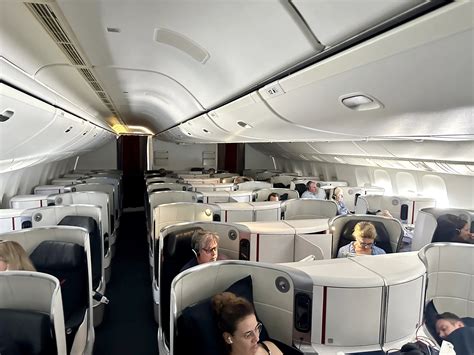
- Boeing 747-400: 5 iconic “Queen of the Skies” aircraft remain in service. These jumbo jets are configured with 12 business class and 510 economy class seats, totaling 522 seats, primarily used on high-capacity leisure routes and to the Far East.
- Boeing 777-300: 3 aircraft of this type, featuring a two-class configuration with 14 business class (often a premium comfort or similar offering) and 355 economy class seats, totaling 373 seats.
- Boeing 777-300ER: 5 extended-range models are in service, configured with 21 business class and 436 economy class seats, for a total of 457 passengers, forming the backbone of its long-haul operations.
- Sukhoi Superjet 100-95B/LR: A significant fleet of 78 aircraft, making Rossiya the largest operator worldwide of this Russian-made regional jet. The entire fleet was taken over from Aeroflot. These aircraft are typically configured with 12 business class and 75 economy class seats (total 87) or in an all-economy layout with 100 seats. An additional order for 34 more SSJ100s was placed in September 2023, underscoring the airline’s commitment to this aircraft type for its regional network.
- Yakovlev MC-21-300: Rossiya has 12 of this next-generation Russian narrow-body aircraft on order, with the passenger configuration yet to be announced. This indicates a future direction towards modernizing its fleet with domestically produced aircraft.
The total fleet comprises 133 aircraft in service with 46 on order, showcasing Rossiya’s substantial operational capacity and its plans for future growth and modernization, particularly with an emphasis on Russian-manufactured aircraft like the Sukhoi Superjet 100 and the upcoming Yakovlev MC-21.
Special Liveries: Celebrating Culture, Conservation, and Sport
Rossiya Airlines has distinguished itself through a series of captivating special liveries, transforming some of its aircraft into flying tributes to Russian culture, wildlife conservation, sports, and significant anniversaries. These initiatives go beyond mere branding, aiming to engage the public and highlight important causes and achievements.
One of the earliest and most prominent special projects was the Zenitolet. On 7 July 2014, Rossiya Airlines became the official carrier of the renowned Zenit Saint Petersburg football club. This partnership involved more than just transportation; the airline prepared a dedicated group of flight attendants for team flights and developed special sports-focused onboard catering in consultation with doctors and nutritionists. The aircraft designated for this, an Airbus A319, was sent to the Netherlands for its unique Zenit-themed painting on October 29, 2014, and was officially presented at Pulkovo International Airport on November 11 of the same year. While serving the team, the Zenitolet also operates on Rossiya’s regular flight schedule, allowing fans and regular passengers alike to experience this unique aircraft.
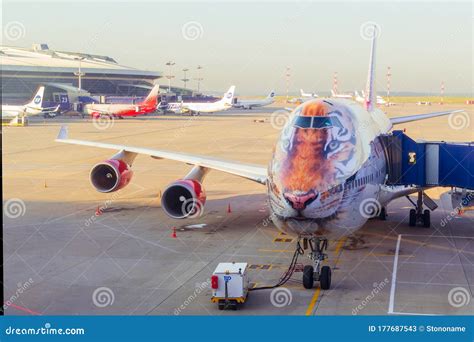
In a powerful display of commitment to wildlife conservation, Rossiya Airlines, in collaboration with the Amur Tiger Center, unveiled the Care About Tigers/Tigrolet livery in September 2016. A Boeing 747-400 (EI-XLD, formerly Japan Airlines JA8914), named after Yuzhno-Sakhalinsk, had its nose section dramatically painted with the face of an Amur tiger. This striking design aims to draw public attention to the critical need for conserving rare wild animal populations. The Tigrolet primarily serves popular routes to Far Eastern cities and resort destinations within Russia, carrying its conservation message across the country.
Continuing its wildlife conservation theme, Rossiya introduced the Far Eastern (Amur) Leopard/Leolet in February 2017. A Boeing 777-300 (EI-UNP, formerly Singapore Airlines 9V-SYB), named after the city of Ussuriysk, features the captivating muzzle of an Amur leopard, the rarest leopard subspecies on Earth. Similar to the Tigrolet, the Leolet operates on high-demand and socially significant routes, particularly to the Far East and popular resorts, raising awareness for this critically endangered feline.
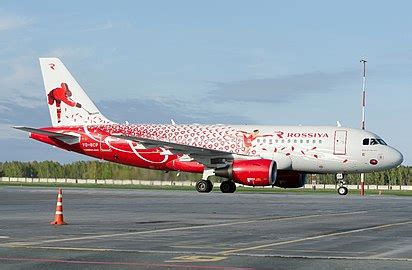
Celebrating Russia’s rich sporting heritage, the Sportolet was introduced on May 29, 2018. An Airbus A319 (VQ-BCP), named Rostov-on-Don, was adorned with a dynamic livery dedicated to Russian sports. In June 2018, Rossiya launched a social media competition to name the aircraft, with “Sportolet” emerging as the most popular choice among over 130 suggestions. This aircraft serves as a flying ambassador for Russian athleticism and sporting achievements.
In April 2022, coinciding with the Year of Cultural Heritage of the Peoples of Russia, Rossiya unveiled the Troika livery on a Sukhoi Superjet 100-95B (RA-89022), named after the city of Velsk. The design features a graphic element of three racing horses harnessed in a traditional troika, a powerful symbol of Russian culture and dynamism, visually enhancing the sensation of flight.
A collaboration with the prestigious State Hermitage Museum led to the Hermitage livery in October 2023. The fuselage of a Superjet 100 (RA-89171), named “Kaluga,” now carries a depiction of a Scythian deer figurine, a renowned piece of decorative art and one of the museum’s iconic symbols. This project aims to promote Russian cultural heritage and the Hermitage’s vast collection. The aircraft is in a mono-class configuration with 100 seats.
To commemorate the 300th anniversary of Saint Petersburg State University, one of Russia’s oldest and leading academic institutions, Rossiya introduced a special livery in February 2024. The anniversary logo of the university was applied to a Superjet 100 (RA-89142), named “Gatchina.” This livery highlights the university’s rich history, scientific achievements, and contributions to education and innovation.
In April 2024, Rossiya unveiled a Superjet 100 (RA-89146), named “Ufa,” with a special livery dedicated to Sambo, a unique Russian martial art. This project, in cooperation with the All-Russian Sambo Federation, promotes healthy lifestyles and celebrates this indigenous sport. The aircraft also features a 100-seat mono-class configuration.
Celebrating family values, in August 2024, Rossiya, in partnership with the Russian children’s and youth movement “The Movement of the First,” unveiled a new livery on a Superjet 100 (RA-89131) named “Murom.” This initiative, timed for the Year of the Family, honors Murom as the birthplace of Saints Peter and Fevronia, patrons of family and marriage. The design incorporates the Movement’s logo alongside iconic Russian symbols like St. Basil’s Cathedral, the Bronze Horseman, and the Crimean Bridge, reflecting a commitment to traditional values and national heritage.
Most recently, in September 2024, Rossiya Airlines celebrated its 90th anniversary with a dedicated livery on a Superjet 100 (RA-89185) named “Leningrad.” The design features a logo inspired by the infinity symbol, representing the continuous motion of aircraft, the professional growth of its employees, and the airline’s ongoing development and enduring legacy in Russian aviation.
These special liveries demonstrate Rossiya Airlines’ commitment to engaging with broader cultural, social, and environmental themes, making its fleet not just a mode of transport but also a canvas for storytelling and national pride. They significantly enhance brand visibility and create a unique connection with passengers and the public, reinforcing Rossiya’s image as a dynamic and culturally aware Russian carrier.