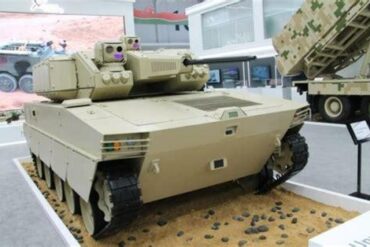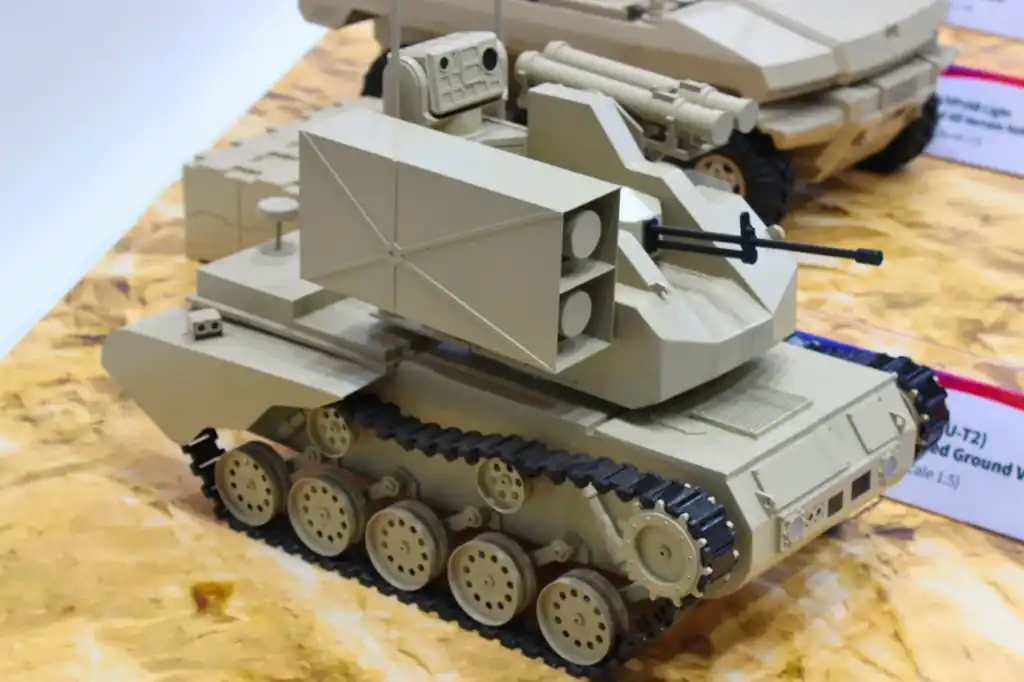
China’s steady push toward roboticized land warfare took a decisive step forward at UMEX 2026, where NORINCO revealed the Sharp Claw VU-T2 tracked unmanned ground vehicle as a mature, combat-ready system rather than a conceptual prototype. Positioned as a light yet heavily armed platform, the VU-T2 underscores Beijing’s intent to integrate unmanned assets directly into frontline ground operations, not merely as support tools but as active participants in maneuver warfare.
The unveiling placed the Sharp Claw VU-T2 within a broader transformation of modern armies toward manned-unmanned teaming, where robotic platforms extend reach, reduce risk to personnel, and deliver precision firepower in contested environments. Displayed prominently at the Abu Dhabi exhibition, the system drew attention for its compact footprint combined with a weapons suite usually associated with much larger vehicles.
Unlike earlier unmanned ground vehicles focused mainly on logistics or surveillance, the VU-T2 is designed from the outset as a multi-role combat system. Its configuration at UMEX 2026 emphasized offensive and defensive tasks, suggesting that NORINCO is marketing the platform as a tactical solution for urban combat, border security, and expeditionary operations.
A Tracked UGV Built for Direct Battlefield Engagement
At the core of the Sharp Claw VU-T2’s appeal is its ability to operate in high-risk zones traditionally dominated by infantry and light armored vehicles. The tracked chassis provides stability across sand, rubble, mud, and uneven terrain, making it suitable for urban warfare, desert patrols, and forward reconnaissance missions. Its compact dimensions allow it to maneuver through narrow streets and confined spaces where heavier platforms struggle.
The vehicle is engineered to perform close-in reconnaissance, covert surveillance, emergency assault operations, search-and-suppression missions, and static guard duties. These roles reflect a deliberate focus on scenarios where early contact with enemy forces would otherwise expose soldiers to ambush or improvised explosive devices. By deploying the VU-T2 forward, commanders gain real-time intelligence while maintaining a safer standoff distance.
Firepower That Redefines Light Unmanned Vehicles
The UMEX 2026 configuration highlighted the VU-T2’s transformation into a mobile fire support asset. The vehicle was fitted with a remotely operated 12.7 mm fire strike module, providing sustained suppressive fire against infantry and lightly armored targets. Complementing this was a BA-5 missile launcher, expanding the engagement envelope to include fortified positions and light vehicles at extended ranges.
This dual-layer armament is significant because it blurs the line between reconnaissance UGVs and unmanned combat vehicles. The Sharp Claw VU-T2 is not merely observing the battlefield; it is designed to shape engagements, fix enemy forces, and support advancing manned units with precision fire.
Advanced Sensors and Autonomous Navigation Architecture
Situational awareness is central to the VU-T2’s operational concept. NORINCO equipped the platform with a multi-sensor perception suite that includes LIDAR, electro-optical cameras, radar, inertial navigation systems, and integrated digital maps. This sensor fusion enables semi-autonomous navigation, obstacle avoidance, and target detection across complex terrain.
The architecture supports both remote operation and limited autonomous functions, allowing the vehicle to conduct patrols or follow pre-defined routes while maintaining constant data links with operators. Such capabilities are essential for future battlefields characterized by electronic warfare, where resilience and adaptability determine survivability.
Mobility, Endurance, and Operator Control
Weighing approximately 2.1 tonnes, the Sharp Claw VU-T2 balances protection, mobility, and payload capacity. Powered by an electric or hybrid drive system, the vehicle achieves a maximum road speed of 40 km/h and an average off-road speed of around 20 km/h. In electric mode, endurance exceeds 100 kilometers or more than 20 hours of continuous operation at moderate speeds.
Control is managed by a two-person crew using either portable terminals or modular control stations. Communication ranges reach 1.5 kilometers with portable equipment and extend to 3 kilometers when using modular systems, allowing flexible deployment from armored vehicles or command posts.
Strategic Implications for Modern Ground Forces
The Sharp Claw VU-T2’s debut at UMEX 2026 reflects a broader strategic shift in Chinese military technology toward networked, unmanned combat systems. By fielding a compact yet heavily armed UGV, NORINCO signals its ambition to offer export-ready platforms capable of reshaping tactical doctrine for both domestic and international customers.
As unmanned ground combat systems proliferate, platforms like the VU-T2 are likely to influence how future armies conduct reconnaissance, urban clearing operations, and force protection missions. Its presence at UMEX 2026 positions China as a leading contender in the evolving market for armed unmanned land vehicles, where autonomy, firepower, and integration define the next generation of ground combat.