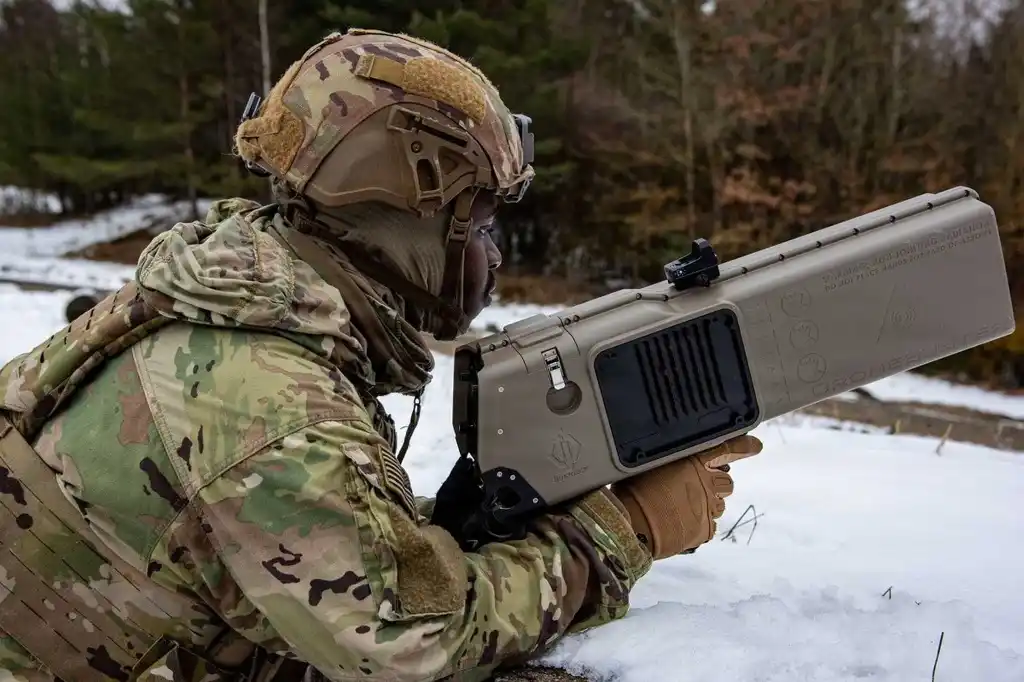
The U.S. Air Force has significantly expanded and formalized its counter-unmanned aerial systems (C-UAS) training footprint in Europe, transforming hard-earned battlefield lessons from Ukraine into structured doctrine at the tactical level. Conducted at the Grafenwoehr Training Area in Germany, the newly institutionalized program reflects a strategic recognition that small drones are no longer peripheral irritants but central actors in modern warfare. The initiative aims to harden American air bases, logistics hubs, and forward operating locations across NATO’s eastern flank against an increasingly accessible and lethal category of aerial threat.
For years, air superiority was largely defined by control of high-altitude airspace against manned aircraft and advanced missile systems. That paradigm has fractured. Commercial quadcopters, improvised reconnaissance drones, and one-way attack systems costing a fraction of a precision missile now pose disproportionate risks to multi-million-dollar aircraft and critical infrastructure. The shift has forced U.S. European Command and U.S. Air Forces in Europe to reexamine base defense not as a static security mission, but as a dynamic, sensor-driven battle occurring at low altitude and short notice.
The expanded training program is delivered under the oversight of U.S. Air Forces in Europe (USAFE), with execution support from the 7th Army Training Command. The three-week Joint Multidomain Counter-UAS Course moves participants through classroom instruction, technical familiarization, and escalating field scenarios, culminating in a 48-hour exercise simulating coordinated drone incursions against defended installations. The course replaces previously ad hoc instruction with a repeatable, theater-level capability development pipeline designed to feed expertise back into operational squadrons.
Technically, the course is built around a layered defense architecture, mirroring real-world deployments observed in Ukraine and the Middle East. Detection begins with radio-frequency (RF) sensors capable of identifying drone control links and telemetry emissions. These systems are paired with electro-optical and infrared sensors to track low-signature aircraft, especially in poor visibility or at night. Instructors emphasize sensor fusion—the integration of multiple data streams—to reduce false alarms and accelerate engagement decisions under compressed timelines.
Electronic warfare tools form the first line of active defense. Trainees operate handheld jamming devices similar to the Dronebuster, designed to disrupt command links or interfere with satellite navigation signals. By severing control or confusing onboard navigation, these “soft-kill” systems can force drones to land, hover, or return to their point of origin. In environments where attribution and escalation management matter, the ability to neutralize a threat without kinetic destruction carries operational and political value.
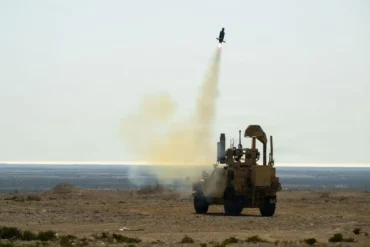
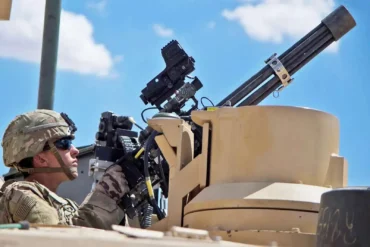
When soft-kill measures fail or time is insufficient, the training transitions to kinetic solutions. Airmen qualify on the SMASH 2000 fire control system, an advanced optic that calculates ballistic solutions in real time and authorizes firing only when probability of hit is optimized. This dramatically increases effectiveness against small, fast-moving aerial targets. More robust threats are addressed through rehearsed engagements using the FIM-92 Stinger missile against simulated unmanned targets, reinforcing the principle that drone defense must scale from hand-held systems to short-range air defense under unified command and control.
The urgency behind this expansion is rooted in operational experience. The war in Ukraine has demonstrated how inexpensive commercial drones can provide real-time targeting data, adjust artillery fire, and conduct precision strikes against fixed military installations. Airbases once considered secure rear areas have become contested zones. In parallel, U.S. facilities in Iraq and Syria have faced repeated drone incidents from non-state actors employing one-way attack systems. These episodes revealed a brutal reality: warning times are often measured in seconds, not minutes.
For the U.S. Air Force, this compression of decision space is particularly dangerous. Unlike maneuver units that disperse across terrain, airpower is concentrated at fixed locations. Fuel farms, munitions depots, maintenance hangars, and parked aircraft present lucrative targets. A single successful drone strike can disrupt sortie generation, degrade readiness, and impose strategic signaling costs far beyond its material damage. The asymmetry is stark: a low-cost drone versus a fifth-generation fighter.
The European expansion of counter-drone training also aligns directly with the Air Force’s Agile Combat Employment (ACE) concept. ACE disperses aircraft across multiple operating locations to complicate adversary targeting by ballistic and cruise missiles. While dispersion reduces vulnerability to high-end threats, it increases reliance on small, self-sufficient defense teams capable of independently detecting and defeating drone incursions. Expeditionary airfields—sometimes austere and lightly manned—cannot depend solely on host-nation integrated air defense systems. Organic C-UAS proficiency becomes essential.
At Grafenwoehr, the culminating field exercise reflects this operational logic. Participants defend simulated airfields under conditions designed to mimic contested European environments. Drone surrogates approach at varying altitudes and speeds, sometimes in coordinated waves. Communications are deliberately stressed. Decision-makers must rapidly classify threats, assign engagement authority, and execute responses without paralyzing hesitation. The exercise underscores that technology alone is insufficient; rehearsed battle drills and disciplined command relationships are decisive.
Institutionalizing the program represents more than a training adjustment—it signals doctrinal evolution. Counter-drone defense is no longer treated as a niche specialty. Instead, it is becoming embedded within base defense squadrons and expeditionary security forces. The train-the-trainer model ensures graduates return to their units as force multipliers, capable of replicating instruction and sustaining readiness across the theater.
The initiative also reflects a broader dual-track transformation within airpower itself. While the Air Force strengthens defenses against hostile unmanned systems, it is simultaneously expanding its own portfolio of autonomous and semi-autonomous platforms. Systems such as the MQ-9 Reaper have long provided persistent intelligence, surveillance, and reconnaissance, but recent conflicts have accelerated interest in smaller, attritable drones capable of operating collaboratively with crewed aircraft. Understanding drone vulnerabilities and countermeasures enhances not only defensive resilience but offensive innovation.
There is a certain irony in modern warfare: the same technological democratization that empowers advanced militaries also empowers their adversaries. Commercial components, open-source software, and additive manufacturing have lowered the barrier to entry for aerial capability. Countering this proliferation demands adaptability rather than complacency. The expanded training in Germany embodies that adaptive mindset.
European allies are watching closely. NATO’s eastern members, acutely aware of drone usage in Ukraine, face similar vulnerabilities at logistics nodes and forward bases. Standardizing tactics, techniques, and procedures through multinational exercises will likely follow, reinforcing alliance cohesion in the drone domain. The training effort at Grafenwoehr could thus evolve into a central node for transatlantic counter-UAS integration.
Modern air warfare no longer unfolds exclusively in the stratosphere at supersonic speeds. It also unfolds at treetop level, where battery-powered quadcopters hum toward their targets with unsettling efficiency. By embedding layered detection, electronic warfare, and kinetic intercept capabilities into routine preparation, the U.S. Air Force is acknowledging that dominance in this new battlespace requires vigilance measured in seconds and proficiency drilled into muscle memory.
The expansion of counter-drone training in Europe is therefore not a temporary response to a single conflict. It is a structural adjustment to the character of war itself—one in which inexpensive unmanned systems can challenge strategic assets, and where preparedness at the smallest scale can preserve power at the highest.