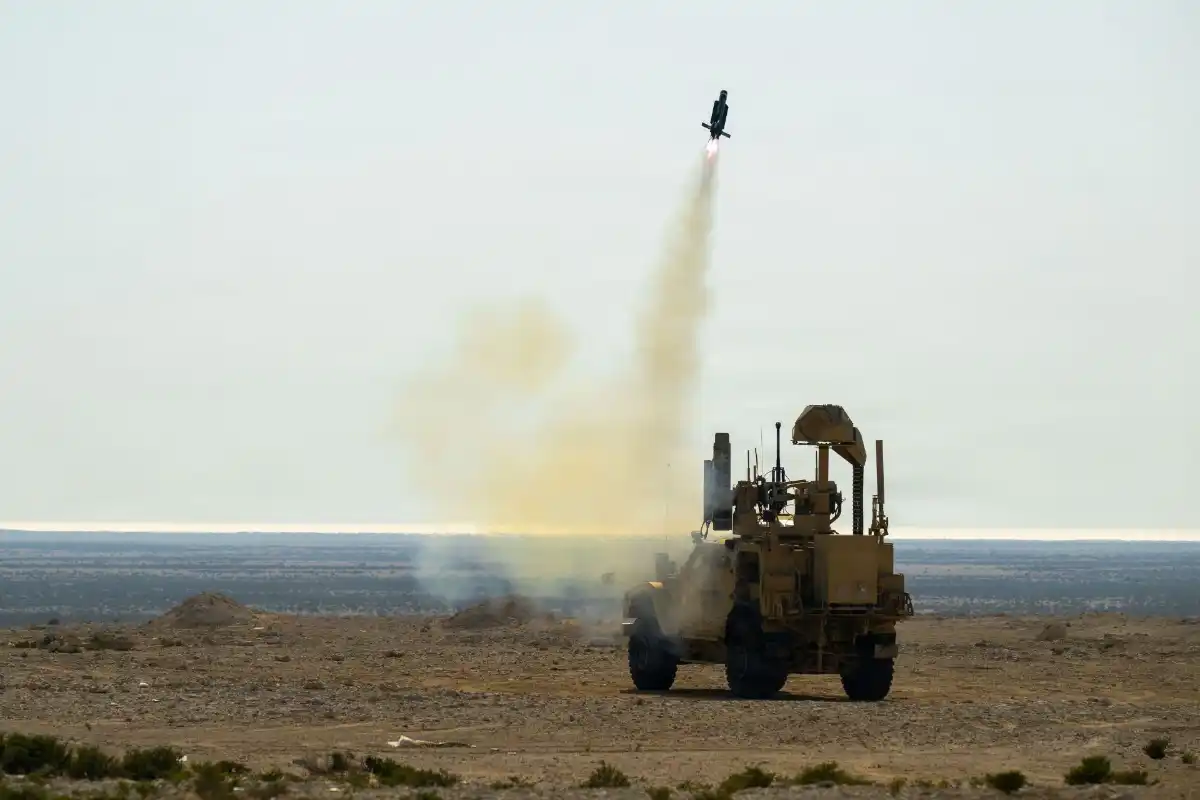
The U.S. Navy has intensified its focus on mobile counter-drone warfare in the Middle East, reflecting a strategic shift driven by the rapid spread of low-cost unmanned aerial threats. Newly released imagery from January 2026 captures a live-fire training event in Bahrain, where U.S. and Bahraini forces rehearsed the detection and engagement of hostile drones using vehicle-mounted air defense systems. The exercise underscores how countering small, agile aerial systems has moved from a niche concern to a frontline operational priority.
The training took place under the authority of U.S. Central Command and involved U.S. Naval Forces Central Command working alongside the Bahrain Defense Force. Conducted at a dedicated training range, the drill showcased a mine-resistant ambush-protected vehicle tracking and engaging a light fixed-wing aerial target. The scenario reflected real-world conditions increasingly faced by coalition forces, where unmanned aircraft appear with little warning and operate at altitudes and speeds that challenge traditional air defense coverage.
Bahrain’s role in this exercise is far from symbolic. As host to the U.S. Fifth Fleet and a critical logistics hub for maritime operations in the Gulf, the island nation sits at the crossroads of regional security dynamics. Its airspace and coastal infrastructure represent high-value targets in any future conflict, making integrated counter-drone preparedness essential rather than optional.
At the heart of the exercise was an Oshkosh M-ATV Mine-Resistant Ambush Protected All-Terrain Vehicle, selected for its survivability and adaptability in harsh environments. Designed originally to withstand roadside bombs and ambushes, the M-ATV has evolved into a versatile platform capable of carrying advanced sensors and weapons without sacrificing mobility. Powered by a robust diesel engine and supported by an independent suspension system, the vehicle can maneuver rapidly across desert terrain while maintaining stability during firing sequences.
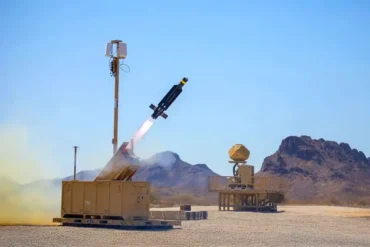
Mounted on the M-ATV was the Mobile Low Slow Small Unmanned Aircraft Integrated Defeat System, commonly known as M-LIDS. Developed to counter drones that fly beneath the radar of conventional air defense systems, M-LIDS brings detection, identification, and engagement into a single, tightly integrated package. This integration shortens reaction times, a critical factor when facing drones that may be launched from short distances or operated autonomously.
The detection layer of M-LIDS relies on a Ku-band radar optimized for identifying objects with minimal radar signatures. Small commercial drones and rudimentary fixed-wing systems often reflect very little energy, making them difficult to spot with legacy sensors. By pairing radar data with electro-optical and infrared imagery, operators can visually confirm targets before engagement, reducing the risk of misidentification in crowded airspace.
For kinetic engagements, the system demonstrated the use of the FIM-92 Stinger missile adapted for counter-drone missions. Traditionally associated with manned aircraft defense, the Stinger’s infrared seeker and short-range agility make it well suited to intercept slow-moving aerial threats. In environments where electronic warfare proves ineffective or where drones operate autonomously, kinetic interceptors remain a decisive option.
The exercise also highlighted the broader tactical value of mobility in counter-drone operations. Unlike fixed installations, a vehicle-mounted system can escort convoys, reposition quickly to cover emerging threats, or reinforce vulnerable points such as ports and airfields. This flexibility complicates adversary planning, forcing hostile operators to contend with an unpredictable defensive footprint rather than static engagement zones.
Interoperability was a central theme throughout the bilateral training. U.S. and Bahraini personnel worked through shared procedures, from initial detection to final engagement, ensuring that data, commands, and responses flowed smoothly between allied forces. In a region where multinational operations are the norm, such procedural alignment is as important as the hardware itself.
Beyond the immediate tactical lessons, the exercise carries wider strategic implications. Unmanned aerial systems have become tools of choice for both state and non-state actors, offering surveillance and strike capabilities at a fraction of the cost of traditional platforms. Their proliferation has altered the threat landscape across the Gulf, where critical maritime routes, energy infrastructure, and naval bases face persistent exposure.
By visibly integrating counter-drone systems into joint training, the United States and Bahrain send a clear signal of collective resolve. The message is not merely defensive but adaptive, demonstrating an ability to evolve military practices in response to emerging technologies. This adaptability is increasingly central to deterrence, as adversaries assess not only capabilities but also the speed at which forces can absorb and counter new threats.
As unmanned systems continue to shape modern conflict, exercises like this one in Bahrain illustrate a broader transformation in air defense thinking. Protection is no longer confined to high-altitude missiles or large radar arrays but extends to agile, ground-based solutions designed to meet threats where they appear. In the complex security environment of the Gulf, such layered and mobile defenses are rapidly becoming the new baseline for operational readiness.