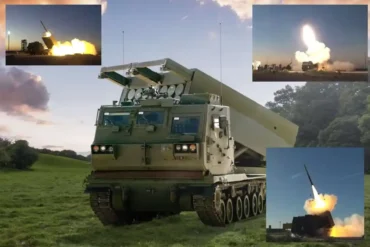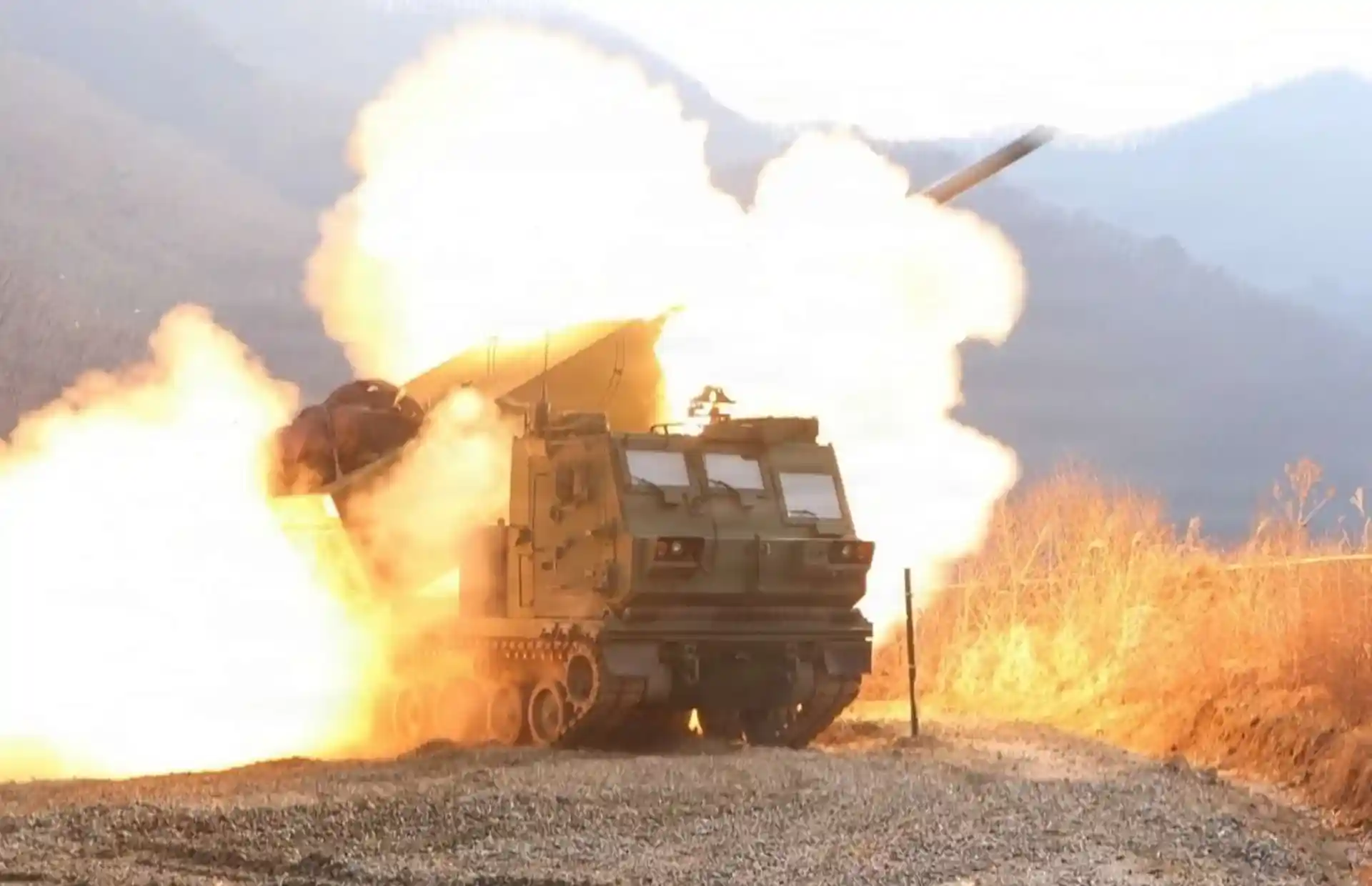
The U.S. Army has formally validated a major leap in rocket artillery reach, qualifying the Extended-Range Guided Multiple Launch Rocket System (ER GMLRS) for operational use at distances exceeding 150 kilometers. Fired from the modernized M270A2 Multiple Launch Rocket System, the successful test confirms that U.S. rocket forces can now strike targets at nearly double the range of legacy GMLRS rockets without altering launcher doctrine, crew workflows, or deployment patterns.
This milestone marks more than a technical upgrade. It represents a deliberate expansion of deep-strike capacity built on existing logistics, training, and battlefield integration. By extending range while preserving system familiarity, the Army is scaling lethality without introducing operational friction—an efficiency prized in high-tempo combat environments where adaptability and survivability must coexist.
The qualification event followed a January 30 flight test at White Sands Missile Range, where ER GMLRS rockets successfully engaged area targets beyond 100 kilometers. The February 9 confirmation finalized certification of the Alternative Warhead (AW) variant, validating both the munition and the launcher as a field-ready combined capability.
Engineering Range Without Reinventing the System
ER GMLRS is a 227 mm class precision rocket guided by GPS-aided inertial navigation (GPS-INS)—a hybrid guidance method that blends satellite positioning with onboard motion tracking. If GPS signals degrade, the inertial system continues calculating trajectory using acceleration and orientation data. The result is resilient precision even in contested electronic environments.
Rather than designing an entirely new missile, engineers evolved the existing GMLRS architecture. The rocket retains the podded launch system used by both HIMARS and MLRS platforms. Crews load, aim, and fire ER GMLRS exactly as they would legacy rounds. This continuity compresses training timelines and simplifies battlefield adoption.
Lockheed Martin’s developmental approach reflects a broader Pentagon acquisition philosophy: increase capability through modular evolution instead of disruptive redesign. By reusing guidance packages, interfaces, and production tooling, the Army accelerates fielding while controlling cost and industrial strain.
In practical terms, the Army has purchased range without purchasing complexity—a rare alignment of engineering ambition and logistical pragmatism.
Alternative Warhead: Precision Meets Area Effects
The Alternative Warhead (AW) transforms ER GMLRS from a point-target weapon into a scalable area-effects system. Each rocket carries a 200-pound-class high-explosive payload containing roughly 182,000 pre-formed tungsten fragments. Upon detonation, these fragments disperse across a wide footprint, neutralizing dispersed personnel and lightly armored assets.
This design replaces legacy cluster munitions, which scattered submunitions that sometimes failed to detonate. Unexploded bomblets created long-term hazards for civilians and friendly forces alike. AW achieves comparable area lethality without leaving behind unexploded ordnance—a shift with operational, humanitarian, and political significance.
Commanders now gain a tool optimized for:
- Dispersed troop formations
- Soft-skinned vehicle concentrations
- Air defense support units
- Logistics hubs and staging areas
The warhead’s fragmentation geometry is engineered for predictable coverage, enabling planners to tailor strike density to mission needs. Modern fire planning increasingly values controllable effects over brute blast yield, and AW fits squarely into that doctrine.
M270A2 Modernization: The Launcher Evolves
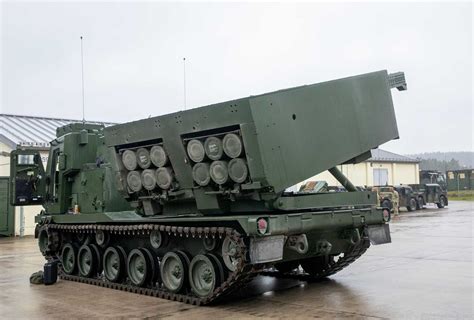
The rocket’s qualification is inseparable from the launcher that fires it. The M270A2 represents a comprehensive recapitalization of the tracked MLRS platform, designed to operate alongside armored formations under modern counter-battery threats.
Key upgrades include the Common Fire Control System (CFCS)—a digital architecture that standardizes fire mission processing across multiple munitions. CFCS acts as the launcher’s computational spine, allowing rapid integration of new rockets and missiles without hardware overhauls.
Additional improvements include enhanced crew armor protection and a new 600-horsepower engine, restoring mobility and reliability to aging chassis. The modernization ensures that tracked launchers can maneuver, shoot, and displace under conditions where survivability hinges on minutes—or seconds.
The Army has already begun fielding the A2 variant to operational units, signaling a transition from programmatic development to battlefield reality.
Doubling the Tactical Geometry of Fires
Traditional GMLRS rockets operate in the 70–80 kilometer range envelope. That reach already revolutionized artillery by pushing precision fires far beyond tube artillery. ER GMLRS extends that envelope to 150 kilometers, fundamentally reshaping how rocket units position themselves.
Range expansion changes battlefield geometry in three critical ways.
First, launchers can operate deeper behind friendly lines while still influencing forward battlespace targets. Second, units can disperse across wider terrain, complicating enemy detection. Third, survivability improves as adversaries must search a vastly larger area for firing signatures.
Counter-battery radars, loitering munitions, and ISR drones now face a stretched hunt problem. The launcher that fires may be dozens of kilometers farther from predicted launch zones than legacy models assumed.
This is not merely additive range—it is exponential survivability.
Qualification: From Demonstration to Deployable Capability
Test launches alone do not make a weapon operational. Qualification events validate reliability, integration, safety, and repeatability under formal acquisition standards.
The January 30 flight closed the loop between experimental performance and field deployment. By firing from an operationally configured M270A2 rather than a test surrogate, the Army proved that ER GMLRS functions within real unit baselines.
This distinction matters in procurement language. Demonstrations show possibility; qualification authorizes procurement, budgeting, and combat planning. Commanders can now incorporate ER GMLRS into operational fire schemes with institutional confidence.
The rocket has crossed the threshold from promising prototype to accountable arsenal.
Industrial Strategy and Development Pathway
ER GMLRS originated in fiscal year 2018 as an engineering change proposal rather than a new missile program. That classification accelerated development by leveraging mature subsystems.
Guidance electronics, manufacturing lines, and software frameworks already existed. Engineers focused on propulsion, aerodynamics, and structural optimization to extend range without destabilizing the design.
This incremental innovation model reflects lessons from modern conflicts where munition consumption rates outpace production expansion. Rather than rely solely on expensive long-range missiles, militaries require scalable, high-volume precision fires.
ER GMLRS occupies the middle tier between standard rockets and theater ballistic missiles—a cost-effective deep-strike bridge.
HIMARS Synergy: Mobility Meets Reach
While the tracked M270A2 validated qualification, the wheeled M142 HIMARS stands to gain equally from the extended-range rocket.
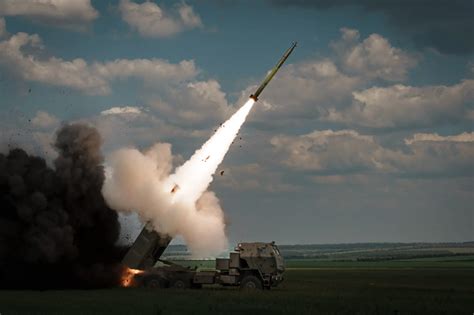
HIMARS carries a single pod of six rockets but compensates with road mobility, air transportability, and rapid deployment flexibility. With ER GMLRS, a lighter launcher can now hold deep targets at risk without moving into high-threat zones.
This synergy amplifies expeditionary operations. HIMARS batteries can deploy across dispersed island chains, austere forward bases, or rapidly shifting frontlines while maintaining strategic reach.
Mobility plus range creates operational ambiguity—an adversary cannot easily predict where fires will originate.
Strategic and Allied Implications
The extended-range rocket arrives at a moment when allied demand for HIMARS systems is accelerating. Nations that structured doctrine around GMLRS immediately benefit from the upgrade without restructuring force design.
Poland and Romania, reinforcing NATO’s eastern flank, gain deeper deterrent reach against high-value targets without forward basing exposure. Extended range enhances layered fires across alliance boundaries.
In the Indo-Pacific, countries such as Australia and Taiwan view HIMARS as a maritime strike adjunct. A 150-kilometer rocket strengthens coastal defense, counter-amphibious fires, and sea-denial networks by pushing engagement zones farther offshore.
Because ER GMLRS uses existing launch infrastructure, allied adoption timelines compress dramatically. The rocket is not a new ecosystem—it is an upgrade pulse through an existing one.
The Expanding Fires Ecosystem
ER GMLRS also fits within the Army’s broader long-range fires modernization portfolio. The same launchers integrating extended-range rockets are slated to field the Precision Strike Missile (PrSM), a weapon reaching far beyond 400 kilometers.
This layered fires approach creates a graduated strike ladder:
- Tube artillery for near fires
- Standard GMLRS for mid-range precision
- ER GMLRS for deep tactical strike
- PrSM for operational-theater targets
Such stratification allows commanders to match munition cost and effect to target value—a critical calculus in sustained conflict.
Operational Meaning Beyond the Numbers
Range figures tell only part of the story. The deeper implication is temporal compression—targets that once required airpower coordination can now be serviced by organic rocket artillery within minutes.
Air defense nodes, command posts, and logistics corridors operating in presumed sanctuary zones must now reconsider exposure. ER GMLRS collapses the buffer between frontline and rear area.
In modern warfare, sanctuary is a shrinking illusion.
A Measured but Transformative Leap
ER GMLRS does not introduce a new class of weapon. It refines an existing one to a sharper edge. Yet incremental advances often produce disproportionate strategic effects.
By doubling rocket artillery reach while retaining system familiarity, the U.S. Army has executed a modernization move that is tactically elegant and industrially efficient. No new launcher. No doctrinal upheaval. Just more distance, delivered with the same precision rhythm crews already know.
Range, in warfare, is influence measured in kilometers. With ER GMLRS, that influence now stretches far deeper into the geometry of battle—quietly, efficiently, and with tungsten certainty.