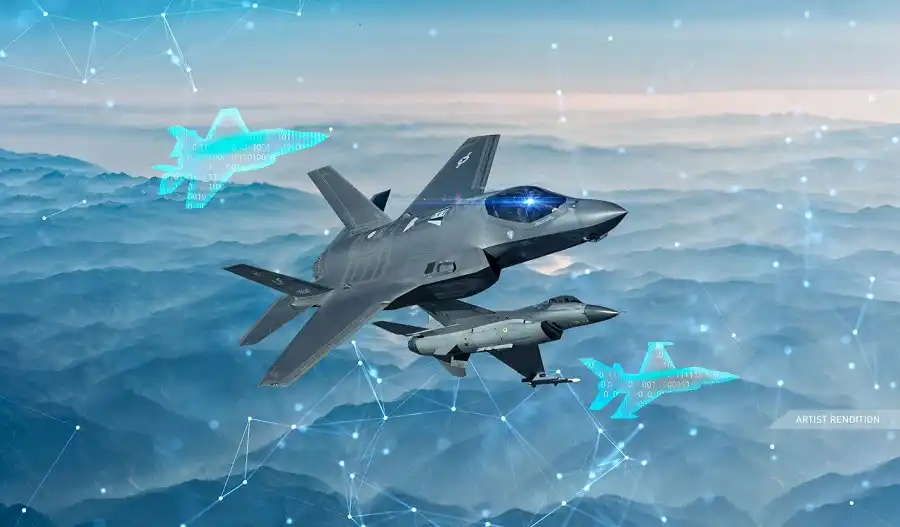
Lockheed Martin’s strategic presence at the Paris Air Show 2025 signaled a definitive evolution in the trajectory of integrated allied air power. Amid an increasingly complex geopolitical environment dominated by near-peer adversaries and contested domains, the American defense giant laid out a robust, deeply interconnected vision for how the United States and its allies must integrate across air, land, sea, space, and cyberspace to retain operational superiority.
The high-level panel discussion, hosted by Lockheed Martin Aeronautics and moderated by Melissa Dueñas, Vice President of Communications, brought forward leading voices from the defense industry. On stage were Greg Ulmer, President of Lockheed Martin Aeronautics; OJ Sanchez, Vice President and General Manager of Skunk Works; and General (Ret.) Mike Scaparrotti, former NATO Supreme Allied Commander Europe. Their message was clear: the future of deterrence and air dominance is not about building the best individual platforms—it’s about how those platforms work as one integrated, adaptive, and scalable force.
Horizontal Integration Across All Domains: The Warfighter’s Reality
Greg Ulmer emphasized that interoperability and cross-domain integration are already shifting from theoretical frameworks into tangible battlefield applications. He cited the Ramstein Flag demonstration, a significant milestone where a Dutch F-35 Lightning II detected a ground threat and relayed targeting data through a Lockheed-developed open architecture gateway, enabling near-instant artillery response via Dutch command systems.
“This is no longer a slide deck vision,” Ulmer stressed. “We are already there. This is where the warfighter is going.” The scenario validated the power of real-time operational integration, showcasing how allied systems can effectively collaborate across different forces and services, fusing data to achieve accelerated decision-making and lethality.
This approach to integration goes beyond connecting sensors and shooters. It redefines mission execution, placing emphasis on networked coordination, AI-enhanced data interpretation, and joint kinetic response—all at speeds no adversary can match.
Skunk Works and the DNA of Next-Gen Air Power Networks
OJ Sanchez brought to the stage the strategic backbone behind Lockheed Martin’s integrative leap—Skunk Works, the storied advanced development program. According to Sanchez, the real transformation is not happening within each platform, but in their ability to act as combat nodes within an adaptive, mission-flexible network.
He broke down Skunk Works’ integration philosophy into five core pillars:
- Open System Architecture (OSA): Ensuring that new and legacy systems can plug into a shared digital backbone.
- Trusted Autonomy: Enabling AI-driven decision tools to operate independently, yet predictably, within human command frameworks.
- Agile Drone Frameworks: Building flexible unmanned systems that can shift roles—from ISR to strike—on demand.
- Model-Based Digital Threads: Connecting design, testing, manufacturing, and operations through unified digital models.
- Additive Manufacturing at Speed: Rapid 3D printing that delivers precision parts, sometimes within 8 hours.

Sanchez’s point was unambiguous: open, resilient, and scalable systems are not optional—they are mission-critical. “Integrated deterrence is not possible without them,” he stated, reiterating the need for interoperability by design, not by retrofit.
Industry Leads, Government Must Follow: Scaparrotti’s Challenge
Adding a powerful perspective, General Mike Scaparrotti highlighted a significant cultural and institutional shift in defense innovation. Unlike decades past, today’s innovation is industry-led, and governments must adapt faster.
“Industry is driving the technological edge,” he said. “If the military wants to retain superiority, it must be far more aggressive in bringing its hardest challenges to the private sector.”
Scaparrotti challenged allied forces to embrace a new level of collaborative culture, where speed, transparency, and shared doctrine are treated as core capabilities. “The challenge is no longer technological,” he warned. “It’s cultural. Are we willing to prioritize speed over bureaucracy, interoperability over nationalism?”
His remarks underscored that while technical capabilities such as AI-enhanced ISR, cross-domain kill chains, and cyber-resilient C2 networks are rapidly maturing, the real bottleneck lies in governance, procurement reform, and trust among allies.
Digital Engineering: The Edge in Sustained Combat Readiness
Lockheed Martin’s panel also explored the strategic value of digital sustainment, particularly under prolonged operational conditions. Digital engineering and additive manufacturing, once considered futuristic, are now critical enablers of tactical endurance.
Sanchez explained how advancements in advanced 3D printing and model-based systems engineering have collapsed production timelines. “What once took 30 days now takes 8 hours,” he noted. Meanwhile, Ulmer added that the company is progressing toward a model where deployed forces can produce mission-critical parts in-theatre using certified digital blueprints.
Such capabilities offer dramatic implications for readiness. Aircraft down for parts in remote bases can be returned to mission-capable status in a single duty cycle. For coalition forces operating across dispersed or austere environments, this offers a strategic edge in tempo and availability.
The sustainment innovation dovetails with Lockheed Martin’s push for logistics-aware mission planning, where AI tools predict parts usage, maintenance needs, and even crew fatigue to ensure uninterrupted mission performance.
From Incremental Upgrades to Radical Operationalisation
The unified message from Lockheed Martin’s leadership is that incrementalism is no longer enough. To maintain a credible deterrent posture, allied air power must undergo a shift—from isolated capability improvements to radical operationalisation of interconnected systems.
This means:
- Creating a shared digital backbone among NATO and partner countries.
- Agreeing on secure, sovereign data-sharing protocols.
- Deploying systems that are designed from inception to be interoperable.
- Prioritizing AI and ML integration not only at the decision-making level but within every link of the mission chain.
Ulmer captured this philosophy succinctly: “One plus one must equal five. That’s the multiplier effect integrated allied air power must deliver.”
Lockheed Martin’s roadmap recognizes that the global balance of air power is shifting—not just in terms of hardware, but in how quickly and effectively allied nations can coordinate operations, share threat intelligence, and act in unison across domains. In that world, software, data, and digital connectivity become the true weapons of advantage.
Paris Air Show 2025: A Catalyst for Strategic Alignment
The significance of Lockheed Martin’s showcase at the Paris Air Show 2025 goes beyond headline demos or panel discussions. It marked a strategic inflection point, where the dialogue about coalition defense matured from platform-centric thinking to enterprise-level integration.
As nations across Europe and the Indo-Pacific confront a resurgence of strategic competition, the vision outlined by Lockheed Martin offers a practical, proven blueprint: one built not on speculation, but on validated operational results, cutting-edge technology, and a willingness to break bureaucratic inertia.
With adversaries investing heavily in anti-access/area-denial (A2/AD) systems, hypersonic threats, and information warfare, the allied advantage must lie in its ability to outpace, outconnect, and outthink—not merely outgun.
If the ideas presented at Paris are translated into doctrine and procurement over the next five years, Lockheed Martin’s concept of allied warfighting integration may well define the future face of deterrence.