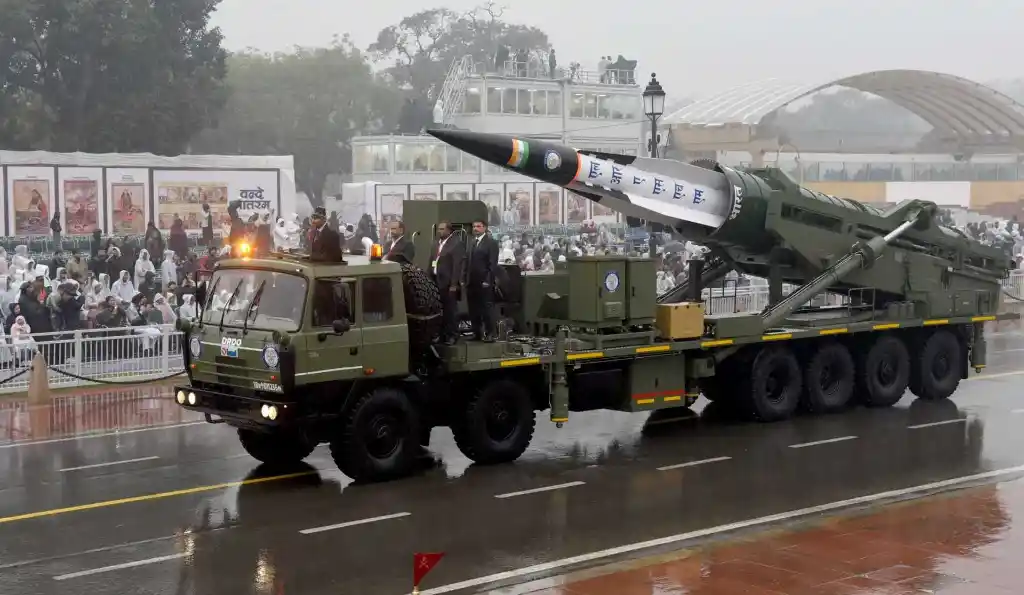
India’s public unveiling of the Long Range Anti-Ship Missile (LR-AShM) during the 77th Republic Day parade marked far more than a ceremonial display. It was a deliberate signal of India’s accelerating entry into the small, technically demanding club of nations capable of fielding hypersonic, maneuvering maritime strike weapons. Shown for the first time as a land-based coastal strike system, the LR-AShM represents a sharp evolution in India’s ability to hold hostile naval forces at risk from deep inland positions, reshaping the balance of maritime power across the Indian Ocean region.
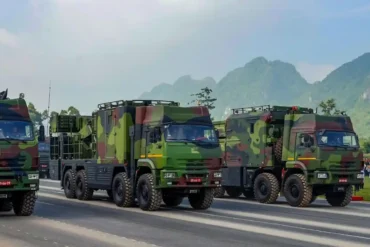
Displayed on Kartavya Path in New Delhi, the missile and its transporter-erector-launcher confirmed that the program has moved beyond experimental secrecy into a phase of visible strategic messaging. With an advertised reach of up to 1,500 kilometers, the LR-AShM extends India’s coastal denial envelope far beyond the capabilities of existing anti-ship cruise missiles, offering a new layer of deterrence against high-value naval assets operating well offshore.
From Parade Ground to Strategic Reality
The Republic Day appearance was not a debut out of thin air. It followed years of quiet development and testing under the leadership of India’s Defence Research and Development Organisation (DRDO). By choosing to showcase the LR-AShM publicly, New Delhi effectively acknowledged that the missile has reached a level of maturity compatible with future operational induction, even if full service entry has not yet been formally declared.
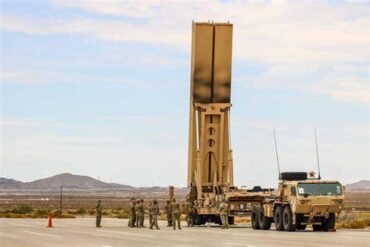
The missile was mounted on a BEML-Tatra T815 8×8 high-mobility vehicle, purpose-built as a transporter-erector-launcher. This configuration underscores the system’s intended role as a mobile, survivable coastal battery, capable of dispersing, relocating, and operating independently of fixed launch sites that might be vulnerable in a conflict.
Filling the Gap Between Cruise and Ballistic Missiles
India’s requirement for the LR-AShM emerged from a clear operational gap. Supersonic cruise missiles such as BrahMos provide formidable regional strike capability but are constrained in range. At the opposite end of the spectrum, longer-range ballistic missiles are optimized for strategic deterrence and are poorly suited for conventional anti-ship missions, particularly against moving targets.
The LR-AShM occupies the space between these categories. It is conventionally armed, explicitly designed for maritime strike rather than nuclear deterrence, and capable of maintaining hypersonic speed while maneuvering within the atmosphere. This combination allows it to threaten naval forces at distances previously unreachable without air or sea-based platforms.
Boost-Glide Architecture and Hypersonic Flight
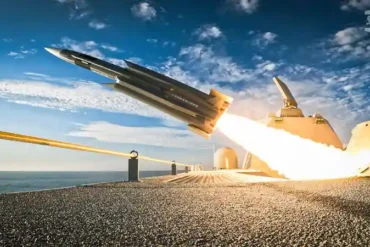
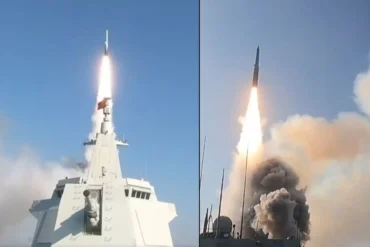
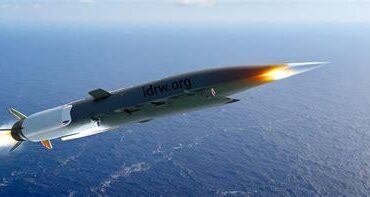
Technically, the LR-AShM is built around a two-stage solid-fuel boost-glide architecture. After launch, the first-stage booster accelerates the missile to hypersonic velocity before separating. A second propulsion stage continues the acceleration phase until burnout, after which the missile transitions into an unpowered hypersonic glide.
Unlike traditional ballistic missiles that follow a predictable parabolic arc, the LR-AShM’s glide vehicle is shaped to generate aerodynamic lift. This allows it to remain within the atmosphere, adjust its trajectory laterally, and execute controlled maneuvers throughout flight. Such behavior complicates interception by missile defense systems that rely on forecasting ballistic paths.
Speed, Maneuverability, and Detection Challenges
Flight parameters disclosed so far indicate an initial velocity approaching Mach 10, followed by sustained hypersonic travel at approximately Mach 5 during the glide phase. The missile reportedly employs a quasi-ballistic, atmospheric trajectory involving multiple high-speed skips, balancing range extension with maneuverability.
This flight profile significantly reduces defender reaction time. Shipborne and coastal radar systems may detect the missile later in its trajectory compared to conventional ballistic threats, while its ability to maneuver undermines interception solutions designed around linear engagement envelopes.
Testing Milestones and Validation
A critical development milestone occurred in November 2024, when the LR-AShM successfully completed a long-range hypersonic test exceeding 1,500 kilometers. That trial validated stage separation, propulsion sequencing, and sustained hypersonic glide, while also confirming the missile’s structural integrity under extreme thermal and aerodynamic stress.
Equally important was the validation of guidance and control during high-speed atmospheric flight, a prerequisite for engaging moving maritime targets. Completion of these trials paved the way for the missile’s public unveiling in January 2026, signaling confidence in the system’s core design.
Guidance and Maritime Targeting
Although specific sensor details remain undisclosed, the LR-AShM is designed with terminal guidance suited for maritime strike, enabling it to adjust its path against moving surface vessels. This capability distinguishes it sharply from traditional ballistic missiles, which are ill-equipped to prosecute dynamic targets at sea.
Integration with India’s expanding network of maritime surveillance assets, including coastal radars, patrol aircraft, satellites, and unmanned systems, is expected to play a decisive role in the missile’s operational effectiveness. The LR-AShM is best understood not as a standalone weapon, but as a node within a broader sensor-to-shooter ecosystem.
Production Status and Industrial Base
At present, LR-AShM production appears aligned with developmental and limited-output phases, supporting testing, evaluation, and early induction planning rather than full-rate serial manufacture. Domestic industry participation under national defense programs contributes to propulsion systems, airframes, and guidance components, reinforcing India’s emphasis on strategic autonomy.
Scaling production will likely depend on formal acceptance by the armed services and decisions regarding deployment density along India’s extensive coastline. The public display suggests these discussions are already well underway.
A New Layer in India’s Coastal Defense Strategy
Operationally, the LR-AShM is intended for shore-based deployment, providing long-range anti-ship coverage across key maritime approaches. It complements shorter-range systems like BrahMos while avoiding the strategic escalation risks associated with long-range ballistic missiles.
This layered approach strengthens India’s anti-access and area denial posture, allowing it to threaten hostile naval forces without relying on forward-deployed aircraft or surface combatants. The result is a more resilient, flexible coastal defense architecture capable of shaping adversary behavior well beyond India’s territorial waters.
Strategic Implications Beyond the Coastline
The LR-AShM’s emergence carries implications that extend beyond India’s immediate shores. Hypersonic, maneuvering anti-ship weapons challenge existing naval doctrines built around layered air and missile defense. Their presence forces adversaries to operate farther from contested coastlines or invest heavily in counter-hypersonic technologies that remain technically and financially demanding.
By fielding a conventional, land-based hypersonic maritime strike missile, India signals both technological maturity and strategic intent. The LR-AShM does not merely add another missile to the inventory; it reshapes the geometry of maritime conflict in the Indian Ocean, where speed, reach, and unpredictability increasingly define credible deterrence.
In that sense, the missile’s appearance on Kartavya Path was not just a parade moment. It was a quiet declaration that India’s coastal strike doctrine has entered the hypersonic age.