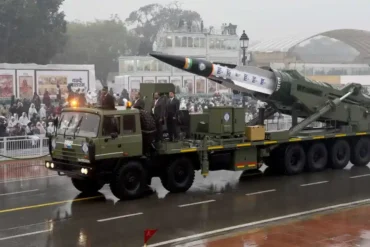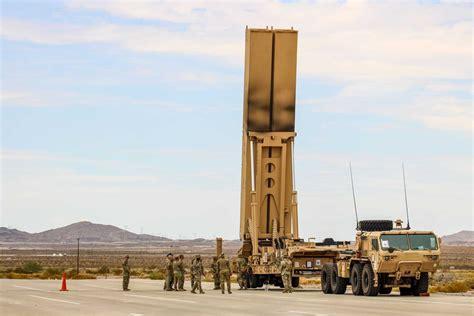
The U.S. Army is on the verge of deploying its first operational Dark Eagle hypersonic missile system, marking a pivotal shift in modern warfare capabilities. Within weeks, the Long-Range Hypersonic Weapon (LRHW) will transition from a developmental program plagued by delays into a frontline asset capable of striking targets at distances exceeding 3,500 kilometers. This deployment signals not just a technological milestone, but a strategic recalibration in response to evolving global threats and intensifying competition in hypersonic weapons development.
At the center of this development is the Army’s effort to deliver rapid, precise, and survivable long-range strike capabilities. Unlike traditional missile systems, Dark Eagle is designed to operate in highly contested environments, where conventional ballistic trajectories are increasingly vulnerable to advanced missile defense systems. Its introduction reflects a broader doctrine shift toward multi-domain operations, where speed, unpredictability, and integration define battlefield dominance.
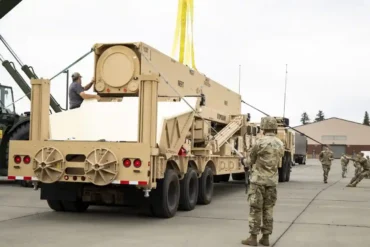
The first operational unit, the 5th Battalion, 3rd Field Artillery Regiment, based at Joint Base Lewis-McChord, has been preparing for this moment since 2021. Training, system integration, and readiness assessments have steadily progressed, even as the program navigated technical hurdles. Now, with launch equipment delivered and missile integration nearing completion, the Army is poised to activate its first hypersonic strike battery.
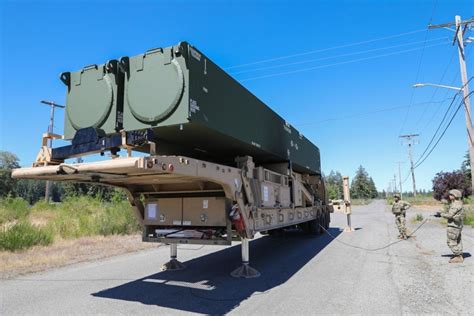
Dark Eagle Hypersonic Weapon: Redefining Speed and Maneuverability
What sets the Dark Eagle system apart is its boost-glide architecture, a sophisticated combination of a two-stage rocket booster and a Common Hypersonic Glide Body (C-HGB). Once launched, the booster propels the glide body to extreme speeds before it separates and continues its flight through the atmosphere at velocities exceeding Mach 5.
This is where the system becomes exceptionally difficult to counter. Unlike ballistic missiles that follow predictable arcs, the glide body actively maneuvers during flight, altering its trajectory and altitude. This unpredictability significantly reduces interception probabilities, even for advanced missile defense systems.
The implications are profound. A weapon capable of traveling thousands of kilometers in under 20 minutes compresses decision-making timelines for adversaries while increasing the survivability of the strike itself. The glide body’s ability to maintain hypersonic speeds while maneuvering introduces a level of operational ambiguity that complicates detection, tracking, and interception.
Operational Structure and Battlefield Flexibility
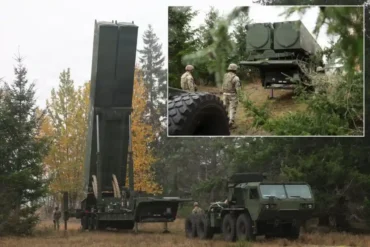
A single Dark Eagle battery is a compact yet formidable formation designed for both mobility and lethality. It consists of:
- Four transporter erector launchers (TELs) mounted on trailers
- Two hypersonic missiles per launcher, totaling eight ready-to-fire rounds
- A dedicated battery operations center
- Supporting command, control, and logistics vehicles
This modular structure allows for dispersed deployment, enabling units to relocate quickly and reduce vulnerability to counterstrikes. Mobility is not just a tactical advantage—it is a necessity in an era where precision-guided munitions can target static positions with alarming accuracy.
The Army’s decision to deploy Dark Eagle within Multi-Domain Task Forces (MDTFs) further underscores its role in future conflict scenarios, particularly in the Indo-Pacific region, where vast distances and contested environments demand long-range, high-speed strike options.
Overcoming Developmental Delays and Technical Challenges
The path to deployment has been anything but smooth. Since 2023, the Dark Eagle program has faced repeated testing setbacks, including failed launches and canceled test events due to pre-flight anomalies. These challenges pushed back initial deployment timelines originally set for fiscal years 2023 and 2025.
However, significant progress was achieved through successful end-to-end flight tests in June and December 2024, where the system demonstrated full integration. During these tests, missiles traveled over 3,200 kilometers, successfully releasing the glide body and validating key aspects of the weapon’s design.
Despite these successes, the Army has made a calculated decision: field the system while testing continues. This approach prioritizes operational capability over complete validation, reflecting the urgency of closing the hypersonic gap with global competitors.
Manufacturing Constraints and Cost Realities
Behind the scenes, the production of hypersonic weapons remains a formidable challenge. Each Dark Eagle missile requires materials capable of withstanding temperatures approaching 1,650°C, generated by sustained hypersonic flight. This extreme requirement introduces complexity in both design and manufacturing.
Currently, production rates are limited—estimated at one missile per month, with ambitions to double output. The manufacturing process involves manual assembly and rigorous quality control, leading to frequent inspection and rework cycles.
Cost is another critical factor. Each missile carries an estimated price tag of $41 million, though early units are likely more expensive due to low production volumes. Scaling production while maintaining quality will be essential for achieving operational sustainability in prolonged conflicts.
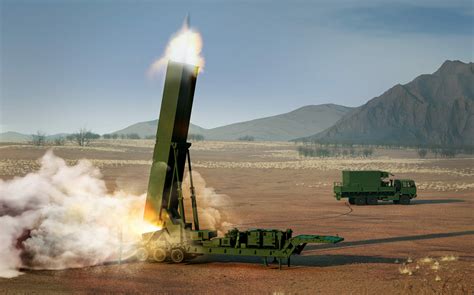
Strategic Impact: Closing the Hypersonic Gap
The deployment of Dark Eagle comes at a time when the United States is playing catch-up in the hypersonic domain. Both China and Russia have already fielded operational hypersonic weapons, with Russia reportedly employing such systems in combat scenarios.
This capability gap has driven over $12 billion in investment into the LRHW program since 2018. The urgency is clear: hypersonic weapons are widely regarded as game-changing tools due to their speed, maneuverability, and reduced detection windows.
By introducing Dark Eagle, the U.S. Army aims to strengthen deterrence against anti-access and area denial (A2/AD) strategies, particularly in regions where adversaries have layered air defense networks. The system’s ability to strike high-value, time-sensitive targets—such as command centers, air defense systems, and missile launch sites—adds a new dimension to U.S. military planning.
Integration with Joint Force and Future Expansion
Dark Eagle is not an isolated program. It is part of a broader joint hypersonic initiative involving the U.S. Navy, which is developing a related system under the Conventional Prompt Strike (CPS) program. Both systems share the same glide body and booster architecture, enabling cross-service interoperability.
Future deployments are expected to expand across multiple MDTFs through fiscal year 2026 and beyond, gradually increasing the Army’s hypersonic footprint. This expansion will depend heavily on overcoming production bottlenecks and refining system performance through continued testing.
The integration of Dark Eagle into existing targeting and sensor networks will also play a decisive role in its effectiveness. Hypersonic weapons are only as powerful as the intelligence that guides them, making real-time data and precision targeting essential components of the overall system.
Limitations and the Road Ahead
Despite its promise, Dark Eagle is not without limitations. The limited inventory, driven by slow production rates, raises questions about its ability to sustain operations in extended conflicts. Additionally, the system’s effectiveness will depend on factors such as:
- The survivability of launch units in contested environments
- The reliability of targeting data
- The integration with broader command and control networks
Moreover, full operational evaluation is not expected until 2027, meaning the system will enter service with incomplete performance data. This calculated risk underscores the urgency driving its deployment—but also highlights the uncertainties that remain.
A New Era of Hypersonic Warfare
The imminent deployment of the Dark Eagle hypersonic missile system represents more than just a technological achievement—it marks the beginning of a new era in military strategy. Speed, precision, and unpredictability are redefining how conflicts are fought and deterred.
As the U.S. Army fields its first operational hypersonic battery, it sends a clear signal: the race for hypersonic dominance is no longer theoretical. It is active, accelerating, and reshaping the global balance of power in real time.