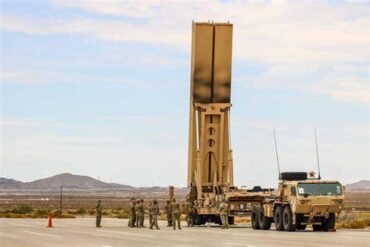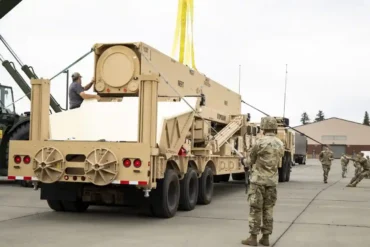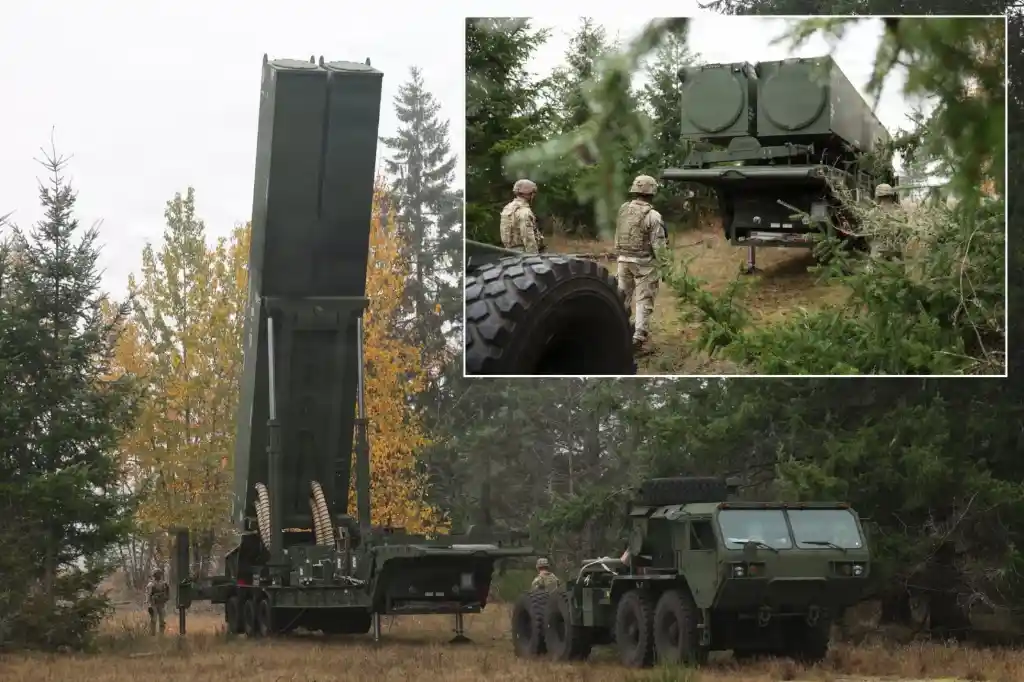
The U.S. Army has briefly unveiled new official photographs of its Dark Eagle Long Range Hypersonic Weapon (LRHW), offering one of the clearest visual updates on the service’s most advanced conventional strike system as it moves toward operational fielding. The images, reportedly released on February 21, 2026, and subsequently removed, provided rare insight into the configuration and readiness of the Army’s first ground-based hypersonic missile capability.
The short-lived publication drew immediate attention within defense circles. Observers noted that the photographs appeared to depict a fully configured operational battery rather than a test configuration, underscoring the program’s transition from development into deployable status. As hypersonic competition intensifies among major powers, even controlled visual disclosures can carry strategic weight.
The Dark Eagle LRHW represents a cornerstone of the Department of Defense’s broader hypersonic modernization initiative. Designed as a non-nuclear, ground-launched missile system, it fills a long-identified capability gap between conventional long-range precision fires and traditional strategic deterrent forces. Its emergence reflects years of experimental groundwork, including programs such as the Hypersonic Technology Vehicle-2 (HTV-2) and the Advanced Hypersonic Weapon (AHW), which validated the feasibility of sustained, maneuverable flight at extreme velocities within the upper atmosphere.
Dark Eagle System Architecture and Launcher Configuration
The LRHW battery is built around a Transporter Erector Launcher (TEL) mounted on a modified M870 trailer, towed by a HEMTT Heavy Expanded Mobility Tactical Truck. Each launcher carries two sealed missile canisters, enabling rapid sequential launches. The road-mobile configuration allows for flexible positioning, dispersal, and survivability in contested operational environments.
A complete battery includes more than just launch vehicles. It integrates a Battery Operations Center (BOC) responsible for command and control, fire coordination, and communications. Supporting vehicles handle reload operations and secure connectivity to joint and combined command networks. This architecture allows the system to function within a broader multi-domain battlespace, linking ground forces to air, maritime, cyber, and space assets.
The recently revealed images appeared to show launchers in operational posture, accompanied by support vehicles consistent with a deployable unit. Such visual confirmation reinforces earlier indications that the Army’s Long Range Fires Battalion under the 1st Multi-Domain Task Force is nearing full operational capability with the system.
Two-Stage Booster and Common Hypersonic Glide Body
At the heart of Dark Eagle lies a combination of a two-stage solid-fuel booster and the Common Hypersonic Glide Body (C-HGB). Upon launch, the booster accelerates the payload to hypersonic velocity before the glide body separates and continues unpowered flight through the upper atmosphere.
Publicly associated performance figures indicate speeds exceeding Mach 5, with some mission profiles potentially approaching Mach 17, depending on trajectory and operational parameters. The system’s estimated range of more than 2,700 kilometers places it firmly within the category of theater-level deep strike capabilities, enabling engagement of high-value targets far beyond traditional artillery envelopes.
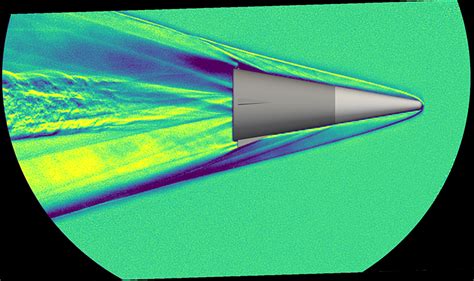
Unlike conventional ballistic missiles that follow predictable parabolic arcs, the glide body maintains the ability to maneuver during flight, altering its trajectory during midcourse and terminal phases. This maneuverability significantly complicates detection, tracking, and interception by missile defense systems designed to counter ballistic threats.
Precision, Guidance, and Survivability in Contested Environments
The glide body’s conical aerodynamic design supports stability and controlled maneuvering within the upper atmosphere. While detailed specifications remain classified, guidance is understood to rely on a robust inertial navigation system (INS), likely supplemented by GPS updates during boost and glide phases. Terminal guidance may incorporate onboard sensors to refine targeting accuracy against fixed or relocatable objectives.
The warhead is conventional, relying on a high-explosive payload combined with the immense kinetic energy generated at hypersonic impact speeds. At velocities measured in kilometers per second, even non-nuclear payloads produce significant destructive effects against hardened or deeply buried targets.
Electronic resilience is central to the system’s design. The missile’s architecture is engineered to operate within contested electromagnetic environments, resisting jamming, spoofing, and cyber interference. In a battlespace characterized by advanced integrated air defense systems and electronic warfare capabilities, this robustness is essential.
Industrial Partners and Program Investment
Development of the LRHW involves a coordinated industrial and government effort. Lockheed Martin serves as prime contractor for system integration. The glide body was developed by Sandia National Laboratories in cooperation with the U.S. Navy, reflecting the joint-service nature of the Common Hypersonic Glide Body initiative. Booster propulsion is provided by Aerojet Rocketdyne, bringing advanced solid rocket expertise into the program.
The estimated cost of the first operational battery, reported at approximately $2.7 billion, reflects the complexity of hypersonic engineering, testing, logistics, and secure integration into joint command structures. Hypersonic systems require advanced materials capable of withstanding extreme thermal stress, precise manufacturing tolerances, and extensive validation testing to ensure reliability.
Operational Integration and Forward Deployment
The Army has progressively integrated Dark Eagle into joint force exercises. In August 2024, during Exercise Bamboo Eagle 24-3 at Nellis Air Force Base, soldiers from Bravo Battery, 5th Battalion, 3rd Field Artillery Regiment, Long Range Fires Battalion, 1st Multi-Domain Task Force presented the LRHW launcher in a joint operational context. The exercise demonstrated integration with broader air and joint operations planning.
In August 2025, the system was deployed to Australia, marking its first known deployment outside the continental United States. This move signaled a clear role for Dark Eagle within Indo-Pacific force posture planning, where extended-range precision strike capabilities contribute to deterrence and operational flexibility across vast maritime distances.
Strategic Implications in the Hypersonic Competition
The timing of the image release and removal occurs amid accelerating global competition in hypersonic weapons. China’s DF-17 and Russia’s Avangard system have already entered service, prompting the United States to prioritize comparable conventional capabilities. Hypersonic weapons compress decision timelines, challenge missile defense architectures, and alter strategic calculations at both regional and global levels.
Dark Eagle is designed to engage high-value targets deep within contested territory, including command and control centers, integrated air defense nodes, mobile missile launchers, airfields, and port infrastructure. Its combination of extreme speed, maneuverability, and mobility enhances penetration of layered Anti-Access/Area Denial (A2/AD) networks.
The road-mobile launcher supports dispersed operations, reducing vulnerability to preemptive strikes. In an era of persistent surveillance, satellite tracking, and long-range counterfire systems, mobility and unpredictability are essential for survivability.
The brief publication of new imagery offers a tangible signal: the Army’s hypersonic capability is no longer theoretical or confined to testing ranges. As the Dark Eagle Long Range Hypersonic Weapon approaches full operational fielding, it reshapes the spectrum of U.S. conventional strike options and reinforces deterrence dynamics in regions defined by major power competition.