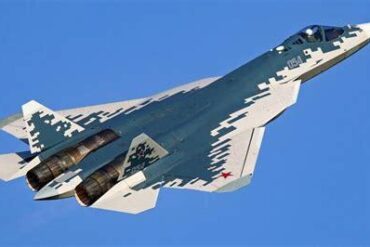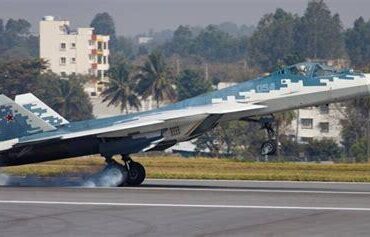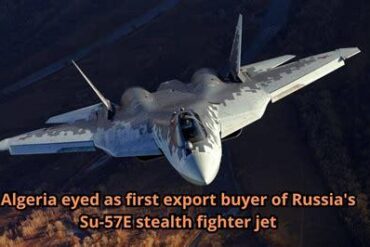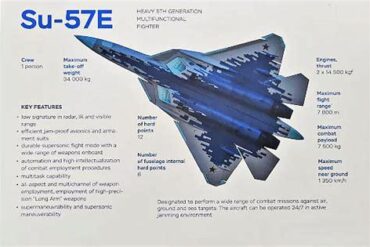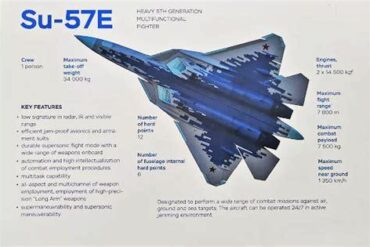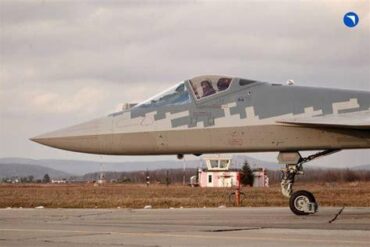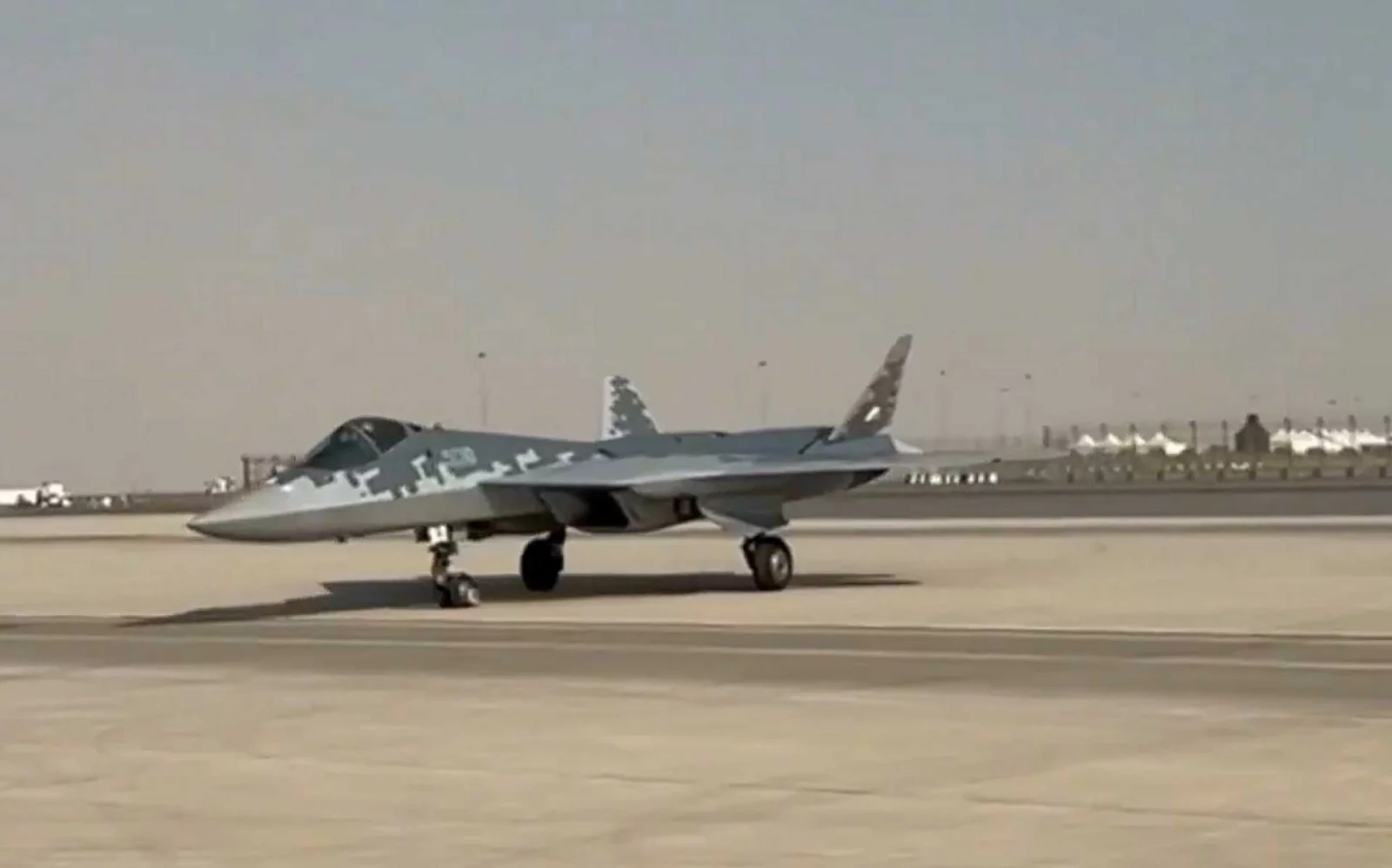
Russia made a bold strategic move at the Dubai Airshow 2025 by unveiling the Su-57E, the export variant of its next-generation stealth fighter, for the first time in the Middle East. This debut marks a significant moment in global military aviation as Moscow sets its sights on breaking the Western monopoly on fifth-generation fighter exports.
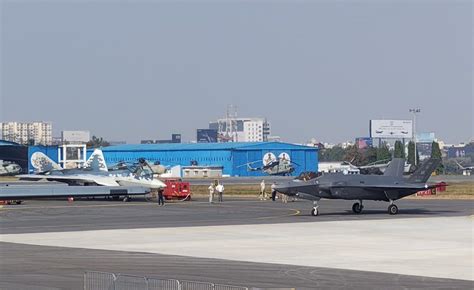
The Su-57E’s arrival at Dubai World Central Airport attracted global attention. It not only served as a public demonstration but also as a direct invitation to Gulf nations and beyond to consider Russia’s offering as a potent alternative to the U.S.-made F-35 Lightning II and China’s Chengdu J-20. With both static display and high-intensity aerial maneuvers, the aircraft sought to impress prospective buyers with its supermaneuverability, versatility, and stealth.
Supermaneuverability Takes Center Stage in Dubai Skies
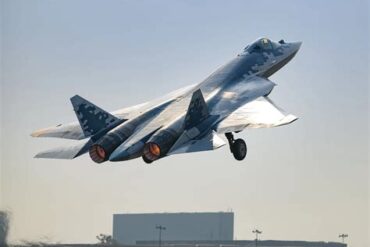
Each day at the airshow, the Su-57E took to the skies in a choreographed display of aerodynamic prowess. Test pilot Sergei Bogdan, renowned for his aggressive control style, executed a series of dramatic maneuvers designed to showcase the fighter’s unique flight envelope. High-angle-of-attack turns, sustained post-stall flight, and low-speed yaw rolls underscored the capabilities endowed by its 3D thrust-vectoring nozzles.
These flight demonstrations were not merely performative. They aimed to reinforce the Su-57E’s role as a true air dominance platform, combining agility and lethality. Unlike conventional stealth jets that often sacrifice maneuverability for stealth, the Su-57E strives to balance both.
Design for Survivability and Multi-role Flexibility
At the heart of the Su-57E’s appeal is its multirole capability. Russian defense representatives from Rosoboronexport and Sukhoi presented the jet as a fifth-generation solution that offers both air superiority and precision strike capabilities. The platform’s blended wing-body design, internal weapons bays, and radar-absorbing coatings contribute to its reduced radar cross-section. A serpentine inlet duct design further minimizes radar exposure from the engine intakes.
Advanced onboard sensors bolster its combat versatility. The fighter is equipped with the N036 Byelka active electronically scanned array (AESA) radar, a sophisticated system that provides enhanced target detection and tracking. Complementing the radar is an infrared search-and-track (IRST) suite, which enables passive detection of adversaries—critical in a world where electronic warfare and radar jamming are growing threats.
Positioning Against Global Rivals: The F-35, J-20, and KF-21
As it steps into the global spotlight, the Su-57E positions itself as a challenger to the world’s leading fifth-generation fighters. Moscow is crafting a pitch that centers on performance, sovereignty, and affordability—three pillars that may resonate strongly with countries unwilling or unable to adopt U.S. or European platforms.
In comparison:
- F-35A Lightning II: Superior in sensor fusion, networked warfare, and digital integration. However, it demands a complex logistics backbone and carries strict export controls, limiting how customers can use and modify the system.
- Chengdu J-20: While rapidly expanding in China’s own inventory, it remains untested in foreign markets. Crucially, it lacks thrust-vectoring control, placing it behind in aerial agility.
- KF-21 Boramae: South Korea’s fighter remains in development and leans toward affordability with moderate stealth, designed more for regional deterrence than global operations.
What sets the Su-57E apart is its full sovereign control for end users—allowing customers to modify avionics, integrate indigenous weapon systems, and operate without embedded U.S. surveillance or backdoors. This independence appeals particularly to nations weary of political strings.
Export Vision and Political Signaling
The decision to debut the Su-57E at Dubai is as much geopolitical as it is technical. The Gulf states, notably the UAE and Saudi Arabia, have historically procured high-end fighters from the United States and Europe, but recent frictions—ranging from export restrictions to human rights concerns—have prompted them to seek alternatives.
Russia’s message is clear: Moscow is ready to deliver fifth-generation capability without political conditions. This approach may attract customers from Southeast Asia, Africa, and Latin America, where governments seek advanced systems without entangling alliances.
Technical Capabilities: Under the Hood
Beneath its radar-evading skin, the Su-57E is a technological showcase. Its AL-41F1 engines—derived from those used in the Su-35—offer robust performance, enabling speeds over Mach 2 and extended range for long-distance strikes or air patrols. In its current configuration, the jet provides enhanced dogfight performance, particularly in close-combat scenarios.
However, Russian officials acknowledge that these engines are interim powerplants. Future production blocks will integrate the Izdeliye 30 engines, a next-generation design offering greater thrust, fuel efficiency, and lower infrared signature. These enhancements are currently undergoing late-stage testing and are central to the Su-57E’s future performance envelope.
Internally, the jet can carry a mix of air-to-air, air-to-ground, and anti-ship munitions. Thanks to its modular weapon bays, it supports an array of Russian and potentially foreign armaments. Furthermore, electronic warfare systems onboard offer self-protection and countermeasure deployment, critical for surviving in modern contested airspaces.
Operational Viability in Harsh Climates
A unique aspect of the Su-57E’s Dubai showcase is its evaluation in desert conditions. Historically, Russian aircraft have faced challenges operating in hot and dusty climates due to differences in airframe cooling, filtration systems, and material degradation.
Western analysts and regional observers are closely monitoring the Su-57E’s operational resilience under Middle Eastern environmental stresses. Any evidence of robust performance here may substantially boost the jet’s credibility in climate-sensitive regions.
Production and Logistics Challenges
Despite its bold presentation, the Su-57E program is not without its constraints. Russia faces questions about:
- Production scalability: Can Sukhoi manufacture at the volume needed to fulfill foreign orders while supplying the Russian Aerospace Forces?
- Supply chain security: Sanctions and geopolitical pressures may disrupt component sourcing, especially for electronic subsystems.
- After-sales support: Long-term maintenance, spare parts availability, and training infrastructure are vital to attract foreign buyers—areas where Russia must still prove parity with Western systems.
The Strategic Stakes: Beyond Sales
The Su-57E’s emergence in Dubai transcends commercial ambition. It is a strategic counterpunch in an increasingly bifurcated global arms market. As Russia is repositioned economically and diplomatically by Western sanctions, the ability to maintain a foothold in high-technology military exports becomes both a symbol of resilience and a practical necessity.
For countries looking to diversify their defense partners and hedge against dependency on the West, the Su-57E offers a path forward. But for Russia, the stakes are higher—it must demonstrate that its aerospace sector remains innovative, reliable, and globally competitive.
Conclusion: A Jet Meant to Signal Power and Possibility
The Su-57E’s debut at Dubai Airshow 2025 is more than a product unveiling; it is a calculated projection of Russian defense capability and geopolitical intent. With aggressive marketing, demonstrated performance, and strategic positioning, Russia seeks to carve a space in the stealth fighter arena that has long been dominated by American and allied platforms.
Whether the Su-57E will see wide export adoption remains to be seen. But its presence in Dubai—loud, fast, and unmistakably bold—signals that Russia is not merely staying in the game. It is attempting to rewrite the rules.