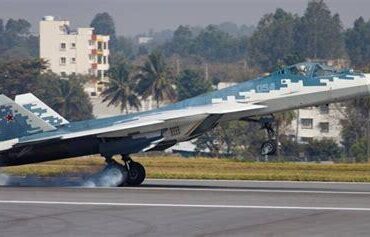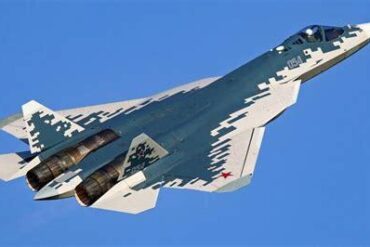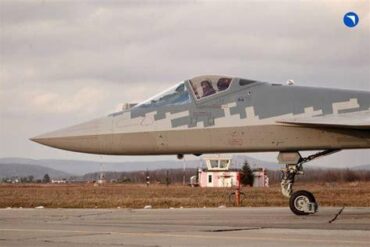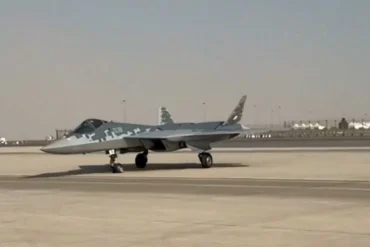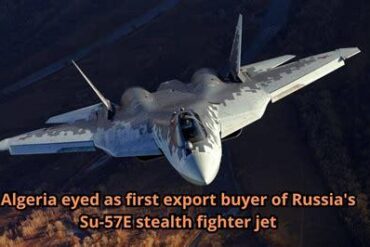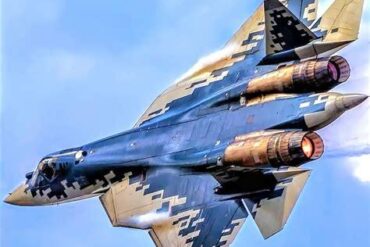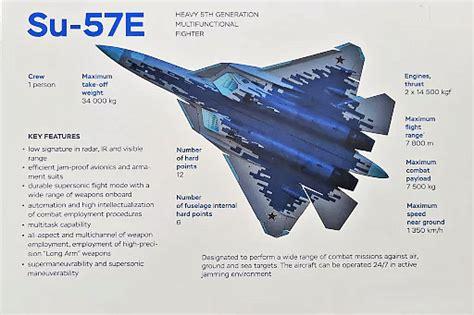
Russia is ramping up pressure on India to consider the Sukhoi Su-57E, an advanced fifth-generation stealth fighter jet that it claims can outperform the French Rafale in nearly every domain. Despite boasting capabilities like stealth, extreme agility, and the formidable R-37M missile with a staggering range of 400 kilometres, the Su-57E’s global journey has faced turbulence, casting a shadow over its potential deal with India.
Russia’s Strategic Bet on the Su-57E
Unveiled as Russia’s answer to the American F-22 Raptor and F-35 Lightning II, the Su-57E is designed to project power and technological prowess in the global fighter jet market. Its export variant, aimed at key strategic buyers in Asia and Africa, is central to Moscow’s efforts to maintain geopolitical influence through arms sales. The aircraft is marketed not only as an air superiority platform but also as a multirole fighter capable of precision strikes and complex missions.
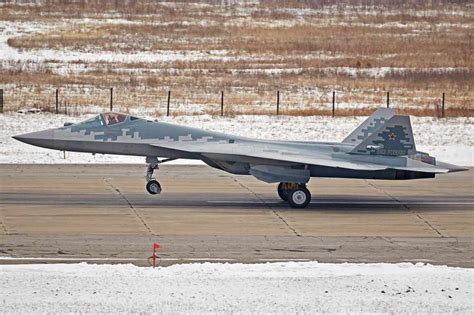
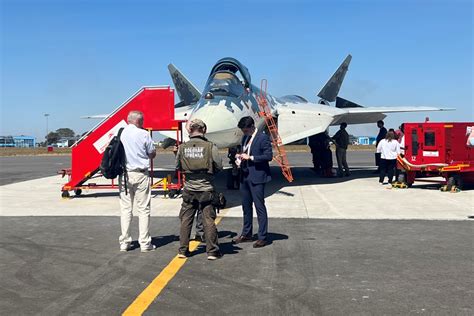
At the LIMA 2025 airshow in Malaysia, where the Su-57E was expected to make a high-profile appearance, reality fell short of expectations. The absence of the actual aircraft—replaced by a scale model—signaled not just logistical issues but deeper questions about readiness, operability, and mass production viability. For an aircraft that claims dominance in the fifth-generation arena, the failure to appear at such a significant venue is a missed opportunity and a red flag for potential buyers.
India’s Cautious Calculus: Between Rafale and the Su-57
India’s relationship with the Su-57 is steeped in history. Once a partner in the Fifth Generation Fighter Aircraft (FGFA) program, India withdrew in 2018 due to concerns over cost, technical transparency, and project delays. Since then, New Delhi has invested in its indigenous Advanced Medium Combat Aircraft (AMCA) initiative while simultaneously augmenting its fleet with 36 Dassault Rafales, delivered under a €7.87 billion deal.
Despite walking away from the FGFA, India remains a prime target for Russia’s export pitch. At the Aero India 2025 expo, Moscow revived its charm offensive. It offered early deliveries, joint production, and a uniquely tailored Su-57MKI variant, aimed at aligning the aircraft with Indian operational doctrines. More significantly, Russia proposed collaboration on India’s AMCA project, positioning itself as a long-term partner in defense co-development.
However, India has not issued any formal response, and its defense establishment continues to deliberate. Insiders suggest that while India remains interested in cutting-edge airpower, it is wary of technology transfer shortfalls, delayed timelines, and lack of combat validation—issues that have historically plagued Russian defense contracts.
How Su-57E Stacks Up: The Technical Edge and Its Pitfalls
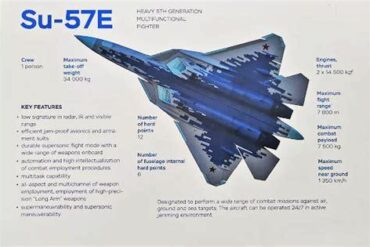
The Su-57E’s appeal lies in its mix of high-end features:
- Stealth Design: A radar-evading airframe with internal weapons bays and radar-absorbent materials
- Supermaneuverability: Thrust-vectoring engines enable tight maneuvers that give it an edge in dogfights
- Avionics: Advanced sensor fusion and radar systems for multirole capabilities
- Long-Range Strike Power: Armed with the R-37M air-to-air missile, capable of taking down targets at distances up to 400 km, well beyond the reach of Western systems
Yet, even with this arsenal, the aircraft faces significant limitations:
- Limited Deployment in Russia: Even the Russian Air Force has not fully adopted the Su-57 in large numbers, raising questions about its maturity
- Production Delays: Only a handful of units have been produced, and full-scale assembly remains behind schedule
- Combat Record: Unlike Rafale, which has seen action in Libya, Mali, and Syria, the Su-57 lacks real-world battlefield credentials
Global Market Hesitation and Geopolitical Implications
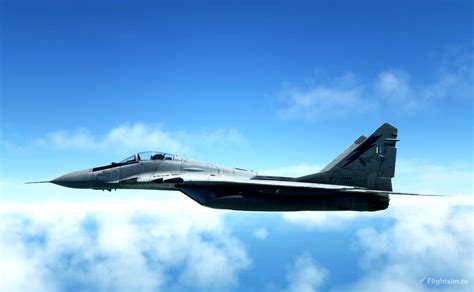
Apart from India, Algeria and Malaysia have been named as potential buyers. Algeria reportedly signed a contract for 14 Su-57s in 2021, but no official confirmations or deliveries have surfaced. In Malaysia, the Su-57E is competing in the long-standing program to replace aging MiG-29s, but the jet’s no-show at LIMA 2025 is likely to diminish its chances.
In contrast, American and European manufacturers have maintained high visibility, transparency, and delivery track records—factors that tip the balance in multi-billion-dollar procurement decisions. Experts note that while the Su-57E offers technical promise, buyers demand assurance on after-sales service, spare parts, long-term upgrades, and most critically, delivery certainty.
Russia’s international reputation, already strained by its conflict in Ukraine, further complicates military transactions. Sanctions, export controls, and geopolitical pressure from the West make it riskier for countries like India—strategically aligned with both the U.S. and Russia—to go all-in on such deals.
India’s Strategic Airpower Roadmap: Indigenous vs Imported
India’s defense planners are keen on reducing dependence on foreign platforms. The Tejas Mk1A, MRFA (Multi-Role Fighter Aircraft) contest, and the indigenous AMCA project collectively represent New Delhi’s pivot towards self-reliance in defense manufacturing.
Still, imported systems serve as interim force multipliers. The Su-57E, with local production and possible collaboration on AMCA, could be seen as a bridge—if Moscow can prove the aircraft’s readiness and future viability.
Yet, time is not on Russia’s side. With India’s defense focus also shifting toward quantum warfare, drone swarms, and hypersonics, any acquisition must not only fulfill present needs but remain future-proof for decades.
The Rafale Benchmark: Why the French Fighter Still Holds the Lead
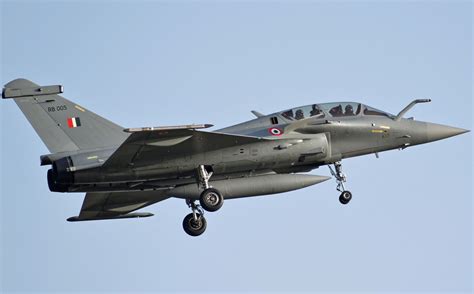
The Rafale has already proven itself in the Indian context. Its customized avionics, India-specific enhancements, and timely delivery give it a major edge. French support for strategic autonomy, visible in nuclear cooperation and joint naval exercises, adds political weight to the deal.
In contrast, the Su-57E is burdened by operational uncertainty. For India to switch allegiance would require extraordinary guarantees from Moscow—technological transparency, cost-sharing flexibility, and assurances on spares and service—none of which have yet been cemented.
Conclusion: A Fighter of Shadows, or the Next Leap for India?
The Sukhoi Su-57E, with its headline-grabbing specs and long-range kill potential, may indeed be more dangerous on paper than the Rafale. Its design philosophy aligns well with India’s ambition for a stealth-dominant air fleet. But without concrete delivery proof, combat exposure, and visible international backing, it remains a promise yet to materialize.
India, balancing on a tightrope between strategic autonomy and global defense diplomacy, cannot afford to make a hasty commitment. The Su-57E’s fate in India will hinge not just on performance claims, but on Russia’s ability to back them up with substance, not scale models.
Until then, the Su-57E will remain an enticing but elusive contender in India’s next big fighter jet deal—a machine built for dominance, still searching for its first loyal customer.