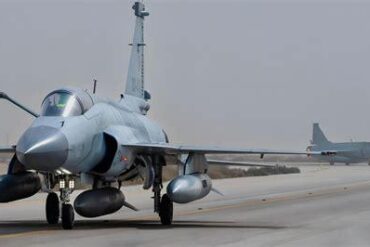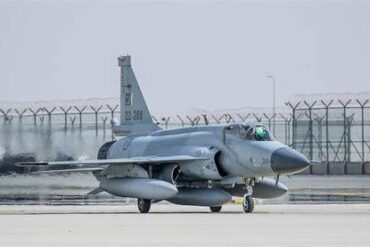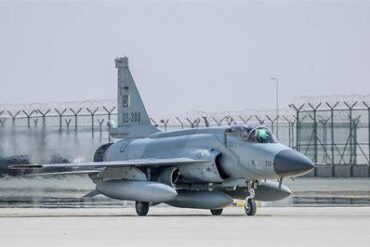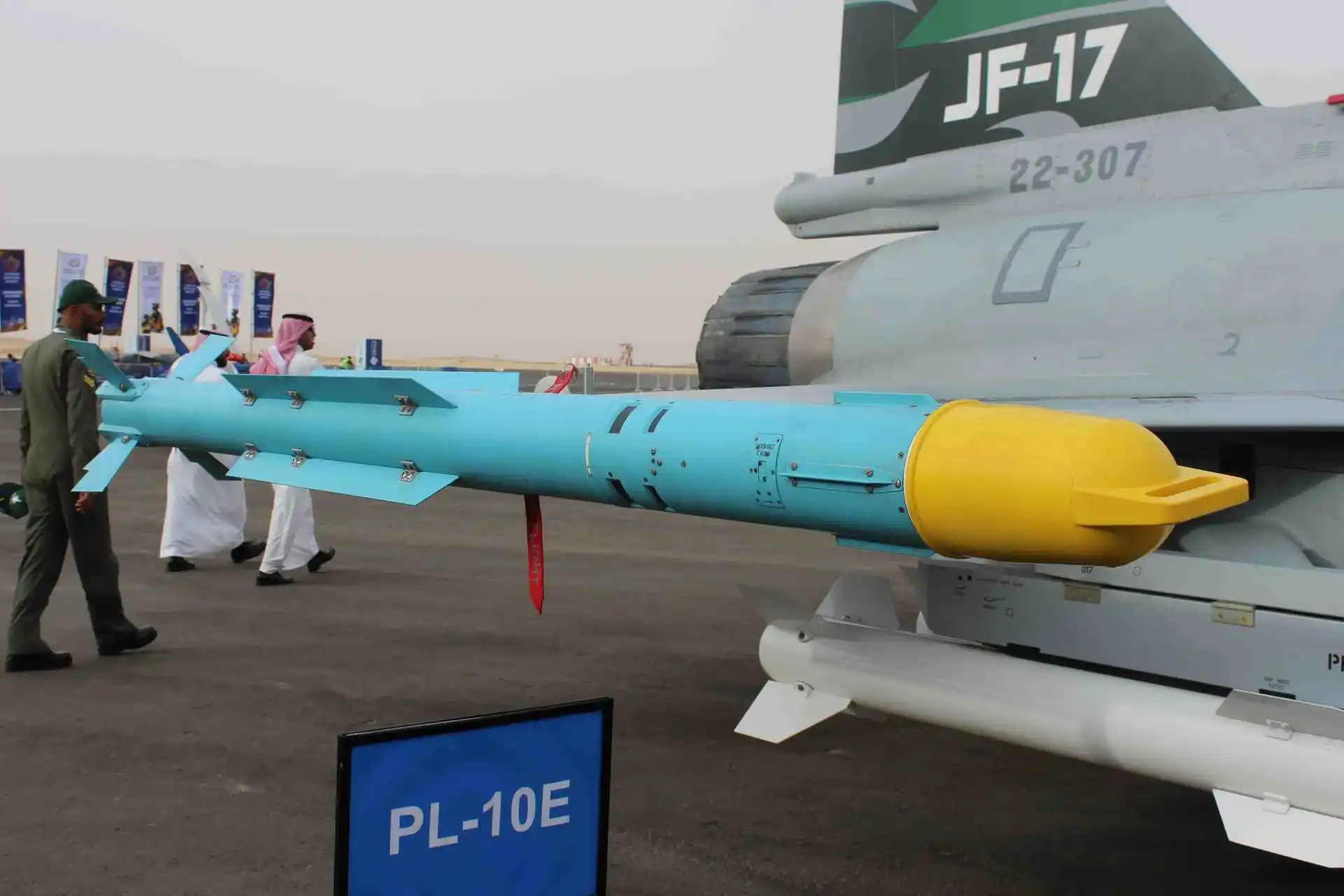
Pakistan used the stage of World Defense Show 2026 in Saudi Arabia to present a sharpened air combat message: the JF-17 Block III multirole fighter paired with the PL-10E short-range air-to-air missile. The display was not merely about hardware on a static ramp. It signaled a maturing integration between Pakistan’s most advanced domestically operated fighter configuration and one of China’s latest-generation within-visual-range missiles, designed for high-agility dogfighting and helmet-cued engagements.
The pairing showcased at the exhibition linked aircraft and missile as a coherent combat system. Rather than emphasizing long-range interception, the configuration highlighted close-range dominance, rapid lock acquisition, and high off-boresight engagement capability. In contemporary air warfare, where sensor fusion and instantaneous pilot cueing define split-second outcomes, that focus carries operational significance.
The PL-10E presented alongside the JF-17 Block III is the export derivative of China’s in-service PL-10 (霹雳-10), known to NATO as CH-AA-9. Developed by the Luoyang Electro-Optics Technology Development Centre, the missile represents a decade-long evolution in Chinese short-range air-to-air missile technology, with development beginning in 2004, design approval in 2010, and production initiated in 2013 before operational service entry in 2015.
PL-10E: Export Variant of a Fifth-Generation Dogfight Missile
The PL-10 was conceived as a next-generation infrared-guided air-to-air missile for modern Chinese fighters, including the J-10C, J-16, and J-20 stealth fighter, with future links to platforms such as the J-35. The export version, PL-10E, retains core design features optimized for high maneuverability and counter-countermeasure performance while being marketed to international customers.
Measuring approximately 3.0 meters in length with a diameter around 160 millimeters, the missile fits squarely within the dimensional envelope of contemporary short-range systems. Launch weight figures vary between 89 kg and roughly 105–110 kg depending on configuration references. Its reported engagement range of 20 to 30 kilometers, contingent on launch altitude and speed, positions it within the standard operational band of modern within-visual-range weapons. It does not seek to rival medium-range systems such as the AIM-120 or PL-15; instead, it concentrates on terminal maneuver dominance.
Speed is commonly cited around Mach 4, with some data indicating peak velocities approaching Mach 4.9. The propulsion system uses a solid-propellant rocket motor combined with thrust-vectoring control vanes and free-moving tail control surfaces. This configuration enables extreme turn performance, reportedly exceeding 60 G, allowing the missile to pursue highly maneuvering targets in close combat.
Imaging Infrared Guidance and High Off-Boresight Capability
The defining feature of the PL-10E is its multi-element imaging infrared (IIR) seeker. Unlike early-generation infrared missiles that locked onto raw heat signatures, imaging infrared systems construct a thermal image of the target. This allows discrimination based on shape and thermal contrast patterns, reducing vulnerability to decoy flares and improving resistance to infrared countermeasures.
The missile supports all-aspect targeting, enabling engagement from virtually any relative angle, including head-on shots. With ±90-degree off-boresight capability, pilots equipped with a helmet-mounted display can designate targets simply by looking at them. The missile seeker can be slaved to the pilot’s line of sight, enabling rapid target acquisition without aligning the aircraft’s nose directly at the adversary.
Both lock-on before launch (LOBL) and lock-on after launch (LOAL) modes are supported. In LOAL mode, inertial guidance and datalink updates steer the missile toward a predicted intercept point until the seeker acquires the target. This flexibility is especially valuable in dynamic close-range engagements where visual tracking and aircraft maneuvering occur simultaneously.
Warhead, Fuzing, and Counter-Countermeasure Design
The PL-10E carries a blast-fragmentation or expanding rod warhead, with reported mass around 33 kg. Detonation is controlled via a combined laser proximity fuze and impact fuze, increasing reliability across diverse engagement geometries. The expanding rod design is intended to maximize structural damage by projecting a continuous ring of metal fragments outward upon detonation.
Counter-countermeasure performance is central to the missile’s design philosophy. Imaging infrared seekers inherently improve flare rejection, but software algorithms further enhance discrimination capability. In an era where aircraft deploy advanced decoys and directional infrared countermeasures, seeker intelligence becomes as critical as propulsion performance.
An alternative variant observed in 2022 reportedly replaces the imaging infrared seeker with a miniaturized active radar seeker, suggesting modular evolution within the PL-10 family. Such a configuration would conceptually blur the line between short-range infrared and compact radar-guided missiles, though the core PL-10E displayed with Pakistan’s JF-17 remains infrared-guided.
Design Evolution and Comparative Context
Early imagery of the missile, initially identified as PL-ASR, surfaced online in 2008. Over time, visible design adjustments included tail-fin reshaping and stabilization refinements before adoption of the current stepped trailing-edge configuration with enlarged tail fins and mid-body strakes. Some observers have suggested conceptual parallels with the South African A-Darter or Japanese AAM-5, though the PL-10 evolved into its own distinct configuration optimized for Chinese fighter integration.
Operational deployment on the J-20 stealth fighter highlights the missile’s compatibility with fifth-generation internal carriage. On the J-20, PL-10 missiles are stored in lateral internal bays behind engine intakes. The launcher mechanism rolls outward, minimizing bay door exposure time and preserving radar signature management. This approach mirrors internal short-range missile deployment concepts seen on aircraft such as the F-22 and F-35, where short-range and beyond-visual-range weapons are compartmentalized for tactical flexibility.
The PL-10 therefore occupies a tactical niche comparable to the AIM-9X Block II or IRIS-T, prioritizing agility and terminal engagement geometry rather than long-range reach. In Chinese doctrine, longer-range interception roles are filled by missiles such as the PL-15, leaving the PL-10 to dominate the dogfight envelope.
JF-17 Block III: Sensor Fusion and Modernized Combat Architecture
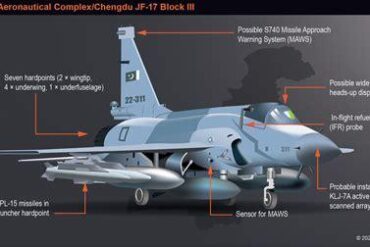
Pakistan’s JF-17 Block III represents the most advanced iteration of the Thunder series. Equipped with an active electronically scanned array (AESA) radar, upgraded avionics, and an integrated helmet-mounted display and sighting system, the aircraft marks a generational step beyond earlier blocks.
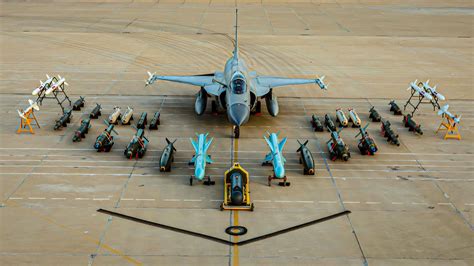
Previous JF-17 variants typically carried the PL-12/SD-10 medium-range missile and short-range systems such as the R-73. Block III expands the air-to-air arsenal with compatibility for both the PL-15 beyond-visual-range missile and the PL-10E for close combat. This layered approach enhances engagement flexibility across multiple threat envelopes.
The aircraft’s revised airframe and systems integration aim to improve survivability and combat effectiveness. While not a stealth aircraft in the same class as fifth-generation platforms, the Block III incorporates refinements intended to reduce radar cross-section relative to earlier versions. Combined with AESA radar capabilities and modern cockpit systems, the platform provides pilots with enhanced situational awareness and engagement options.
Strategic Significance of the World Defense Show Display
The decision to display the JF-17 Block III armed with PL-10E at World Defense Show 2026 carries strategic messaging weight. Saudi Arabia’s exhibition serves as a major defense industry platform, drawing regional and international delegations. By presenting the aircraft and missile as an integrated package, Pakistan underscored export viability and operational readiness.
The framing emphasized compatibility between a modern fighter platform and a fifth-generation within-visual-range missile. For potential customers evaluating fighter acquisitions or fleet upgrades, the integration signals access to advanced short-range engagement capabilities without reliance on Western missile ecosystems.
For Pakistan’s own air force modernization trajectory, the configuration reflects a shift toward sensor-driven combat, where helmet cueing, data links, and high off-boresight missiles compress reaction time in dynamic air combat scenarios. In close engagements, milliseconds determine outcomes; high-agility missiles coupled with helmet-mounted targeting shorten the decision loop.
Operational Role Within a Layered Air Combat Doctrine
The PL-10E’s operational envelope complements longer-range systems. In a layered doctrine, beyond-visual-range missiles such as the PL-15 engage threats at extended distances, while short-range missiles provide decisive capability once aircraft merge into visual contact.
Within this framework, the PL-10E’s thrust-vectoring agility and imaging infrared discrimination equip pilots for high-angle shots during evasive maneuvering. The ability to engage targets at extreme off-axis angles reduces dependence on classic tail-chase geometry, altering traditional dogfight dynamics.
The JF-17 Block III’s integration of advanced radar, data fusion, and helmet cueing ensures the missile’s capabilities are fully exploited. The pairing therefore represents not merely a hardware match but a system-level alignment between aircraft sensors, pilot interface, and missile performance envelope.
Conclusion: A Defined Statement in Modern Air Combat
Pakistan’s presentation of the JF-17 Block III armed with the PL-10E at World Defense Show 2026 illustrated a focused air combat proposition. The missile’s imaging infrared seeker, thrust-vectoring propulsion, high off-boresight capability, and counter-countermeasure resilience define it as a dedicated close-combat weapon. Integrated with the Block III’s AESA radar and helmet-mounted sighting system, it forms a cohesive within-visual-range engagement package.
In an era where air superiority increasingly hinges on sensor fusion and rapid engagement cycles, the combination underscores a modernization pathway centered on agility and precision rather than sheer range. By showcasing the aircraft and missile together, Pakistan projected both operational capability and export potential, situating the JF-17 Block III and PL-10E as a contemporary solution within the evolving landscape of air combat technology.