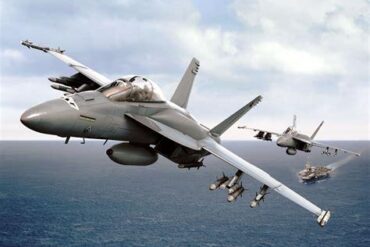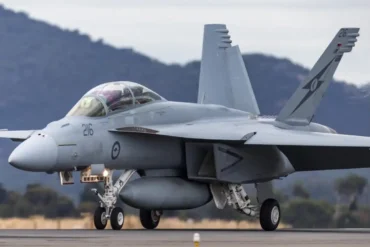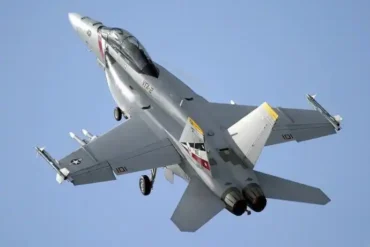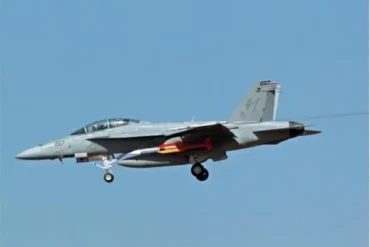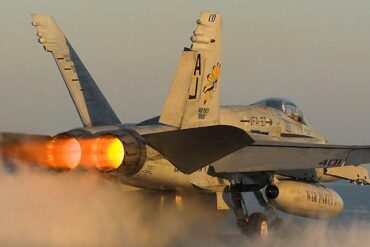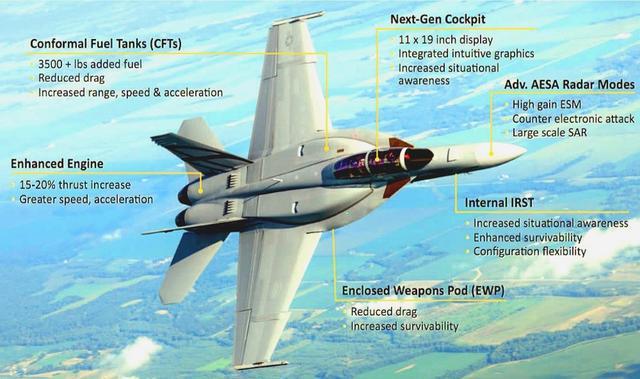
The F/A-18 Block III Super Hornet is the latest evolution of the proven Super Hornet platform, developed by Boeing for the United States Navy. Designed to bridge the gap caused by F-35C production delays, it enhances network-centric warfare capabilities, range, sensor performance, and overall service life. By integrating seamlessly with fifth-generation fighters, the Block III Super Hornet ensures dominance in modern aerial combat.
Core Technological Advancements
Advanced Avionics and Digital Cockpit
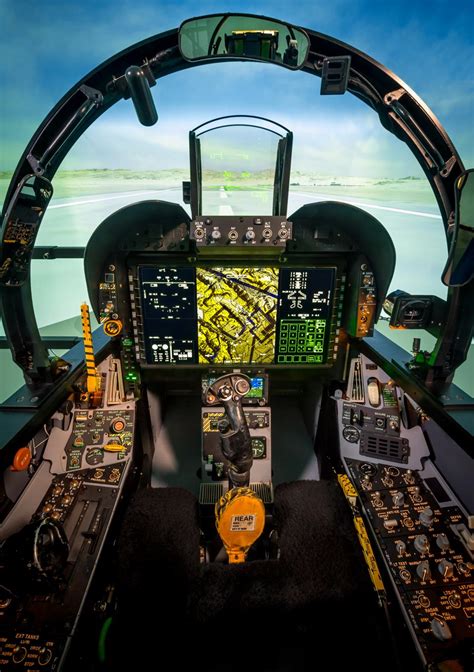
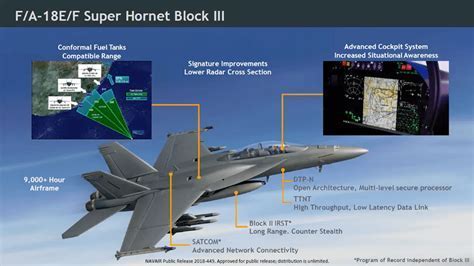
A significant upgrade in the Block III Super Hornet is its 10×19-inch widescreen touchscreen display, offering a highly customizable interface that mirrors the glass cockpit design of the F-35. This reduces pilot workload and enhances situational awareness.
To optimize real-time data sharing, the aircraft is equipped with the Distributed Targeting Processor Network (DTP-N) and Tactical Targeting Network Technology (TTNT) data link. This allows the F/A-18 Block III to integrate with F-35C fighters, E-2D Hawkeye early warning aircraft, and EA-18G Growler electronic warfare jets, forming a highly networked combat environment.
Additionally, it incorporates the ALQ-214 Block II integrated defensive electronic countermeasures and the Block IV electronic warfare suite, enhancing electromagnetic warfare capabilities.
Enhanced Sensors and Targeting Capabilities
The F/A-18 Block III features an upgraded AN/ASG-34 Infrared Search and Track (IRST) pod, enabling passive detection of stealth aircraft like the F-22 Raptor by tracking their infrared signatures. Although this improves counter-stealth capabilities, its detection range and reaction speed remain inferior to the active sensors of fifth-generation fighters.
Moreover, the fighter is equipped with a new-generation Active Electronically Scanned Array (AESA) radar, significantly improving multi-target tracking and electronic warfare functionalities.
Improved Powerplant and Extended Range
To enhance performance, the F/A-18 Block III integrates the F414 Enhanced Performance Engine (EPE) or Enhanced Durability Engine (EDE). The EPE version boosts thrust by 20%, reaching 118 kN, while the EDE variant triples engine lifespan and improves fuel efficiency by 5%.
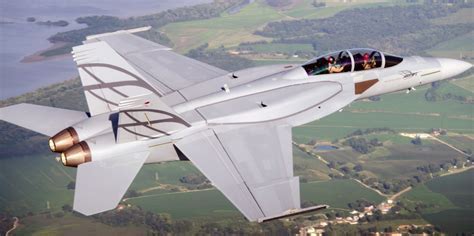
Furthermore, the inclusion of Conformal Fuel Tanks (CFTs) increases combat radius by approximately 222 kilometers, extending its maximum operational range to 944 kilometers. These aerodynamically integrated tanks reduce drag compared to traditional drop tanks, though some Navy variants may not include this feature.
Stealth Enhancements and Structural Improvements
While not a stealth aircraft, the Block III Super Hornet features Low Observable (LO) coatings and Radar Absorbent Materials (RAM) to reduce its Radar Cross Section (RCS). Although these measures improve survivability, they are insufficient to compete with fifth-generation stealth fighters.
Additionally, structural modifications extend airframe longevity from 6,000 to 10,000 flight hours, reducing lifecycle costs by 30% and ensuring the aircraft remains a cost-effective solution for the U.S. Navy.
Strategic Role and Combat Effectiveness
Filling the F-35C Gap
Due to budget overruns and production delays of the F-35C, the F/A-18 Block III is being integrated into carrier air wings alongside fifth-generation fighters in a 1:3 ratio. It will remain operational until 2040, fulfilling roles in medium-range air combat, ground strikes, and electronic warfare.
Counter-Stealth Capabilities and Limitations
Despite its IRST system, the Block III Super Hornet struggles against stealth fighters like the F-22 Raptor and J-20. The U.S. Navy’s simulations suggest that fifth-generation aircraft can engage the Super Hornet beyond visual range before being detected, underscoring its vulnerability against advanced adversaries.
Expanding International Market
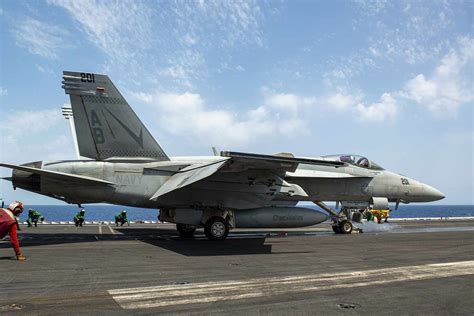
Boeing is actively marketing the F/A-18 Block III to international buyers, including India and Kuwait. Indian tests confirmed the aircraft’s capability to operate from ski-jump aircraft carriers, making it suitable for the INS Vikrant and INS Vikramaditya. However, its reliance on TTNT data links without integration with F-35C’s ecosystem limits its potential in networked warfare scenarios.
Limitations and Challenges
Combat Range and Missile Threats
Reports suggest that the F/A-18 Block III’s range helps it avoid China’s hypersonic anti-ship missile zones, yet its 944 km combat radius remains inferior to missile threats spanning 1,000 to 1,500 km. This raises concerns about its strategic deterrence capabilities in high-threat environments.
Lack of Stealth Capabilities
Unlike fifth-generation fighters, the Super Hornet’s lack of full stealth significantly reduces its survivability against advanced enemy air defenses. It must rely on escort aircraft and electronic warfare support to remain competitive in contested airspace.
Cost and Configuration Variability
While the Block III Super Hornet is more affordable than the F-35C, with a unit cost of approximately $50 million (compared to the F-35C’s $150 million), certain enhancements, such as CFTs, may not be universally deployed across all aircraft, leading to inconsistent capabilities among different units.
Conclusion
The F/A-18 Block III Super Hornet represents a major upgrade over previous iterations, featuring advanced avionics, enhanced sensors, increased range, and improved survivability. However, its non-stealth design limits its effectiveness in high-end air combat against fifth-generation adversaries. As a critical component of the U.S. Navy’s carrier-based air power, it will serve as a complementary asset to the F-35C, ensuring operational flexibility and force projection into the 2040s. Furthermore, its potential for foreign sales strengthens U.S. alliances, maintaining strategic influence across key regions.
Frequently Asked Questions (FAQ)
1. How does the F/A-18 Block III compare to the F-35C?
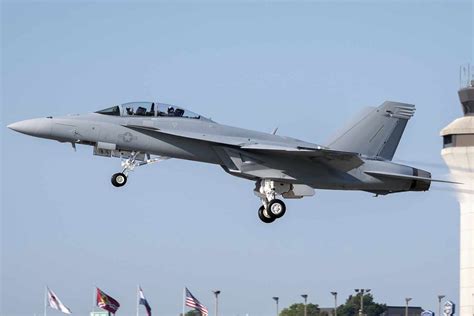
The F/A-18 Block III lacks the stealth capabilities and advanced sensor fusion of the F-35C, but it offers lower costs, longer operational lifespan, and greater availability. While the F-35C excels in stealth penetration missions, the Block III Super Hornet provides multi-role versatility and supports networked operations.
2. Can the F/A-18 Block III Super Hornet operate from all aircraft carriers?
Yes, the F/A-18 Block III is compatible with CATOBAR (Catapult Assisted Take-Off but Arrested Recovery) carriers like those of the U.S. Navy. It has also demonstrated ski-jump launch capabilities, making it a viable option for carriers used by India and other nations.
3. What weapons does the F/A-18 Block III carry?
The Block III Super Hornet is equipped with a 20mm M61 Vulcan cannon and can carry a wide range of air-to-air and air-to-ground munitions, including the AIM-120 AMRAAM, AIM-9X Sidewinder, AGM-88 HARM, and precision-guided bombs. Its improved sensor suite enhances targeting effectiveness in modern combat scenarios.