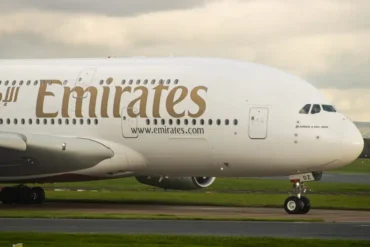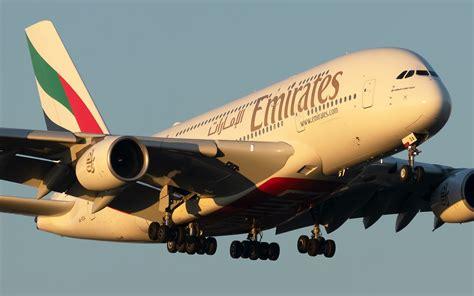
An Emirates Airbus A380 operating a long-haul flight from Dubai to San Francisco was forced to make an extraordinary diversion to London Heathrow after a passenger suffered a medical emergency while the aircraft was crossing Russia. The unexpected decision turned a routine transcontinental journey into a 2,485-mile (4,000 km) detour, sending hundreds of passengers to the United Kingdom instead of California.
The aircraft, operating as Emirates flight EK225, was approximately six hours into its journey when the crew decided that continuing toward the United States was no longer the best option. Flight tracking data showed the A380 was flying over the Russian region near the town of Nyagan when it began turning west toward Europe rather than continuing northward toward its planned route across the Arctic.
The decision to divert to London Heathrow Airport (LHR) was influenced by several operational factors. Heathrow is one of Emirates’ most important international hubs outside Dubai, with dedicated airline personnel, maintenance support, and passenger-handling facilities capable of managing an unexpected arrival of a large aircraft. For an aircraft carrying hundreds of travelers, access to established ground support can make a major difference during an irregular operation.
Emirates confirmed that the diversion was caused by a passenger medical emergency. The airline stated that EK225 from Dubai to San Francisco on July 29 was diverted to London Heathrow due to a passenger medical emergency. The aircraft landed in London at approximately 7:20 PM local time, nearly 12 hours after departing Dubai.
A Long-Haul Flight Turned Into an Unexpected London Arrival
The flight had originally departed from Dubai International Airport (DXB) at 11:06 AM, around three hours later than its scheduled departure time. The service was planned to cover one of Emirates’ longest routes to the United States, connecting Dubai with San Francisco in a journey of roughly 8,103 miles (13,040 km).
Instead of arriving on the American West Coast, passengers suddenly found themselves in Europe. A typical nonstop flight between Dubai and London takes around seven hours, meaning the aircraft had already spent a significant amount of time in the air before reaching Heathrow.
The choice of London rather than a closer airport suggests that the medical situation allowed the crew more flexibility. In cases involving an immediately life-threatening emergency, aircraft typically prioritize the nearest suitable airport. However, because the Airbus A380 requires specialized airport infrastructure, the number of practical diversion options is more limited compared with smaller aircraft.
After landing, Emirates arranged accommodation for affected passengers, with travelers placed in hotels overnight. The aircraft remained at Heathrow before continuing its journey the following day. The replacement departure was scheduled for the afternoon but experienced additional delays before pushing back from the gate.
The Airbus A380 Behind the Diversion
The aircraft involved was A6-EVH, an eight-year-old Airbus A380-842 operated by Emirates. The aircraft was delivered to the airline in December 2018 and represents the type of aircraft that has become central to Emirates’ global long-haul network.
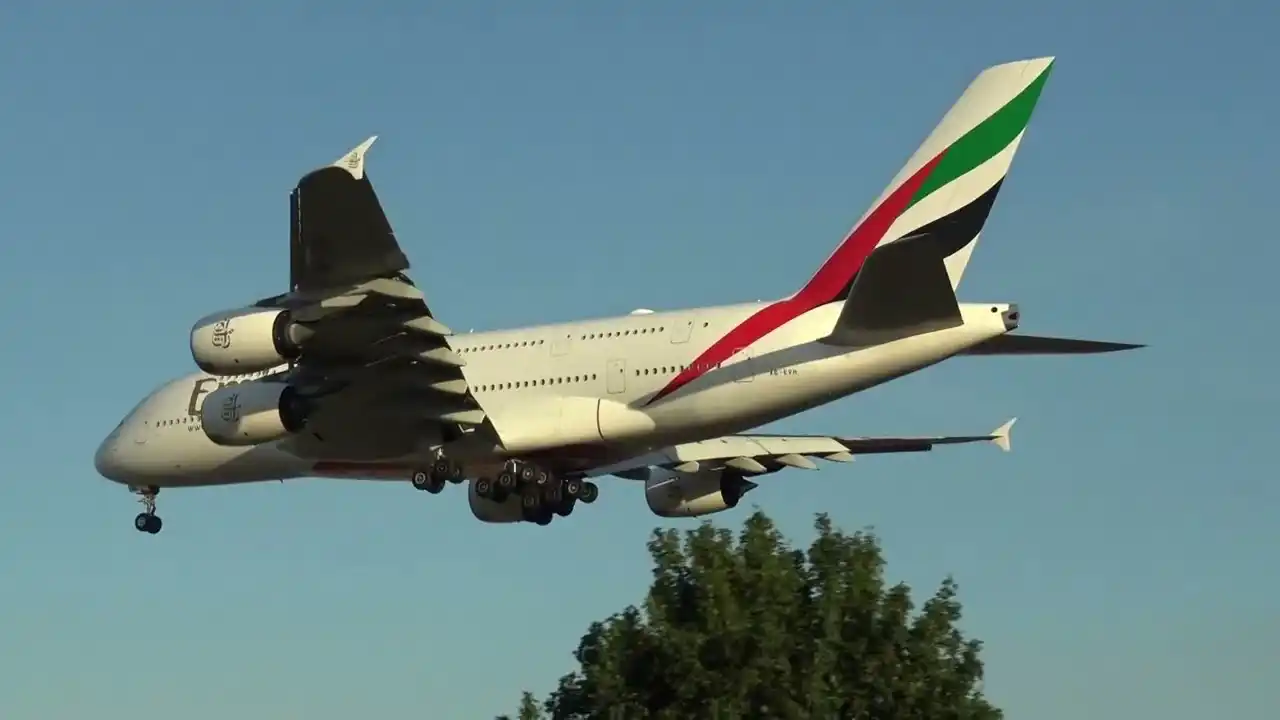
A6-EVH features Emirates’ four-class configuration with space for 484 passengers, including 14 First Class seats, 76 Business Class seats, 56 Premium Economy seats, and 338 Economy Class seats. As one of more than 100 A380 aircraft operated by Emirates, it reflects the airline’s strategy of using high-capacity aircraft on some of the world’s busiest international routes.
The incident also highlights the operational complexity of flying the world’s largest passenger aircraft. While the A380 provides significant passenger capacity and range, diversions require airports with suitable runways, parking areas, maintenance capability, and passenger facilities.
Another Emirates A380 Diversion Highlights Operational Challenges
This was not the only recent Emirates A380 diversion involving unusual circumstances. Just one week earlier, another Emirates A380 flying between Dubai and Shanghai was diverted to Hangzhou Xiaoshan International Airport because of severe thunderstorms affecting the destination area.
That aircraft reportedly remained on the ground for several hours while passengers waited for the situation to be resolved. These events demonstrate how airlines must constantly balance passenger safety, weather conditions, aircraft capability, and airport availability when managing unexpected disruptions.
For Emirates, the EK225 diversion ultimately ended safely. Although passengers experienced a significant delay and an unexpected stop thousands of miles away from their destination, the event showed how airline crews rely on careful decision-making and global support networks to handle medical emergencies during some of the world’s longest flights.