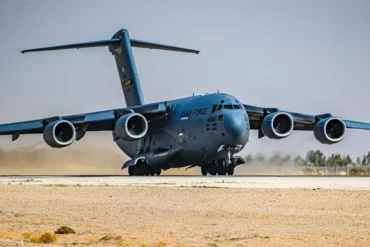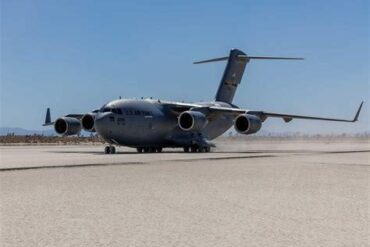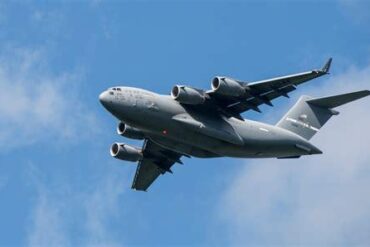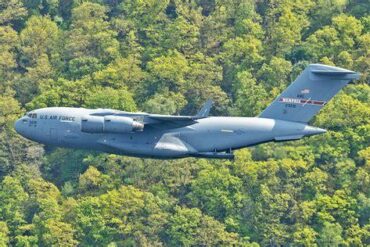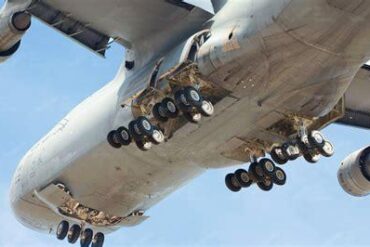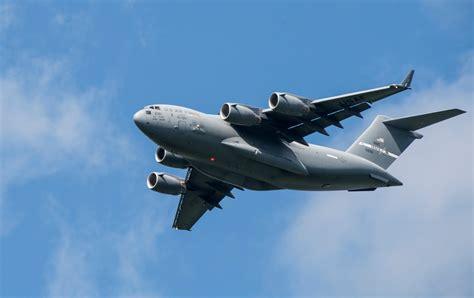
The C-17 Globemaster III is one of the most recognizable military transport aircraft in the world. Its massive wings, high T-tail, and unmistakable quartet of turbofan engines make it a symbol of global mobility for the United States Air Force. Yet one question often surfaces among aviation enthusiasts and engineers alike: why did McDonnell Douglas design the C-17 with four engines instead of two or three?
The answer lies at the intersection of military strategy, engineering limitations, and operational reality. During the late Cold War and the decades that followed, the US Air Force needed a transport aircraft capable of performing an extraordinary range of missions. The aircraft had to carry heavy armored vehicles across oceans, deliver troops directly into austere battlefields, and operate from short or damaged runways where traditional strategic airlifters simply could not go.
Designing such an aircraft required difficult trade-offs. Engineers had to balance power, reliability, fuel efficiency, and redundancy while ensuring the aircraft could operate safely in combat zones and remote regions. The decision to use four engines ultimately emerged as the most practical way to meet these demanding requirements with the technology available at the time.
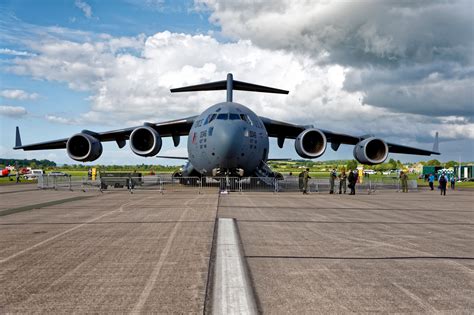
Strategic Mission Requirements That Demanded Immense Power
The C-17 Globemaster III was conceived as a bridge between two existing transport aircraft: the C-5 Galaxy, which carried enormous loads across continents, and the C-130 Hercules, which specialized in tactical operations on short or rough runways.
The US Air Force wanted a single aircraft capable of doing both jobs.
That meant designing a plane capable of transporting up to 170,900 pounds (77,500 kilograms) of cargo, including large military vehicles such as the M1 Abrams main battle tank. At the same time, the aircraft had to take off from runways as short as 3,500 feet and land on surfaces that might be unpaved, damaged, or surrounded by terrain obstacles.
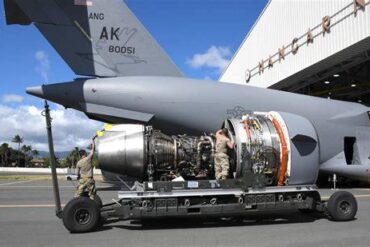
Generating the thrust required to lift such massive payloads under those conditions was no small feat. Engineers selected the Pratt & Whitney F117-PW-100 turbofan, a powerful high-bypass engine derived from the commercial PW2040 used on the Boeing 757.
Each engine produces approximately 40,440 pounds of thrust, giving the aircraft a combined output of more than 160,000 pounds of thrust. Four engines allowed designers to distribute that power across the aircraft in a balanced way, ensuring both strong takeoff performance and safe climb capability even when operating at maximum weight.
Without this level of total thrust, the aircraft would not have been able to meet the Air Force’s demanding short-field performance requirements.
Short Takeoff and Landing Performance Required Four Engines
One of the defining capabilities of the C-17 Globemaster III is its short takeoff and landing (STOL) performance. Few aircraft of its size can land on extremely short runways and then depart again with heavy cargo.
This ability is critical for military logistics. Modern warfare often requires aircraft to deliver equipment directly into remote areas rather than relying on large, well-equipped airbases. Troops operating in regions such as Afghanistan, Iraq, or parts of Africa frequently rely on airlift to move vehicles, supplies, and humanitarian aid.
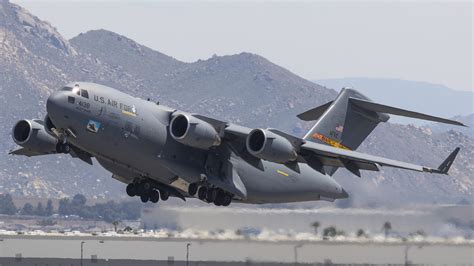
Operating from short runways presents a unique set of aerodynamic challenges. Aircraft must accelerate quickly during takeoff while maintaining strong lift at relatively low speeds during landing. The C-17 addresses these demands through several features working together:
- Four powerful turbofan engines
- Externally blown flaps that direct engine airflow over the wing
- A large supercritical wing designed for both efficiency and lift
The interaction between the engines and the wing is especially important. When the aircraft deploys its flaps, the engine exhaust is directed over the wing surface, increasing lift during low-speed operations. This aerodynamic technique allows the C-17 to approach the runway at slower speeds while still maintaining control.
Without four engines providing evenly distributed airflow, achieving this level of short-field performance would have been far more difficult.
Engine Redundancy and Combat Survivability
Military aircraft must be designed with the assumption that things can go wrong far from help. In combat zones or remote regions, there may be no nearby maintenance facilities, spare parts, or safe diversion airports.
Engine redundancy therefore becomes a matter of mission success and crew safety.
With four engines, the C-17 retains 75 percent of its power even if one engine fails. This allows the aircraft to continue climbing, maintain altitude, and safely complete its mission or divert to another airfield.
A twin-engine aircraft, by contrast, would lose half of its available thrust in the same situation.
In commercial aviation this is manageable because airliners usually operate between large airports with long runways and strong infrastructure. Military cargo aircraft frequently operate under far harsher conditions.
Imagine a fully loaded transport aircraft departing a high-altitude airfield surrounded by mountains. If one engine fails shortly after takeoff, losing half of the available thrust could make it impossible to clear nearby terrain.
Four engines significantly reduce that risk.
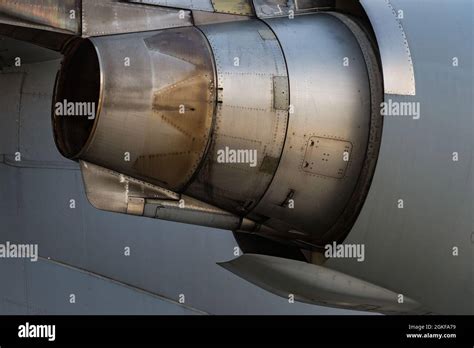
The design philosophy reflects decades of military aviation experience. Earlier transports such as the C-141 Starlifter and C-124 Globemaster II also relied on four engines to provide the redundancy needed for long-range operations in uncertain environments.
The C-17 simply applied modern turbofan technology to this proven concept.
How the YC-15 Prototype Shaped the Four-Engine Layout
The story of the C-17’s engine configuration actually begins years before the aircraft itself was designed.
During the 1970s, the US Air Force launched the Advanced Medium STOL Transport (AMST) program. The goal was to create a new tactical airlifter capable of operating from extremely short runways while carrying heavier loads than the C-130 Hercules.
McDonnell Douglas developed the YC-15 prototype, an experimental aircraft that incorporated several groundbreaking features.
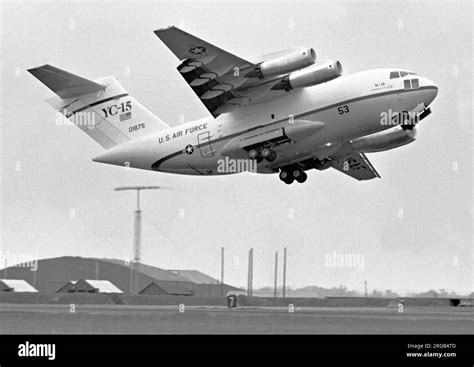
The YC-15 introduced:
- A four-engine turbofan layout
- Externally blown flaps for increased lift
- A supercritical wing optimized for efficiency
Although the AMST program was eventually canceled, the YC-15 proved that a four-engine STOL transport could achieve remarkable performance.
When the Air Force later issued requirements for a new heavy airlifter under the C-X program, McDonnell Douglas essentially scaled up the YC-15 concept. The result was the aircraft that would eventually become the C-17 Globemaster III.
Keeping the four-engine configuration reduced development risk. Engineers were able to refine a proven design rather than attempting a completely new propulsion arrangement.
This continuity between the YC-15 and the C-17 demonstrates how experimental aircraft programs often shape future military platforms, even when the original project never enters full production.
Technological Limits of 1980s Jet Engines
Another important factor in the C-17’s design was the state of jet engine technology in the 1980s.
Today’s largest commercial aircraft often rely on only two engines. Aircraft like the Boeing 777 and Boeing 787 Dreamliner are powered by extremely powerful turbofans capable of producing more than 100,000 pounds of thrust each.
Those engines did not exist when the C-17 was being designed.
During the early stages of the program, available engines simply could not provide enough thrust individually to power a twin-engine aircraft capable of lifting 170,000 pounds of cargo from short runways.
Using four smaller engines offered several advantages:
- Higher combined thrust
- Better distribution of aerodynamic forces
- Reduced stress on individual engines
- Improved safety margins
Engine technology eventually advanced to the point where twin-engine heavy aircraft became viable. However, by that time the C-17’s configuration had already been finalized.
The aircraft’s design therefore reflects the technological realities of its era.
Comparing the C-17 With Other Military Transport Aircraft
Looking at other transport aircraft highlights why the C-17’s four-engine layout makes sense.
Different aircraft are optimized for different mission profiles, and engine configuration plays a major role in determining those capabilities.
For example, the Airbus A400M Atlas uses four turboprop engines rather than turbofans.
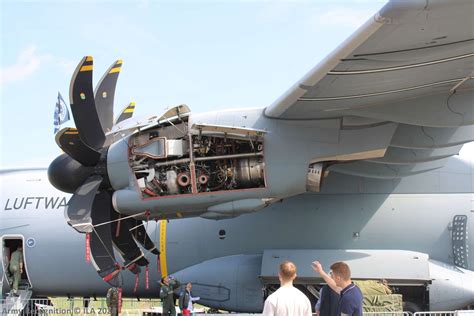
Turboprops are highly efficient at lower speeds and perform well on short runways, making the A400M an excellent medium-lift tactical transport. However, turboprop aircraft generally cannot match the high cruise speeds and intercontinental range of large jet transports.
At the other end of the spectrum, the KC-46 Pegasus aerial refueling tanker uses two turbofan engines similar to those on the Boeing 767.
That configuration works well for long-range flights between established air bases, but it is not designed for landing on short or improvised airstrips.
Another modern aircraft worth examining is the Embraer C-390 Millennium, a twin-engine jet transport.
The C-390 is faster than the C-130 Hercules and more fuel efficient than many four-engine aircraft. However, it carries only about 52,000 pounds of cargo, roughly one-third of the C-17’s maximum payload.
The comparison highlights a clear pattern: greater payload capacity and extreme runway performance often require additional engines.
Operational Advantages Seen in Real-World Missions
The practical benefits of the C-17’s design became evident during military operations around the world.
During the wars in Afghanistan and Iraq, C-17 aircraft frequently flew into remote airfields located at high elevations. These environments present a challenge known as “hot and high” conditions.
High altitude and high temperature both reduce air density. Thin air decreases the amount of lift generated by wings and reduces engine performance at the same time.
In such conditions, aircraft often require longer runways and lighter payloads to take off safely.
The C-17’s four engines provide enough additional thrust to compensate for these challenges. Pilots often describe the aircraft as having exceptional power reserves, allowing them to depart difficult airfields even when carrying heavy cargo.
This capability has proven invaluable during humanitarian missions as well.
C-17 aircraft have delivered aid following earthquakes, hurricanes, and other disasters, often landing at damaged or partially functional airports. The aircraft’s ability to operate in such environments makes it one of the most versatile airlifters ever built.
The Trade-Offs of Operating Four Engines
While the four-engine configuration provides significant advantages, it also introduces certain drawbacks.
More engines inevitably mean greater complexity and higher operating costs. Each engine requires routine inspections, maintenance hours, spare parts, and fuel.
For military organizations operating under tight budgets, these factors cannot be ignored.
Four engines also consume more fuel than a comparable twin-engine aircraft performing the same mission. Over the lifetime of an aircraft fleet, fuel costs represent a substantial portion of operating expenses.
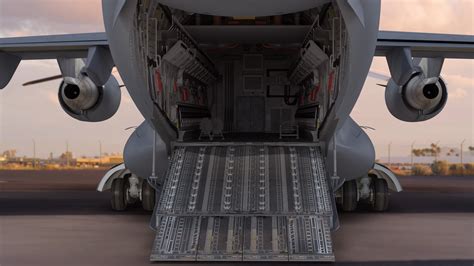
These financial realities explain why only a relatively small number of countries operate the C-17. The aircraft offers extraordinary capabilities, but maintaining such a fleet requires significant resources.
For the United States Air Force, however, the benefits outweigh the costs. The ability to move large quantities of equipment anywhere in the world within hours is a cornerstone of American military strategy.
The C-17 is one of the key tools that makes that global mobility possible.
Why the Four-Engine Design Still Makes Sense
The C-17 Globemaster III represents a careful balance between engineering capability and operational necessity. Its four-engine configuration was not chosen simply out of tradition; it was the logical solution to a complex set of requirements.
The aircraft needed to combine strategic range, massive payload capacity, short-runway performance, and high levels of reliability. Achieving all of those capabilities simultaneously demanded large amounts of thrust and strong redundancy.
Four Pratt & Whitney F117 turbofan engines provided the optimal solution within the technological limits of the time.
Future heavy airlifters may eventually adopt twin-engine configurations as engine technology continues to evolve. Ultra-high-thrust turbofans now powering modern commercial aircraft could make such designs practical.
Yet the enduring success of the C-17 demonstrates an important lesson in aerospace engineering: the best design is not always the most efficient or the most modern, but the one that best fulfills its mission.
More than three decades after its first flight, the C-17 continues to serve as one of the most capable military transport aircraft ever built. Its four engines remain a defining feature of a machine designed to deliver people, equipment, and hope to almost any runway on Earth.