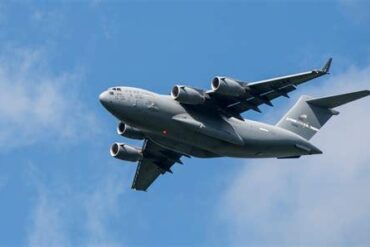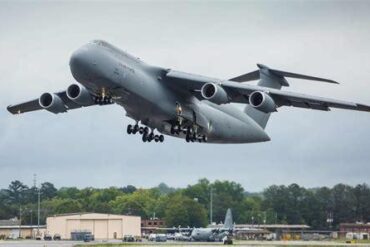
The Lockheed C-5M Super Galaxy is more than just one of the largest military aircraft ever built. It is a flying logistics platform engineered to transport the heaviest, largest, and most critical military equipment across continents while operating from airfields that would challenge many other heavy transport aircraft. Every aspect of its design reflects a singular mission: move enormous cargo anywhere in the world as quickly as possible.
Among its most recognizable engineering features are its remarkable kneeling landing gear system and its 28-wheel landing gear arrangement. At first glance, these may appear to be unusual design choices. In reality, they are the foundation of the aircraft’s operational flexibility. Without them, the C-5M would lose much of the capability that has made it indispensable to the United States Air Force for more than five decades.
Instead of depending on massive cargo terminals equipped with specialized cranes and loading systems, the Super Galaxy was designed to bring its own loading solution wherever it lands. Whether delivering armored vehicles to an expeditionary base, transporting helicopters across the Pacific, or establishing logistics hubs for next-generation stealth aircraft, the aircraft’s unique landing gear transforms it into a self-contained cargo handling system capable of operating almost anywhere.
The Engineering Philosophy Behind the C-5M Super Galaxy
When Lockheed developed the original C-5 Galaxy during the height of the Vietnam War, military planners faced an enormous logistical challenge. The United States needed an aircraft capable of transporting oversized military equipment thousands of miles without requiring extensive disassembly or lengthy loading procedures.
Earlier cargo aircraft could transport personnel and conventional freight efficiently, but they struggled with exceptionally large cargo. Tanks often had to be partially dismantled before loading, helicopters required rotor removal, and specialized engineering equipment frequently exceeded cargo compartment limitations.
The Galaxy solved these problems by combining an enormous cargo bay with unmatched payload capacity. Today’s upgraded C-5M Super Galaxy continues that mission with modernized engines, advanced avionics, improved reliability, and one of the highest payload capacities of any operational military transport aircraft.
Its cargo compartment can accommodate nearly every major ground system used by the U.S. military, allowing combat-ready equipment to arrive exactly as it will be used in the field.
Why the C-5M Needs 28 Wheels
The most visually striking feature beneath the aircraft is its enormous landing gear system.
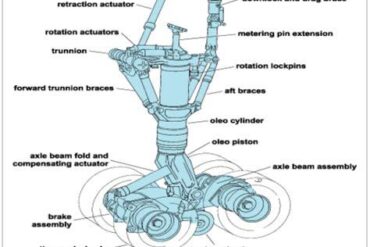
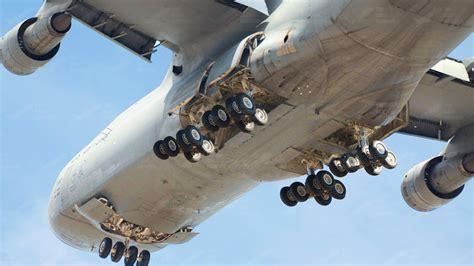
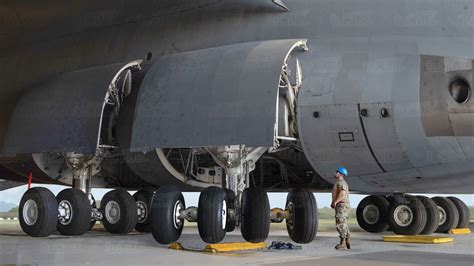
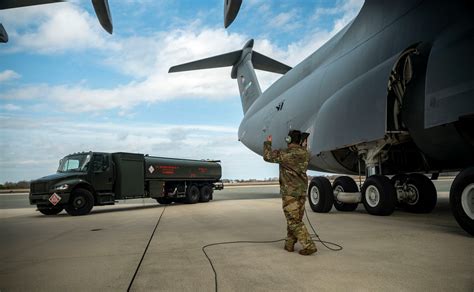
Instead of relying on only a few large wheels like conventional airliners, the C-5M distributes its weight across 28 separate wheels. The configuration includes:
- Four wheels on the nose landing gear
- Twenty-four wheels on four separate main landing gear bogies
- Six wheels mounted on each main landing gear assembly
This arrangement is not simply about supporting weight. It is about managing pressure.
A fully loaded C-5M can weigh well over 800,000 pounds during takeoff. Concentrating that mass onto only a handful of tires would create enormous ground pressure capable of damaging asphalt, cracking concrete, or sinking into softer surfaces.
By distributing the aircraft’s weight across twenty-eight tires, engineers dramatically reduce the pounds exerted on every square inch of runway.
The principle is similar to how snowshoes prevent a person from sinking into deep snow. Rather than increasing strength alone, the design spreads the load over a much larger contact area.
Operating From Airfields That Other Heavy Aircraft Cannot Use
Heavy transport aircraft are only valuable if they can actually reach the locations where supplies are needed.
Military operations rarely occur near modern international airports. Instead, they frequently depend on temporary expeditionary bases, repaired wartime runways, remote islands, or semi-prepared landing strips.
The C-5’s landing gear was specifically designed to handle these environments.
During the Vietnam War, the aircraft routinely operated from airfields where asphalt had been hastily repaired after attacks or where runway construction standards varied significantly. A more concentrated landing gear would have risked damaging these surfaces every time the aircraft landed.
Instead, the 28-wheel configuration minimized runway stress while maintaining stability during taxi, takeoff, and landing.
This capability remains highly relevant today. Modern U.S. military strategy increasingly emphasizes Agile Combat Employment (ACE), which focuses on dispersing aircraft across numerous smaller operating locations rather than concentrating forces at a handful of major bases.
Remote Pacific islands, temporary logistics hubs, and austere operating locations often possess limited infrastructure. The C-5M’s landing gear allows it to access these bases while minimizing runway damage that could affect follow-on aircraft.
Understanding the C-5M’s Unique Kneeling Mechanism
The aircraft’s second signature feature is its remarkable kneeling system.
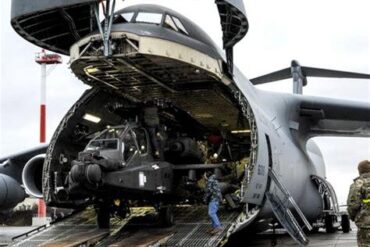
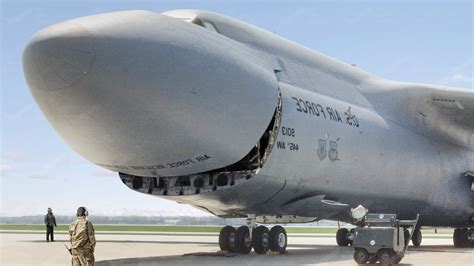
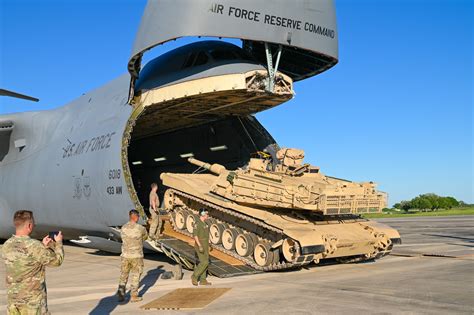
Unlike conventional cargo aircraft, the C-5M can hydraulically lower its nose after parking. This action reduces the height of the forward cargo deck until it sits approximately six feet above the ground.
Rather than requiring elevated cargo loaders, the lowered deck aligns closely with the height of standard military trucks and commercial flatbed trailers.
The result is dramatically simplified loading operations.
Vehicles can drive directly into the aircraft using the front cargo ramp, while heavy pallets roll smoothly aboard without requiring excessive lifting equipment.
This innovation significantly reduces loading times while expanding the number of locations capable of supporting C-5 operations.
Drive-Through Cargo Operations Increase Speed
One of the Super Galaxy’s most valuable features is its drive-through loading capability.
Unlike many cargo aircraft that load through only one end, the C-5M includes both forward-opening nose doors and a rear cargo ramp.
Once both ramps are lowered, vehicles can literally drive straight through the aircraft.
Instead of backing heavy equipment into tight cargo compartments, operators simply drive in one end and exit the other.
This greatly simplifies loading for:
- Main battle tanks
- Armored personnel carriers
- Bulldozers
- Missile launchers
- Fuel trucks
- Helicopters
- Engineering equipment
Large military convoys can move efficiently without complex maneuvering inside the cargo hold.
The reduced handling also lowers the risk of accidental damage to expensive equipment.
Self-Sufficiency in Remote Locations
Military logistics cannot always depend upon ideal infrastructure.
Many forward operating locations possess little more than a runway, a few fuel trucks, and minimal personnel.
The C-5M was specifically designed to remain operational under these conditions.
Its kneeling mechanism eliminates dependence on heavy cranes.
Its cargo ramps remove the need for specialized loading docks.
Its landing gear reduces runway stress.
Together, these features allow the aircraft to arrive, unload massive cargo independently, and depart with minimal external assistance.
For expeditionary operations, this level of self-sufficiency is invaluable.
Reducing Time on the Ground During Combat Operations
Every minute spent on the ground during wartime increases an aircraft’s vulnerability.
Airfields are often priority targets during military conflicts because they concentrate personnel, fuel, and aircraft in predictable locations.
The C-5’s rapid unloading capability directly addresses this problem.
During Vietnam-era operations, crews could unload enormous cargo loads and depart in less than thirty minutes under favorable conditions.
The combination of kneeling gear, front and rear ramps, and drive-through loading minimized delays while reducing exposure to rocket attacks, artillery, or mortar fire.
Even today, minimizing ground time remains an essential consideration during high-threat operations.
Transporting Cargo Too Large for Other Aircraft
The enormous internal dimensions of the C-5M allow transportation of equipment that many cargo aircraft simply cannot accommodate.
Examples include fully assembled:
- M1 Abrams tanks
- CH-47 Chinook helicopters
- Large engineering vehicles
- Missile defense components
- Oversized generators
- Tactical bridges
- Aviation maintenance facilities
Rather than disassembling complex equipment before transport, crews can load many systems in operational configuration.
This dramatically reduces preparation time while enabling units to begin operations almost immediately after arrival.
Supporting the Air Force’s Agile Combat Employment Strategy
The modern Agile Combat Employment doctrine depends heavily on flexible logistics.
Rather than concentrating fighters at major installations, aircraft operate from numerous dispersed airfields spread across vast geographic regions.
This approach complicates enemy targeting while increasing operational resilience.
However, dispersed operations also create major logistical challenges.
Each temporary base requires:
- Fuel
- Spare parts
- Maintenance equipment
- Weapons
- Communications systems
- Ground support vehicles
- Shelter equipment
The C-5M’s immense cargo capacity allows much of this infrastructure to arrive in a single sortie.
Its ability to unload without specialized equipment makes these temporary locations immediately operational.
Sustaining Fifth- and Sixth-Generation Aircraft
Modern combat aircraft demand increasingly sophisticated logistical support.
Platforms such as the Lockheed Martin F-35 Lightning II, Northrop Grumman B-21 Raider, and future sixth-generation aircraft rely upon advanced sensors, stealth coatings, specialized electronics, and complex maintenance procedures.
These systems cannot be supported with ordinary repair equipment.
Instead, maintenance teams require:
- Precision tooling
- Diagnostic systems
- Environmental shelters
- Spare engines
- Specialized replacement components
- Containerized maintenance facilities
The C-5M possesses sufficient cargo volume to transport entire deployable maintenance packages rather than individual replacement parts.
This enables advanced aircraft to remain operational far from permanent military installations.
Becoming a Mobile Logistics Hub for Future Drone Operations
The evolution of military aviation increasingly includes Collaborative Combat Aircraft (CCA), often described as loyal wingman drones.
Future operations may involve hundreds of autonomous aircraft supporting crewed fighters and bombers.
The C-5M is ideally suited to become their logistics platform.
Its enormous cargo compartment can transport:
- Complete drone systems
- Launch equipment
- Spare components
- Fuel
- Weapons
- Ground control stations
- Communications infrastructure
Once arriving at remote island airfields, the kneeling system allows rapid unloading of the entire support package.
Some future drones may even launch directly from expeditionary sites shortly after delivery.
This transforms the Super Galaxy from a transport aircraft into the logistical backbone of distributed drone operations.
Supporting the Future B-21 Raider Force
The upcoming B-21 Raider represents one of the Air Force’s highest strategic priorities.
Future bomber operations are expected to rely on dispersed deployment rather than permanent basing.
Supporting these bombers requires moving enormous quantities of fuel, precision weapons, maintenance equipment, and specialized support vehicles.
The C-5M’s landing gear and kneeling capability make it uniquely qualified for this mission.
It can arrive at remote airfields carrying fuel bladders, bomb-loading equipment, maintenance shelters, and precision-guided munitions.
Within a short period, crews can establish an operational forward arming and refueling point capable of sustaining stealth bomber operations far from traditional bases.
Rugged Landing Gear Designed for Reliability
The landing gear provides another important operational advantage beyond weight distribution.
Its highly redundant design enhances survivability.
If one tire becomes damaged during operations, the remaining wheels continue distributing aircraft weight safely.
Ground crews can replace damaged tires independently, reducing dependence on external maintenance support.
This resilience becomes particularly important on isolated airfields where replacement equipment may be days away.
Rather than immobilizing the aircraft because of a single damaged wheel, the Super Galaxy’s landing gear provides built-in redundancy that helps keep strategic airlift missions moving.
Why These Features Remain Essential More Than Fifty Years Later
Many military aircraft gradually lose relevance as technology evolves.
The C-5M has experienced the opposite.
Although its basic design dates back to the late 1960s, its core engineering solutions remain remarkably well suited to modern military operations.
Future conflicts will likely emphasize dispersed forces, rapid deployment, remote island operations, and resilient logistics. Every one of these priorities aligns perfectly with the Super Galaxy’s unique capabilities.
Its 28-wheel landing gear enables operations from runways that cannot support comparable heavy transports. Its kneeling mechanism removes dependence on specialized cargo infrastructure. Its enormous payload allows entire military capabilities—not simply individual vehicles—to be delivered in a single mission.
Far from becoming obsolete, these engineering innovations continue to expand the aircraft’s strategic value. As the U.S. Air Force prepares for increasingly distributed operations involving stealth fighters, next-generation bombers, autonomous drones, and expeditionary logistics networks, the C-5M Super Galaxy remains one of the world’s most capable military transport aircraft. Its ability to combine extraordinary payload capacity with unmatched operational flexibility ensures that its kneeling landing gear and 28-wheel design will remain essential components of American global air mobility for years to come.