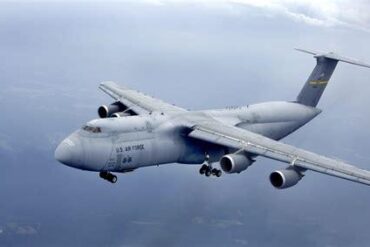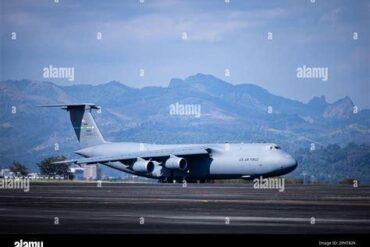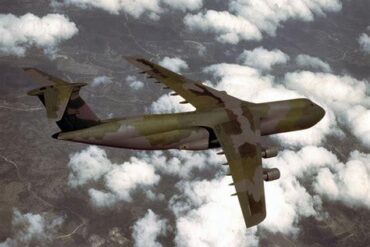
The Lockheed Martin C-5M Super Galaxy occupies a unique place in military aviation. Built to solve one of the most difficult logistical challenges imaginable—moving enormous combat power across continents in a matter of hours—it remains the largest strategic airlifter in the United States Air Force. While modern military transports such as the C-17 Globemaster III and C-130J Super Hercules excel in their respective roles, the Super Galaxy operates in an entirely different category. Its sheer internal volume, extraordinary payload capability, and self-sufficient cargo handling systems allow it to transport equipment that would require multiple flights by smaller aircraft.
Rather than simply carrying more cargo, the C-5M fundamentally changes how military operations are planned. Entire armored formations, helicopters, engineering units, humanitarian relief supplies, and expeditionary airbase equipment can be deployed worldwide using a single aircraft. In an era where speed often determines strategic advantage, the Super Galaxy continues to serve as America’s heavyweight logistics champion.
Designed during the Cold War but continuously modernized, today’s C-5M combines decades of proven engineering with upgraded engines, digital avionics, improved reliability, and the ability to receive fuel while airborne. These enhancements ensure the aircraft remains one of the most valuable assets in the Air Force’s global mobility fleet, particularly as military strategy increasingly focuses on long-distance operations across the Indo-Pacific.
The Strategic Airlifter Built for Impossible Missions
Unlike tactical transports that shuttle supplies between nearby bases, the C-5M was designed for strategic airlift—transporting massive amounts of cargo thousands of miles without relying on intermediate infrastructure. During its original development, the United States required an aircraft capable of moving heavy armored vehicles and combat aircraft directly to overseas theaters faster than ships could ever manage.
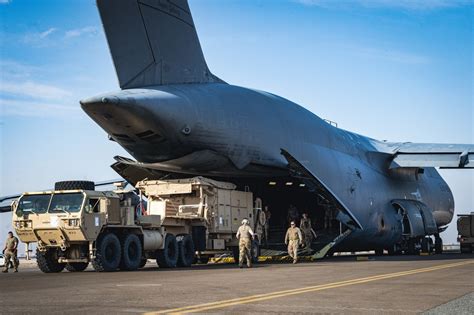
That requirement produced one of the largest operational aircraft ever built. The Super Galaxy’s enormous fuselage allows oversized military hardware to fit inside without disassembly, dramatically reducing deployment time. Instead of transporting vehicles in pieces and rebuilding them upon arrival, crews can simply drive equipment directly into the aircraft and fly it wherever it is needed.
This capability has become even more important as the Air Force embraces Agile Combat Employment (ACE), a doctrine emphasizing dispersed operations across numerous small airfields. Rather than concentrating aircraft at a handful of vulnerable bases, modern combat plans rely on rapidly establishing temporary operating locations. The C-5M provides the logistical muscle that makes this concept practical, carrying everything from fuel systems and maintenance equipment to munitions and support vehicles in a single mission.
A Cargo Hold That Functions Like a Drive-Through Warehouse
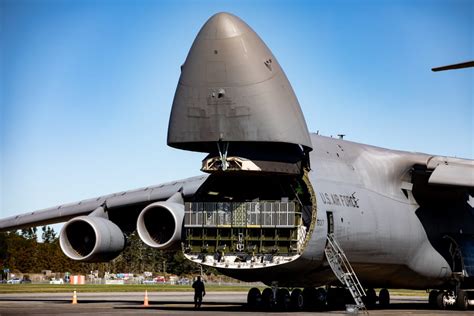
The most recognizable feature of the C-5M is its remarkable drive-through cargo bay, an engineering solution that dramatically accelerates loading and unloading.
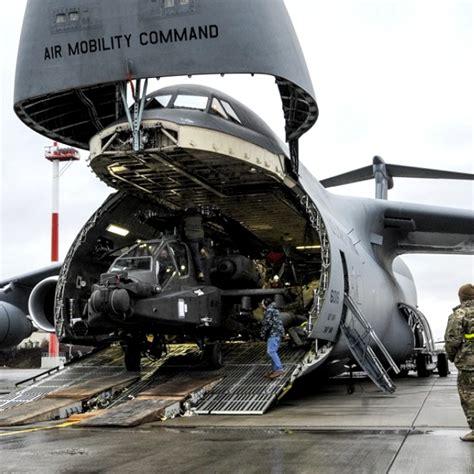
Instead of relying solely on a rear cargo ramp like most transport aircraft, the Super Galaxy features both a forward-opening nose door and a rear loading ramp. This unique configuration allows vehicles to enter through one end and exit through the other, eliminating complicated reversing maneuvers and reducing ground time.
The cargo compartment itself stretches to extraordinary dimensions, providing enough room for equipment that would overwhelm virtually every other aircraft in Western military service. Tanks, helicopters, engineering vehicles, missile launchers, generators, aircraft engines, and hundreds of pallets can all be accommodated with remarkable flexibility.
Unlike many cargo aircraft requiring extensive external support, the C-5M incorporates permanently installed cargo rails, rollers, tie-down systems, powered winches, and even an overhead crane. These integrated systems enable crews to reposition massive loads internally without waiting for specialized airport equipment.
The result is a transport aircraft that functions almost like a mobile logistics terminal, capable of operating even where sophisticated cargo facilities do not exist.
Engineering Designed Around Speed and Efficiency
Moving heavy cargo is only half the challenge. Loading it efficiently often determines how quickly combat forces become operational.
The Super Galaxy incorporates numerous engineering features specifically intended to minimize handling time.
One of the most impressive is its kneeling landing gear. Hydraulic actuators lower the aircraft closer to the ground while parked, reducing the loading angle of both ramps. This feature allows trucks and armored vehicles to transition smoothly between the ground and the cargo deck while minimizing the risk of scraping or high-centering.
The lowered cargo floor also aligns closely with standard military transport trucks, simplifying transfers between ground vehicles and the aircraft itself.
This system becomes particularly valuable when transporting delicate equipment such as fighter aircraft engines or heavy maintenance modules that require gentle handling.
Payload Capacity That Redefines Heavy Airlift
Nothing illustrates the C-5M’s capabilities better than its payload.
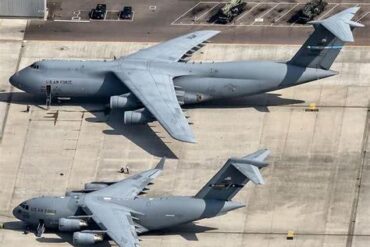
The aircraft can carry nearly twice the cargo transported by a C-17 Globemaster III and approximately eight times the payload of the C-130J Super Hercules.
These numbers translate into real battlefield capability.
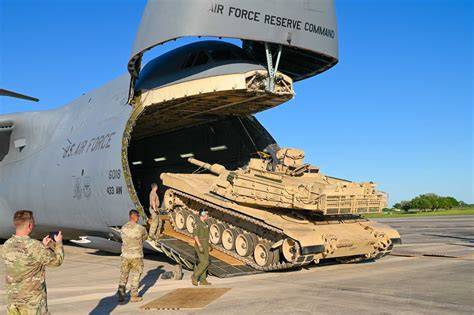
Instead of transporting a single main battle tank, the Super Galaxy can move two M1A2 Abrams tanks simultaneously while still carrying supporting equipment. Alternatively, it can deliver multiple Bradley Fighting Vehicles, Humvees, ammunition, engineering assets, and accompanying personnel during one deployment.
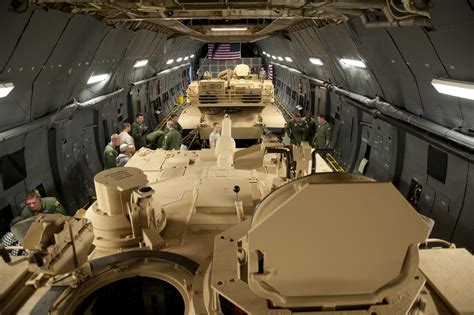
For expeditionary operations, this concentration of combat power dramatically reduces the number of sorties required to establish an effective fighting force.
Fewer flights mean lower operational costs, reduced aircrew exposure, simplified scheduling, and faster force buildup during crises.
Self-Sufficient Cargo Handling Wherever It Lands
Many military transports depend heavily on specialized loading equipment positioned at established airbases.
The C-5M reduces this dependency through an impressive degree of onboard autonomy.
Its cargo rails permit crews to manually move standard 463L cargo pallets rapidly throughout the aircraft. The built-in overhead crane allows heavy machinery, engines, or disabled vehicles to be repositioned without forklifts. Internal winches provide additional flexibility for awkward loads.
These integrated systems prove especially valuable when operating from temporary expeditionary locations where cranes, loaders, and forklifts may not yet be available.
Instead of waiting for ground infrastructure, the Super Galaxy effectively brings much of its own cargo handling capability with it.
Built for Global Reach
Although enormous in size, the C-5M is not limited by range in the way many large transport aircraft are.
Perhaps its greatest operational advantage is compatibility with aerial refueling. Tanker aircraft can replenish the Super Galaxy while airborne, allowing it to remain in the air for exceptionally long missions without landing.
This capability dramatically expands deployment flexibility.
Cargo can travel directly from the continental United States to distant operational theaters while minimizing intermediate stops that increase complexity and vulnerability.
For military planners facing operations across the vast Pacific Ocean, aerial refueling transforms the C-5M from a large cargo aircraft into a truly global logistics platform.
Surprisingly Capable on Austere Airfields
Its immense size often creates the misconception that the C-5M requires pristine runways.
In reality, the aircraft was specifically engineered to operate from more rugged environments than many observers expect.
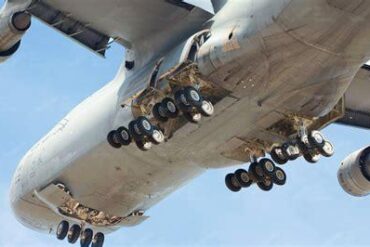
The Super Galaxy distributes its enormous weight across 28 landing gear wheels, significantly reducing ground pressure. This flotation design allows the aircraft to use many temporary, damaged, or unreinforced runways that support a fully loaded C-17.
Combined with its kneeling landing gear and integrated cargo handling equipment, the aircraft can rapidly offload combat vehicles without requiring permanent airport infrastructure.
This capability enables commanders to deliver unprecedented quantities of heavy equipment directly into forward operating areas rather than relying solely on major logistics hubs.
Supporting Agile Combat Employment Across the Pacific
Modern military strategy increasingly emphasizes flexibility over fixed infrastructure.
Instead of concentrating aircraft at large bases vulnerable to missile attacks, Agile Combat Employment disperses forces across numerous remote islands and expeditionary airfields.
The C-5M has become one of the key enablers of this concept.
Its enormous internal volume allows it to transport portable shelters, fuel systems, maintenance equipment, runway repair kits, generators, communications infrastructure, munitions, and replacement aircraft components together in a single deployment.
Future autonomous systems, including collaborative combat aircraft and loyal wingman drones, may also be repositioned rapidly aboard the Super Galaxy as these platforms become more common within the Air Force.
Rather than merely transporting equipment, the aircraft effectively delivers the infrastructure required to create an operational airbase almost anywhere.
Passenger Comfort That Supports Combat Readiness
Heavy airlift is not solely about transporting equipment.
Personnel arriving exhausted are less effective upon deployment.
Unlike many cargo aircraft, the C-5M incorporates a fully separated upper passenger deck isolated from the cargo compartment below.
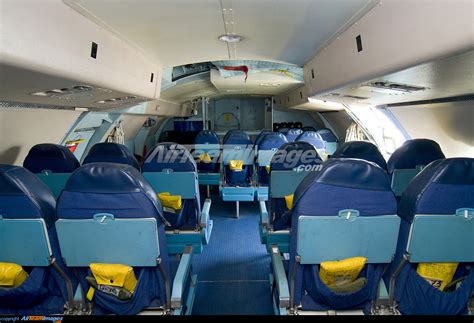
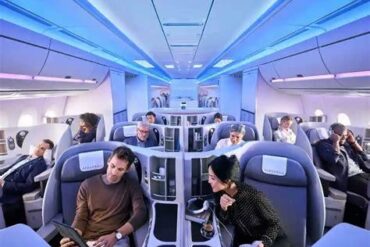
Military personnel benefit from airline-style seating, pressurization, climate control, restrooms, a galley, and crew rest facilities. This environment provides a significant improvement over traditional cargo-bay seating found aboard smaller transports.
The aircraft can transport nearly 300 fully equipped troops together with their vehicles, supplies, ammunition, and sustainment equipment.
This combination ensures forces arrive ready for immediate operations rather than requiring lengthy recovery after transit.
The Economics of Massive Strategic Airlift
Operating one of the world’s largest aircraft is undeniably expensive.
However, evaluating the C-5M solely by fuel consumption misses the broader logistical equation.
Each sortie replaces multiple flights by smaller transports while reducing maintenance cycles, aircrew requirements, scheduling complexity, and exposure to operational risk.
Concentrating enormous cargo loads into fewer missions also simplifies command and control while accelerating force deployment during emergencies.
Whether responding to natural disasters, humanitarian crises, or military contingencies, the Super Galaxy consistently demonstrates that moving more cargo at once often proves more economical than dividing it across numerous aircraft.
Its ability to transport oversized equipment without disassembly further reduces labor costs and dramatically shortens deployment timelines.
Why the C-5M Continues to Define Strategic Airlift
Even as the Air Force studies future aircraft capable of replacing both the C-17 and the C-5, no operational platform currently matches the Super Galaxy’s unique combination of payload, internal volume, cargo handling autonomy, and global reach.
Its drive-through loading system, kneeling landing gear, aerial refueling capability, integrated cargo equipment, separated passenger deck, and enormous payload create an aircraft specifically optimized for moving military power—not merely freight.
The Super Galaxy represents more than engineering ambition; it embodies the understanding that wars are won as much through logistics as through firepower. Tanks, helicopters, fighter engines, humanitarian supplies, expeditionary airfields, armored vehicles, and hundreds of soldiers can all arrive together aboard a single aircraft, ready to begin operations almost immediately after landing.
In an age of increasingly dispersed battlefields and rapidly evolving operational concepts, the C-5M remains one of the United States Air Force’s most indispensable assets. While newer aircraft may eventually inherit portions of its mission, the Super Galaxy continues to stand alone as the definitive heavyweight of Western military aviation—a transport so enormous that it makes virtually every other military cargo aircraft seem almost regional by comparison.