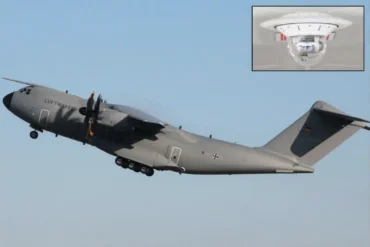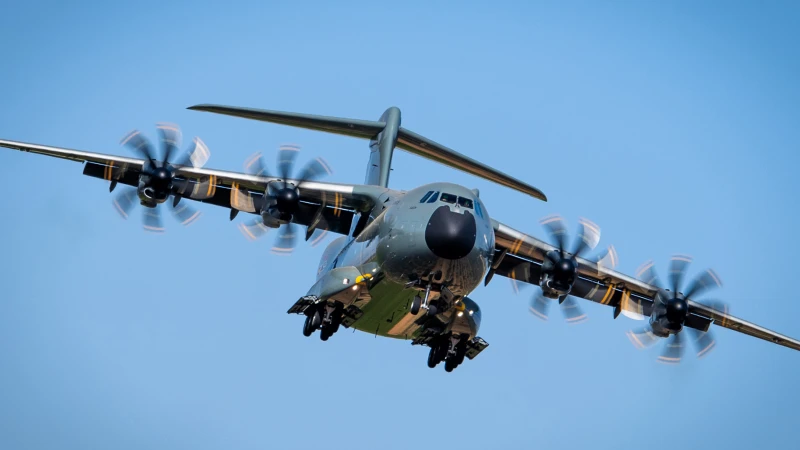
The Airbus A400M Atlas is one of the most distinctive military transport aircraft ever developed, not only because of its size, payload capability, and advanced avionics but also because of the unusual sound it produces. Unlike traditional turboprop transports such as the Lockheed C-130 Hercules, the A400M does not generate the familiar uneven roar associated with conventional propeller-driven aircraft. Instead, it creates a highly recognizable acoustic signature shaped by one of aviation’s most advanced propeller arrangements: the Down Between Engines (DBE) counter-rotating propeller configuration.
The A400M’s sound is the result of a carefully engineered interaction between four enormous propellers, powerful turboprop engines, and aerodynamic forces around the wings. The aircraft uses four Europrop TP400-D6 engines, each producing around 11,000 horsepower, making them among the most powerful turboprop engines ever installed on an operational aircraft. These engines drive eight-blade composite propellers that rotate in carefully selected directions to reduce aerodynamic problems and improve overall efficiency.
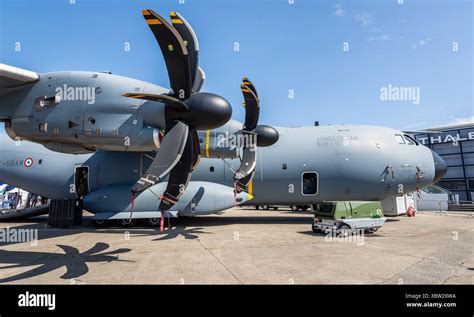
The unusual arrangement gives the Atlas a noise profile that is immediately recognizable to aviation enthusiasts and military personnel. Instead of a simple repetitive propeller rhythm, the A400M produces a deeper, complex acoustic pattern created by interacting blade movements, pressure waves, and airflow between the engines. This distinctive sound is not just an accidental byproduct of the design. It represents a major engineering decision intended to improve performance, reduce vibration, and make tactical operations more effective.
The A400M’s Down Between Engines Propeller System Explained
Most multi-engine turboprop aircraft use relatively conventional propeller arrangements. Aircraft such as the C-130 Hercules typically have propellers rotating in the same direction on each wing. Some aircraft use mirrored propeller rotation, where engines on opposite wings rotate in opposite directions to balance aerodynamic forces.
The A400M takes the concept further with its unique DBE configuration. Instead of simply reversing rotation between the left and right wings, Airbus designed each wing as an independent aerodynamic system. The two propellers on each wing rotate toward each other, directing airflow between the engine nacelles.
On the left wing, the outer propeller rotates clockwise while the inner propeller rotates counterclockwise. On the right wing, the pattern is reversed, with the inner propeller rotating clockwise and the outer propeller rotating counterclockwise. This means the propellers effectively push their strongest aerodynamic effects into the space between the engines rather than directly toward the aircraft fuselage.
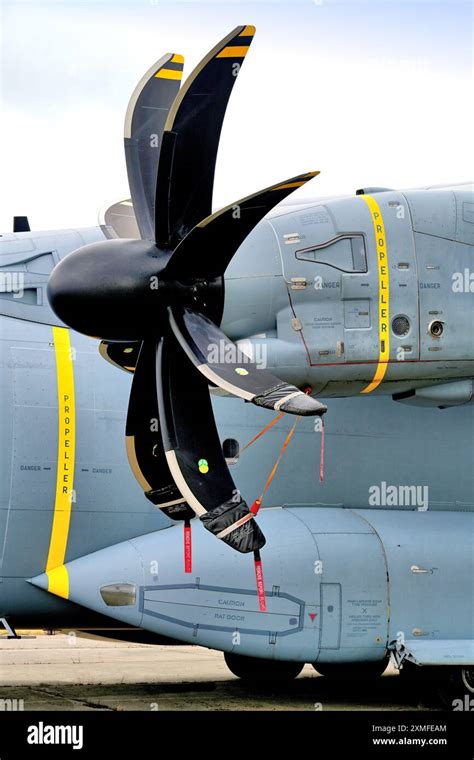
This arrangement creates several advantages. The propellers’ slipstreams combine into a more symmetrical airflow pattern over the wings, improving lift generation and reducing uneven forces. At the same time, the interaction between rotating blades changes the way sound waves travel away from the aircraft.
The result is a noise signature unlike traditional military transports. Instead of producing large amounts of vibration and uneven acoustic energy around the fuselage, the A400M’s propeller-generated pressure waves interact with each other between the engines. Some of these waves partially cancel each other through destructive interference, reducing certain frequencies that would otherwise contribute to cabin noise and structural vibration.
Why the A400M Sounds Different From Other Military Transports
The sound produced by a turboprop aircraft comes from several sources. The engines themselves generate mechanical noise, but much of the recognizable propeller sound comes from the movement of the blades through the air. Each blade creates pressure changes as it rotates, producing waves that combine into the familiar propeller noise heard from the ground.
On a conventional aircraft, these pressure waves can strike the fuselage and wings directly. The result is increased vibration, especially inside the cabin. For military transport aircraft carrying troops, this can create a difficult working environment during long missions.
The A400M’s DBE system changes this interaction. Because the propellers rotate toward each other, the strongest blade-tip vortices and pressure disturbances are concentrated in the area between the engines. Rather than sending asymmetric airflow across the aircraft, the propellers create a more balanced aerodynamic environment.
This does not make the A400M silent. A four-engine turboprop aircraft with massive eight-blade propellers will always produce significant sound. However, the character of that sound is different. Many observers describe the Atlas as having a deeper, smoother, and more complex propeller note compared with older military transports.
The unique acoustic signature comes from the relationship between blade rotation speed, propeller synchronization, engine power settings, and aerodynamic interaction. Each propeller is effectively communicating with the airflow created by the others, producing a sound pattern that is specific to the A400M.
How Reduced Noise Improves Military Operations
Noise reduction may seem like a secondary concern for a military aircraft designed to transport troops, equipment, and vehicles. However, in real-world operations, a quieter cabin environment can provide significant advantages.
The A400M can carry up to 116 fully equipped paratroopers, and airborne operations require precise coordination between crews and soldiers. During a parachute mission, jumpmasters must communicate instructions clearly, often in stressful conditions where timing is critical.
Traditional turboprop transports can create extremely loud internal environments, forcing personnel to rely heavily on hand signals or shouted commands. The A400M’s improved acoustic environment allows crews to communicate more effectively before and during airborne operations.
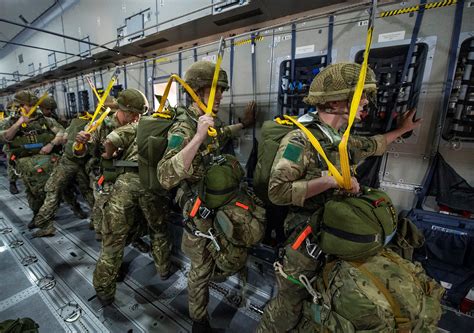
This improved communication can directly influence safety. Jump procedures involve multiple coordinated steps, including equipment checks, positioning, aircraft configuration, and timing with the drop zone. Clear communication reduces confusion and allows corrections to be made before soldiers leave the aircraft.
The benefits extend beyond airborne troops. Medical evacuation teams, humanitarian personnel, diplomats, and other passengers transported by the Atlas also experience a less exhausting environment during long flights. While the A400M is not as quiet as a commercial airliner, its cabin environment is significantly more comfortable than many older military transports.
DBE Propellers Reduce Vibration and Improve Aircraft Strength
The A400M’s unusual propeller design does more than reduce noise. It also changes how aerodynamic forces are distributed across the aircraft.
Traditional propeller aircraft experience significant torque effects. As propellers rotate, they generate twisting forces that must be absorbed by the wings and fuselage structure. Engineers designing conventional aircraft often need additional reinforcement to handle these loads.
The DBE system reduces these forces by balancing propeller effects on each wing. The counter-rotating arrangement minimizes asymmetric torque and creates a more stable aerodynamic environment.
This allows Airbus to reduce structural weight while maintaining strength. The A400M uses advanced composite materials, including carbon fiber reinforced components that make up a significant portion of the aircraft’s exterior structure. The combination of lightweight materials and balanced propulsion contributes to the Atlas’ impressive performance.
The reduced vibration also helps protect aircraft components. Lower structural stress means less fatigue over time, potentially reducing maintenance requirements and extending the service life of the airframe.
The Connection Between Noise Reduction and A400M Performance
The A400M’s unique propeller design was not created simply to make the aircraft quieter. The noise benefits are a consequence of a broader aerodynamic strategy designed to maximize performance.
One of the biggest advantages of the DBE arrangement is improved low-speed lift. The propellers accelerate large amounts of air over the wings, effectively increasing airflow across the wing surface even when the aircraft itself is moving at relatively low speed.
This gives the A400M exceptional short takeoff and landing capability. The aircraft can operate from shorter, rougher airfields that would challenge larger strategic transports.
The DBE system allows the Atlas to generate strong lift during takeoff while carrying heavy payloads. This capability was one of the aircraft’s primary design goals because European air forces wanted a transport positioned between the smaller C-130 and larger strategic aircraft such as the C-17 Globemaster III.
The result is an aircraft capable of carrying oversized military equipment while still operating from austere locations. The same engineering choices that produce its distinctive sound also contribute to its tactical flexibility.
A Unique Acoustic Identity in Modern Military Aviation
Military aircraft often develop recognizable identities through their appearance, performance, or sound. The A400M Atlas has all three. Its large swept wings, massive propellers, and unusual engine arrangement make it visually distinctive, while its acoustic signature separates it from nearly every other transport aircraft in service.
The aircraft’s sound represents the combination of advanced propulsion technology and aerodynamic innovation. The DBE configuration demonstrates how engineers can use unconventional solutions to solve multiple challenges simultaneously: reducing vibration, improving lift, increasing safety, and creating a more efficient transport platform.
The A400M’s propellers are not simply powerful—they are carefully choreographed aerodynamic systems. Every rotation of every blade influences airflow, structural loads, and the sound produced by the aircraft.
That is why the Atlas sounds unlike any other military transport. Its unique noise signature is a direct reflection of its equally unique engineering philosophy: using advanced design to create an aircraft that is quieter, stronger, safer, and more capable in demanding military environments.
Why the A400M Atlas Remains One of Aviation’s Most Innovative Transports
The Airbus A400M represents a rare combination of technologies that have never been brought together in quite the same way. Its TP400 engines, carbon composite structure, advanced flight systems, and DBE propeller arrangement create a transport aircraft unlike anything before it.
The distinctive sound heard from the ground is more than an acoustic curiosity. It is evidence of a propulsion system designed around efficiency and control. The A400M’s unusual propeller rotation pattern demonstrates how aerospace engineers can transform a traditional concept—the turboprop engine—into something significantly more advanced.
For military operators, the benefits are practical. A quieter cabin improves communication, balanced airflow improves handling, reduced vibration improves durability, and enhanced lift improves tactical mobility.
The A400M Atlas does not merely carry cargo and troops. It represents a new generation of tactical airlift engineering, where every design decision, including the way its propellers create sound, contributes to a more capable battlefield transport aircraft.