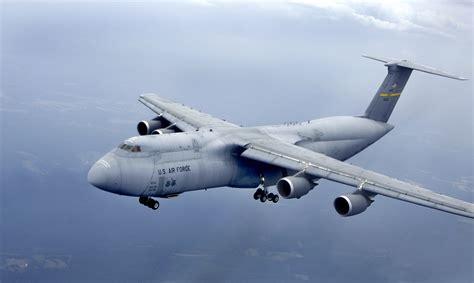
The Lockheed C-5 Galaxy does not arrive quietly. Long before its enormous silhouette becomes visible, the air itself seems to tense up, vibrating with a rising, metallic howl that feels less like an airplane and more like a force of nature announcing itself. For seasoned aviation enthusiasts, that sound is instantly recognizable. For everyone else, it can be startling, even unsettling, because it bears little resemblance to the smooth, muted roar associated with modern commercial jets.
That unique acoustic signature is not an accident, nor is it a quirk of poor design. It is the audible result of Cold War engineering priorities, early high-bypass turbofan technology, and a mission profile that valued raw strategic reach and lifting power above refinement or community noise concerns. The C-5 Galaxy sounds the way it does because it was designed to move the unmovable, across oceans, at a time when silence was irrelevant and capability was everything.
Understanding why the C-5 sounds so distinctive requires peeling back layers of aeronautical history, propulsion science, and operational philosophy. Its sound is not just noise; it is a living artifact from a specific era of military aviation, preserved in aluminum, titanium, and turbulent airflow.
A Strategic Airlifter Built for a Different Era
The C-5 Galaxy emerged from one of the most demanding requirements ever issued by the US Air Force. In the early 1960s, the Pentagon needed an aircraft capable of transporting outsized and overweight cargo across intercontinental distances without relying on overseas bases or specialized loading infrastructure. This was not about efficiency or elegance. This was about global reach, the ability to deliver tanks, helicopters, and entire logistical ecosystems anywhere on Earth.
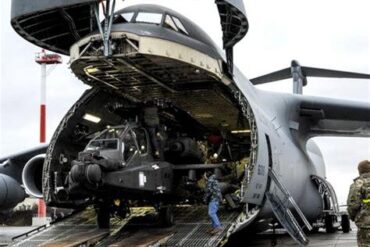
First flown in 1968, the C-5 was revolutionary in scale. With a wingspan of over 222 feet, a length exceeding 247 feet, and a maximum takeoff weight approaching 840,000 pounds, it dwarfed anything that came before it. Its cavernous cargo hold could swallow main battle tanks, CH-47 Chinooks, and even space hardware with room to spare.
Yet despite its visual dominance, it was the sound that left the deepest impression. During takeoff and initial climb, the C-5 produced a rising, resonant whine that seemed to bend the air itself. This was not the sharp crackle of turbojets nor the smooth rush of modern turbofans. It was something stranger, heavier, and far more dramatic.
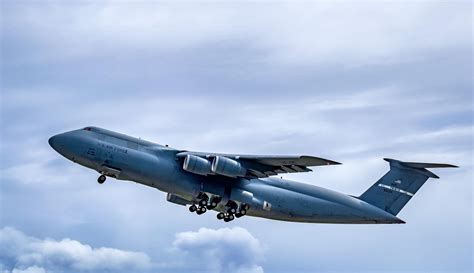
Operationally, the Galaxy justified every decibel. During Operation Desert Storm, C-5s carried nearly 44 percent of all airlifted cargo, despite making up a small fraction of the airlift fleet. Over decades, the aircraft became a backbone of US global mobility, proving that its design philosophy, however loud, was brutally effective.
The TF39 Engine: The True Voice of the Galaxy
At the core of the C-5’s sound lies the General Electric TF39, one of the earliest high-bypass turbofan engines ever fielded. Each legacy C-5 was powered by four TF39-GE-1C engines, each producing roughly 41,000 pounds of thrust. In the late 1960s, this was cutting-edge technology.
The TF39 introduced a bypass ratio of approximately 6:1, meaning far more air was pushed around the engine core than through it. This dramatically improved fuel efficiency and made the Galaxy’s immense payload possible. However, early high-bypass engines lacked many of the noise-mitigation technologies that define modern turbofans.
Acoustic liners inside the nacelle were rudimentary. Fan blade shaping was optimized for thrust, not tonal suppression. Exhaust mixing between hot core flow and bypass air was minimal. The result was an engine that moved staggering volumes of air with very little concern for how loudly it did so.
As the engines spooled up for takeoff, especially under heavy loads, the TF39 produced a distinctive high-frequency fan whine layered over deep, turbulent airflow noise. This sound intensified as the engines approached maximum power, creating the famous rising howl that made the C-5 audible miles before it appeared.
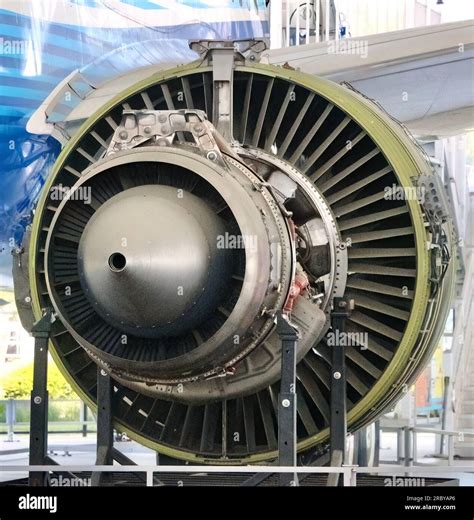
Ground crews often described the sound as physical, something felt in the chest as much as heard in the ears. Pilots likened it to a sustained musical chord under tension, a fitting metaphor for an engine operating near the limits of what 1960s metallurgy and aerodynamics could support.
The Physics Behind That Unmistakable Howl
From an acoustic science perspective, the C-5’s sound is the product of fan noise dominance, scale effects, and turbulent airflow interacting at extreme power settings. Fan noise occurs when large fan blades slice through incoming air, creating pressure fluctuations that radiate outward as sound waves.
In the TF39, those blades were enormous, and they rotated at speeds that generated strong tonal peaks in the human hearing range. These peaks often clustered around the 1–2 kHz frequency band, which the human ear perceives as particularly piercing. That frequency range is a key reason the C-5’s sound feels so sharp and unsettling, even at a distance.
Compounding this was the engine’s simple exhaust geometry. Without modern chevrons or advanced mixers, the exhaust flow preserved its tonal character instead of diffusing it. Add in the turbulence generated by the massive nacelles and wing interaction, and the result was a layered acoustic signature that felt raw and unfiltered.
Sound pressure levels near a fully powered C-5 could approach or exceed 120 decibels, well into the range requiring hearing protection. Unlike modern engines designed to soften and spread noise, the TF39 let it escape almost unrestrained, turning the Galaxy into an audible landmark.
Loading, Thrust, and the Sound of Strain
The C-5’s sound was not static. It changed depending on payload weight, ambient conditions, and departure profile. A lightly loaded Galaxy departing for a ferry flight produced a cleaner, sharper whine, with less low-frequency rumble beneath it.
At maximum gross weight, however, the aircraft sounded entirely different. The engines labored against gravity, producing a deeper undertone that blended with the high-pitched fan noise. This combination created a sense of strain and power, as if the aircraft were dragging the planet itself into the sky.
Military airlift operations often required maximum-thrust departures, unlike commercial flights optimized for noise abatement. That operational reality kept the TF39 operating in its loudest regime far more often than civilian engines ever would, cementing the C-5’s reputation as one of the loudest aircraft in regular service.
Re-Engining the Giant: The C-5M Super Galaxy
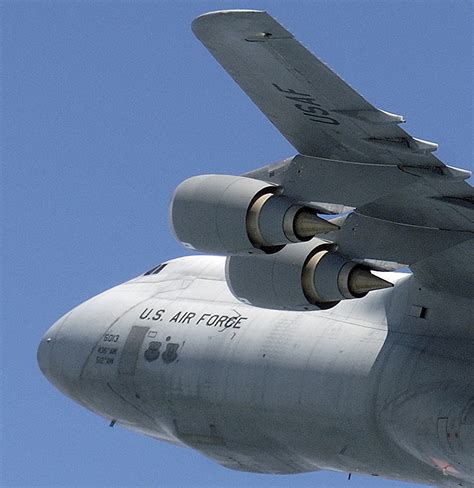
By the early 2000s, the C-5’s sound had become both iconic and problematic. Noise regulations, maintenance costs, and reliability concerns drove the US Air Force to modernize the fleet through the Reliability Enhancement and Re-engining Program. The result was the C-5M Super Galaxy, powered by General Electric F138 engines, a military variant of the CF6-80C2.
Each new engine delivered over 51,000 pounds of thrust, a significant increase over the TF39. More importantly, they incorporated decades of advancements in aerodynamics, materials, and acoustic control. Fan blades were reshaped for smoother airflow. Nacelles featured improved acoustic liners. Exhaust flows were better mixed to reduce tonal noise.
The difference was immediate and dramatic. Pilots reported shorter takeoff rolls, steeper climbs, and vastly improved reliability. Observers on the ground noticed something else: the howl was gone. In its place was a deeper, smoother roar more reminiscent of older widebody airliners.
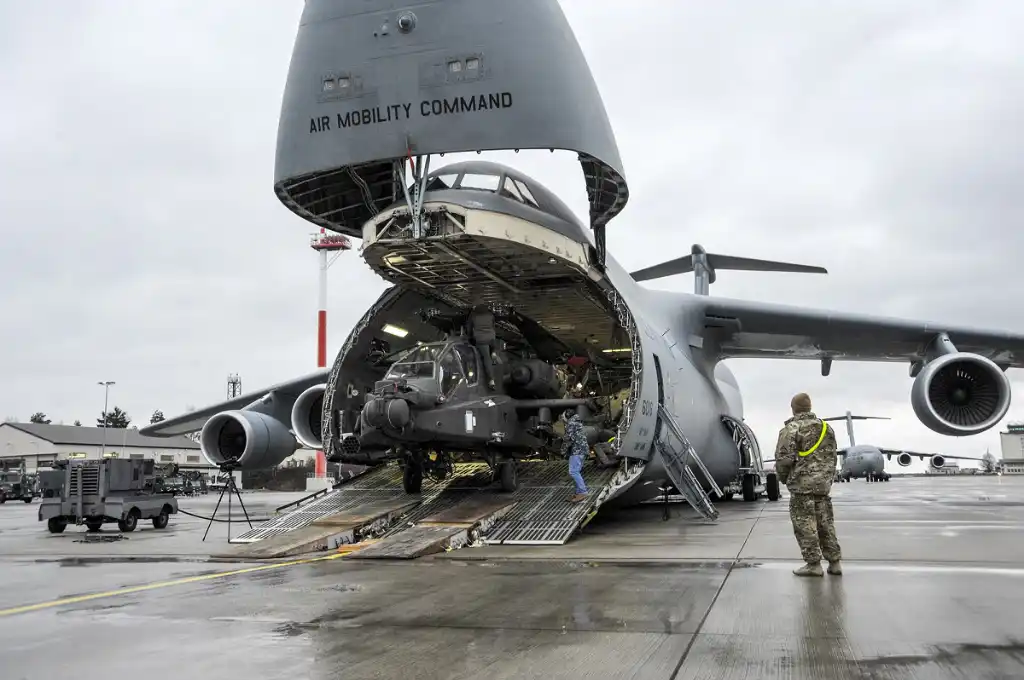
While still loud by civilian standards, the C-5M’s noise footprint is tens of decibels lower than that of its predecessors, depending on conditions. The aircraft retained its physical presence but lost much of its auditory intimidation.
How the C-5 Compares to Other Heavy Lifters
The uniqueness of the C-5’s sound becomes clearer when compared to other large aircraft. The C-17 Globemaster III, powered by Pratt & Whitney F117 engines, produces a controlled, low-frequency rumble optimized for short-field operations and reduced community impact. It sounds powerful, but never piercing.
The Antonov An-124, another giant of the skies, emits a heavy, bass-rich roar from its Progress D-18T engines. Its sound is imposing but lacks the high-frequency scream that defined the TF39-powered Galaxy.
Commercial widebodies, especially modern designs, prioritize compliance with strict noise standards. Their engines are engineered to avoid sustained maximum-thrust operation and to spread sound energy across less intrusive frequencies. Compared to them, the legacy C-5 sounds almost alien, a relic from a time before acoustic diplomacy mattered.
An Audible Fingerprint of Engineering Priorities
The C-5 Galaxy’s sound is ultimately a story about trade-offs. Every design choice reflects a priority, and in the 1960s, those priorities were clear. Lift the heaviest loads. Fly the farthest distances. Do it reliably, regardless of how it sounds.
Noise reduction was not ignored, but it was secondary. The result was an aircraft whose acoustic signature became inseparable from its identity. That rising howl was the sound of strategic reach, of deterrence logistics, of a military prepared to move mountains if necessary.
As propulsion technology advanced, those priorities shifted. Efficiency, reliability, and environmental impact took center stage, smoothing the rough edges of aviation’s soundscape. The C-5M embodies that evolution, quieter, cleaner, and more refined.
The Fading Echo of a Legendary Sound
Today, the classic TF39-powered C-5 sound is rapidly disappearing. With the fleet fully transitioned to the C-5M Super Galaxy, that eerie howl survives mostly in recordings, memories, and museum visits. It is a reminder of an era when aircraft announced themselves with authority, unconcerned with subtlety.
Future airlifters will almost certainly be quieter still, their engines optimized to whisper efficiency rather than shout power. That is progress, undeniably. Yet something is lost along the way, an auditory connection to a time when engineering left bold, unmistakable fingerprints on the sky.
The C-5 Galaxy’s unique sound was never just noise. It was the voice of a mission, a philosophy, and a moment in history. And for those who heard it rise over the horizon, it is a sound that will never truly fade.