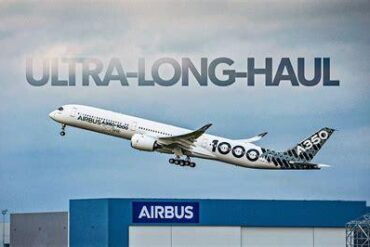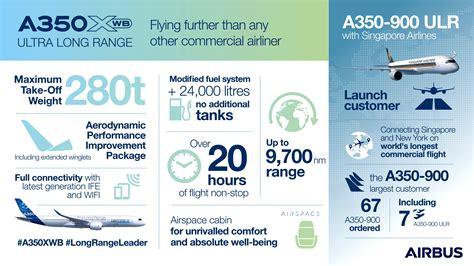
The Airbus A350-1000 has earned a reputation across the global airline industry for delivering exceptional fuel efficiency on missions where every kilogram of fuel burned directly impacts profitability. We are not discussing marginal gains or optimistic brochure figures, but a real-world performance envelope that consistently surprises operators with how little fuel the aircraft consumes relative to its size, payload capability, and range. In an era where fuel represents the largest and most volatile cost item on long-haul routes, this advantage fundamentally reshapes route economics.
Fuel efficiency at this level is not accidental. It is the outcome of a holistic design philosophy that integrates aerodynamics, propulsion, structural engineering, and systems architecture into a single coherent platform. The A350-1000 was conceived from the outset as a next-generation widebody designed to outperform legacy aircraft across every meaningful efficiency metric, particularly fuel burn per seat and per tonne of payload carried.
What makes the A350-1000 remarkable is that its efficiency is achieved without sacrificing range, speed, or payload. On the contrary, the aircraft thrives precisely because it balances these competing requirements better than any large twin currently in service. We will examine why this balance exists, how it is engineered into the aircraft, and why it translates into what many operators accurately describe as an “insane” fuel burn advantage.
The economic implications are profound. Lower fuel burn does not merely reduce operating costs; it enables airlines to open thinner long-haul routes, carry more cargo on existing services, and significantly reduce emissions per passenger-kilometre. These benefits compound over the aircraft’s lifecycle, delivering superior cash flows rather than just incremental savings.
Aerodynamic Excellence: A Wing Engineered for Growth and Efficiency
The A350-1000’s fuel efficiency story begins with its aerodynamic architecture, which reflects one of the most advanced applications of computational fluid dynamics ever deployed on a commercial aircraft. From the earliest design phase, Airbus pursued drag minimisation across all flight regimes, not only at cruise but also during climb, descent, and high-weight operations.
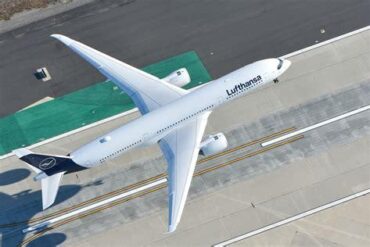
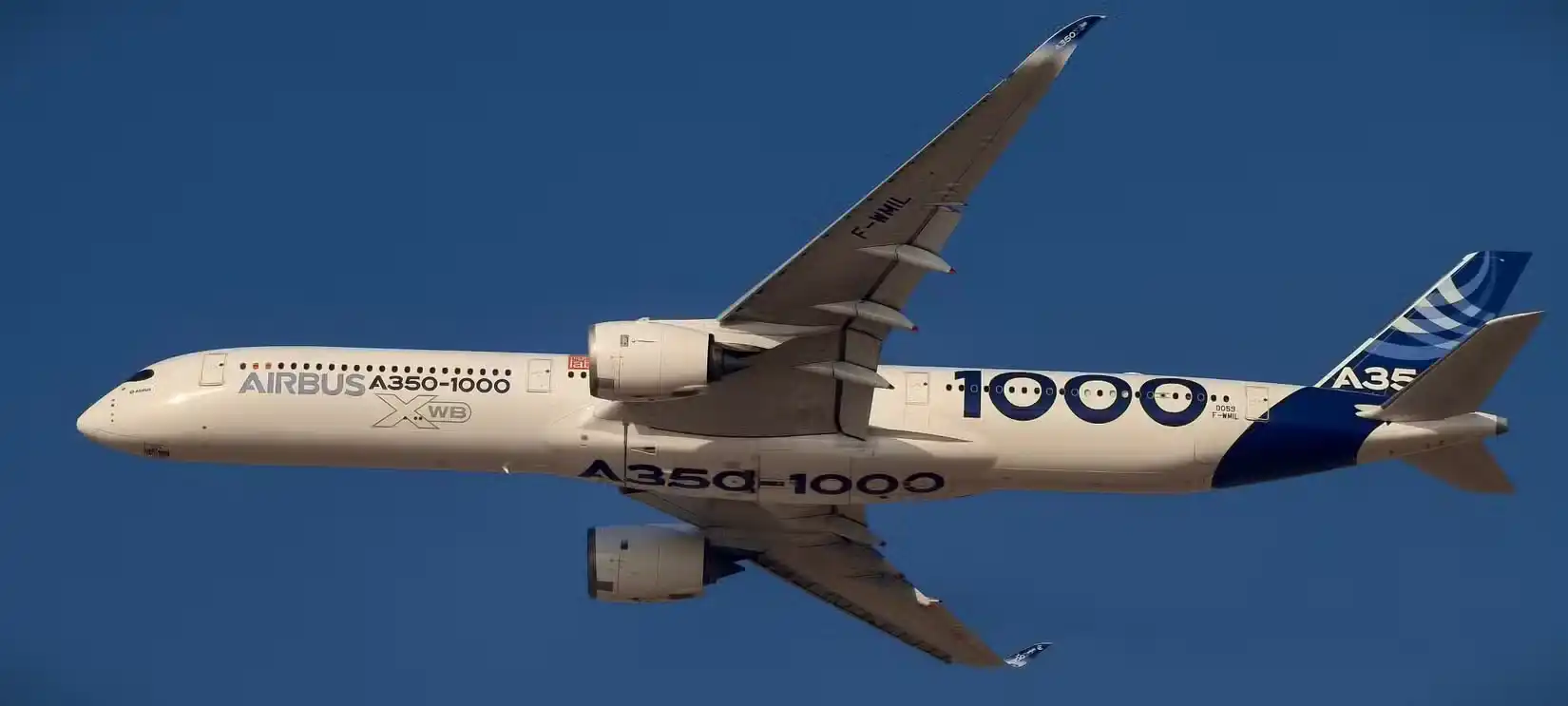
The aircraft shares the same 64.75-metre wingspan as the A350-900, a deliberate choice that reveals the program’s long-term thinking. This wing was engineered with significant growth margin, allowing the -1000 to carry a longer fuselage and higher maximum take-off weight without incurring a proportional drag penalty. As a result, the A350-1000 transports substantially more passengers on essentially the same aerodynamic platform, lowering fuel burn per seat through scale efficiency rather than brute-force thrust.
Subtle yet powerful design features amplify this advantage. The wing’s natural laminar flow characteristics reduce parasitic drag, while advanced winglets optimise vortex behaviour at the tips. The adaptive wing structure subtly morphs under load, maintaining an optimal lift distribution throughout the flight envelope. Each of these refinements contributes incrementally, but together they produce a cruise lift-to-drag ratio that surpasses older-generation widebodies by a meaningful margin.
The Rolls-Royce Trent XWB-97: An Engine Built Around the Airframe
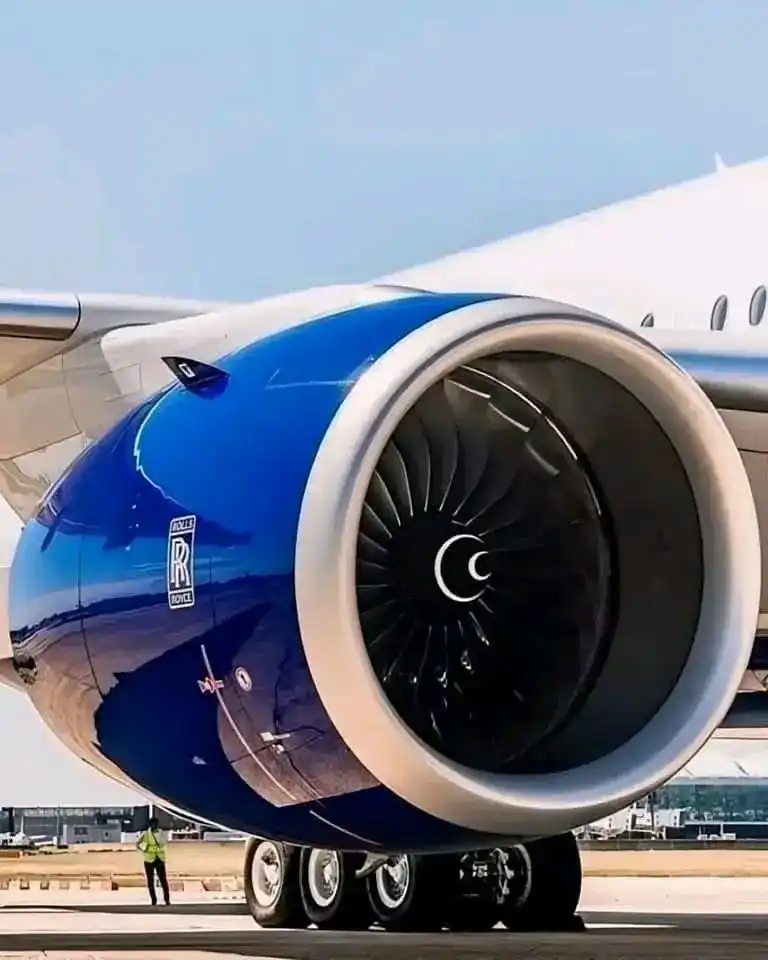
At the heart of the A350-1000’s fuel efficiency lies the Rolls-Royce Trent XWB-97, an engine developed not as a derivative but as a bespoke powerplant optimised specifically for this airframe. This integration between engine and aircraft is critical, as even the most efficient wing cannot compensate for an inefficient propulsion system.
The Trent XWB-97 delivers nearly 97,000 pounds of thrust while maintaining exceptionally low specific fuel consumption for an engine in its class. Its very high bypass ratio significantly improves propulsive efficiency, meaning more of the fuel’s energy is converted into useful thrust rather than wasted as heat and noise. Advanced core aerodynamics allow the engine to operate at higher overall pressure ratios, extracting more work from each unit of fuel burned.
Equally important are the materials and manufacturing techniques embedded within the engine. Ceramic matrix composites and advanced single-crystal turbine blades enable higher operating temperatures without compromising durability. These thermal efficiency gains translate directly into lower fuel flow across all phases of flight, from take-off to long-range cruise.
Operational feedback reinforces the technical data. Pilots consistently report lower-than-expected fuel flows during climb and cruise, even at high weights. This is a practical demonstration that the engine-airframe match is not merely theoretical but delivers tangible results on real routes under real conditions.
Composite Structure: Weight Reduction Without Structural Compromise
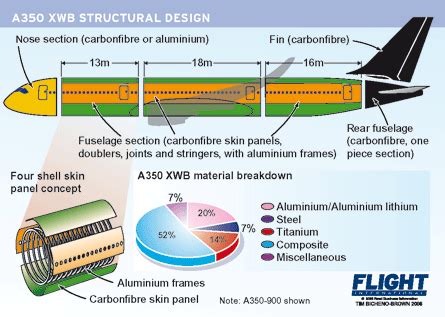
Weight is fuel’s most persistent enemy, and the A350-1000 addresses this reality through one of the most extensive uses of carbon-fibre composites ever seen on a commercial aircraft. Over 53 percent of the airframe’s primary structure is made from advanced composites, including the fuselage barrels, wing box, and major control surfaces.
This structural approach offers multiple efficiency advantages simultaneously. Composites are significantly lighter than aluminium for equivalent strength, allowing Airbus to reduce operating empty weight without sacrificing structural integrity. Thinner panels, fewer fasteners, and simplified joints further reduce mass while also lowering long-term maintenance requirements.
The impact on fuel burn is direct and compounding. A lighter airframe requires less thrust to maintain cruise speed, which reduces engine fuel flow. Over thousands of flight hours per year, even modest weight savings translate into hundreds of tonnes of fuel saved. Additionally, composites resist fatigue and corrosion far better than traditional materials, allowing the aircraft to retain its weight advantage throughout its service life rather than gradually gaining mass through repairs and reinforcements.
Because the A350-1000 is a stretched variant of an already composite-intensive design, it achieves higher seating capacity without incurring the weight penalties that plagued stretched derivatives of earlier aluminium aircraft. This structural efficiency is a cornerstone of its per-seat fuel burn superiority.
Scale Efficiency: Why More Seats Mean Lower Fuel Burn per Passenger
Fuel efficiency in modern airline economics is measured not by total fuel burned, but by fuel burned per seat and per unit of payload. The A350-1000 excels precisely because it leverages scale efficiency better than any aircraft in its category.
The stretch from the A350-900 to the -1000 adds significant seating and cargo capacity while increasing drag and fuel burn only marginally. This asymmetry is crucial. Each additional row of seats generates incremental revenue at a far lower incremental fuel cost, pushing down the overall cost per available seat-kilometre.
On dense long-haul routes, the effect is dramatic. Airlines can carry more passengers and more belly cargo on each flight while consuming only slightly more fuel than smaller variants. The result is a structural cost advantage that cannot be replicated through operational optimisation alone.
Importantly, this efficiency is resilient across a wide range of missions. Whether operating ultra-long-haul sectors or high-frequency intercontinental routes, the A350-1000 consistently delivers strong per-seat economics, making it one of the most versatile widebodies ever produced.
Operational Reality: Fuel Savings Confirmed in Daily Service
Theoretical efficiency matters, but operational performance is the ultimate test. Across multiple operators, the A350-1000 has demonstrated an unusual tendency to beat planned fuel burn figures, often by two to four percent on long sectors. In an industry where planning margins are already tight, this level of outperformance is striking.
Pilots and dispatchers report that block fuel numbers frequently come in below forecasts, even under adverse wind conditions. During take-off and climb, phases traditionally associated with high fuel flow, the aircraft’s efficient engines and low structural weight keep consumption remarkably controlled.
When these savings are extrapolated across an entire fleet and a full year of operations, the financial impact becomes substantial. Airlines routinely avoid burning hundreds of tonnes of fuel annually per aircraft, translating into millions of dollars in reduced operating costs and a significant reduction in carbon emissions.
Continuous Improvement: Efficiency That Gets Better Over Time
One of the most underappreciated aspects of the A350-1000’s fuel burn advantage is that it is not static. Airbus and Rolls-Royce treat aircraft performance as a living system, continuously refined through software updates, aerodynamic tweaks, and engine enhancement packages.
Incremental improvements in engine efficiency, flight management algorithms, and drag reduction compound over time. Each update may deliver only a fraction of a percent in fuel savings, but collectively they ensure that the A350-1000 remains at the forefront of efficiency even as competing designs enter service.
This continuous improvement philosophy is particularly important given the long service life of widebody aircraft. An A350-1000 delivered today will likely be more fuel-efficient five years from now than it was at entry into service, further extending its economic advantage.
Why the A350-1000’s Fuel Burn Advantage Truly Is “Insane”
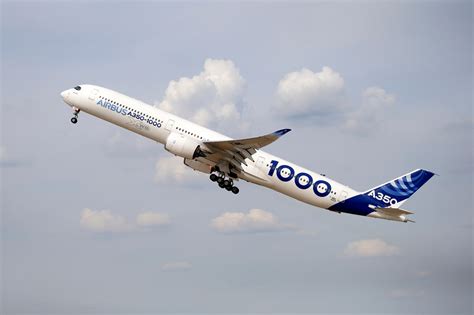
The A350-1000’s extraordinary fuel efficiency is not the result of a single breakthrough but the outcome of integrated excellence across every major design domain. A low-drag wing engineered for growth, a lightweight composite structure, an industry-leading engine optimised for the airframe, and relentless incremental improvement all converge to produce an aircraft that fundamentally outperforms its peers.
For airlines, this translates into lower costs, higher margins, and greater operational flexibility. For passengers, it means lower emissions per journey and the long-term sustainability of global air travel. And for the industry as a whole, the A350-1000 sets a benchmark that future widebodies will be measured against for decades.
In a market where fuel efficiency defines competitiveness, the Airbus A350-1000 does not merely compete. It redefines what is possible.