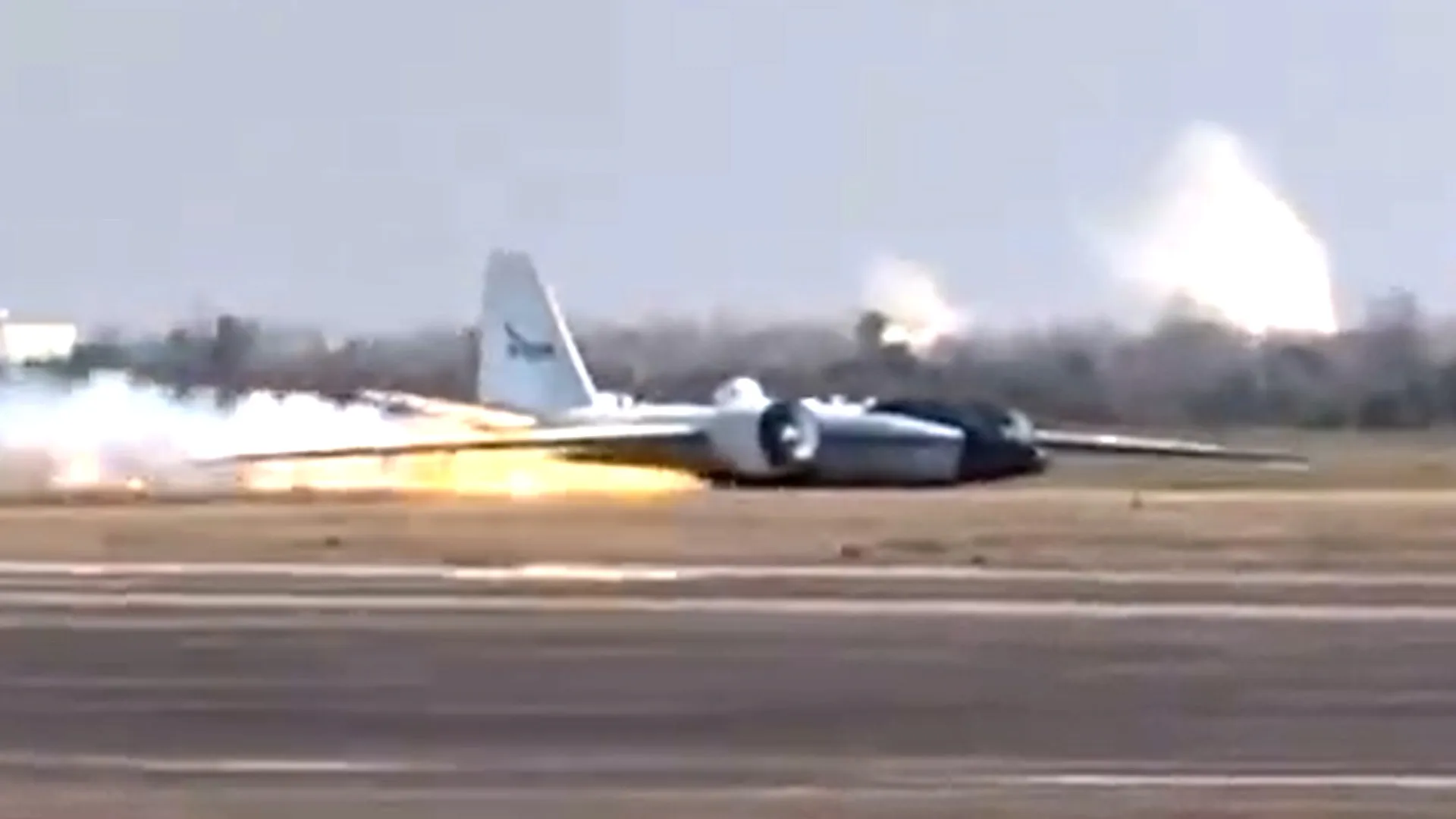
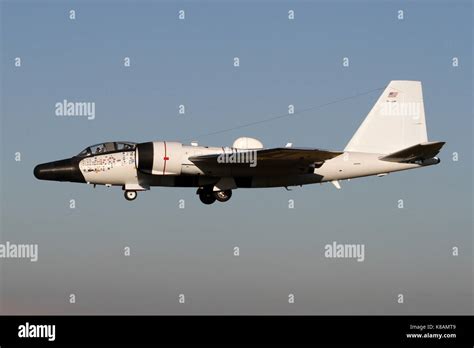
On a quiet January morning in Texas, one of the United States’ rarest high-altitude reconnaissance aircraft scraped across a runway in a shower of sparks, its landing gear stubbornly refusing to deploy. The aircraft was not a fighter jet or a bomber, but something far more obscure and historically charged: NASA’s WB-57F, a Cold War–era platform once designed for nuclear spying, atmospheric sampling, and covert intelligence missions. The dramatic belly landing at Ellington Airport in Houston instantly reignited attention around a machine that has spent most of its life operating above politics, radar, and public awareness.
The incident occurred on January 27, when the twin-engine aircraft returned from a mission and encountered a mechanical landing-gear failure. Video footage captured by bystanders and later shared widely on social media showed the long-winged jet touching down without wheels, sliding down the runway as flames licked from beneath its fuselage. Despite the violence of the landing, both crew members survived, exiting the aircraft with assistance from first responders. NASA confirmed that all personnel were safe and that a full investigation was underway.
At first glance, the event appeared to be a narrow aviation mishap. In reality, it exposed how fragile—and how irreplaceable—America’s remaining fleet of high-altitude scientific and reconnaissance aircraft has become.
A Near Loss for an Almost Extinct Aircraft
Only 21 WB-57F aircraft were ever built, and today NASA operates just three, all based at the Johnson Space Center in Houston. These aircraft are not museum pieces; they remain actively deployed for missions that no modern jet can fully replicate. A single loss would significantly reduce NASA’s ability to conduct high-altitude atmospheric research, sensor testing, and strategic observation missions.
NASA described the incident succinctly on X, stating that a “mechanical issue resulted in a gear-up landing” and emphasizing transparency as the investigation proceeds. What remains unknown is whether the damaged aircraft can be returned to flight. If structural damage proves too severe, NASA’s operational WB-57F fleet could shrink to just two aircraft, a razor-thin margin for a capability that supports both civilian science and national security objectives.
The landing itself underscored the professionalism of the crew. Bringing a heavy, long-winged aircraft down safely without landing gear demands precise energy management, calm decision-making, and intimate familiarity with the aircraft’s handling quirks. That skill, like the aircraft itself, is increasingly rare.
The WB-57F’s Secretive Cold War Origins
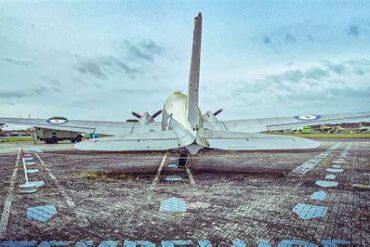
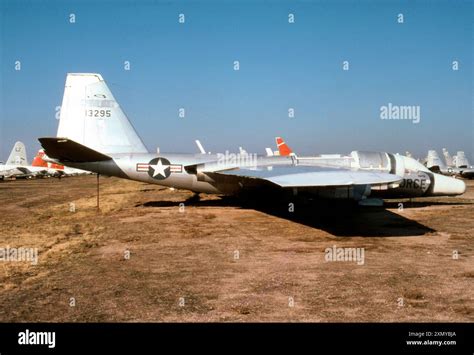
The WB-57F did not begin life as a NASA research tool. Its roots lie deep in the Cold War intelligence race, where altitude meant survival and information meant power. Developed in the early 1960s by General Dynamics, the aircraft was derived from the Martin B-57 Canberra, itself an American adaptation of the British English Electric Canberra bomber.
The first RB-57F prototype flew on June 23, 1963, entering U.S. Air Force service a year later. Officially, it belonged to the Air Weather Service, but that designation was largely a veil. In practice, the RB-57F specialized in high-altitude atmospheric sampling and radiation detection, quietly collecting data from nuclear tests conducted by adversaries.
In 1968, the aircraft was redesignated WB-57F, reinforcing the weather-research narrative. Behind that label, however, the aircraft continued to play a role in monitoring nuclear fallout, missile telemetry, and weapons development activities across the globe. It was a flying laboratory with a strategic edge.
Designed to Fly Where Others Couldn’t
Technically, the WB-57F occupies a unique niche. It is a mid-wing, twin-engine aircraft capable of sustained operations above 63,000 feet, well into the lower stratosphere. Two crew members sit in tandem cockpits, separated by function: the pilot flies the aircraft, while the sensor equipment operator manages a complex array of scientific and surveillance payloads distributed across the fuselage, wings, and tail.
The aircraft can remain airborne for approximately 6.5 hours, with a range of about 2,500 miles and a payload capacity of 8,800 pounds. That payload flexibility is its defining strength. Unlike sleeker spy planes, the WB-57F can carry bulky, power-hungry instruments designed for radiation sampling, atmospheric chemistry analysis, infrared imaging, and classified sensor testing.
This combination of altitude, endurance, and payload has kept the WB-57F relevant long after most of its contemporaries were retired or scrapped.
Not a U-2, But Often Mistaken for One
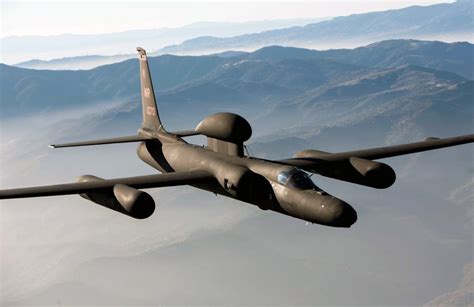
During the Cold War, the WB-57F was frequently confused with the far more famous Lockheed U-2 Dragon Lady. The comparison is understandable but misleading. The U-2 is a single-engine, ultra-high-altitude aircraft optimized for stealth and penetration, capable of flying above 70,000 feet with a minimal radar cross-section.
The WB-57F, by contrast, trades some altitude for payload capacity and versatility. Where the U-2 carries lighter, specialized sensors deep into denied airspace, the WB-57F excels at heavy scientific missions, loitering in international airspace or friendly territory while sampling the upper atmosphere. In short, the U-2 was built to spy unseen; the WB-57F was built to measure, collect, and endure.
Combat Encounters and International Incidents
Despite its scientific cover, the RB-57F saw real danger. During the 1965 India-Pakistan War, RB-57F aircraft operated by the Pakistan Air Force’s 24th Squadron conducted reconnaissance missions over contested regions. On September 11, 1965, one such aircraft was damaged during descent after an SA-2 Guideline surface-to-air missile detonated nearby. The aircraft survived and made a forced landing at Peshawar, later repaired and returned to the United States.
Another RB-57F disappeared over the Black Sea after departing from Turkey on a mission to collect telemetry from Soviet ICBM tests near Kapustin Yar. Western sources attributed the loss to technical failure, but persistent speculation holds that the aircraft was shot down by a Soviet S-75 Dvina SAM. The two crew members were never recovered, a grim reminder that “weather reconnaissance” was often anything but benign.
From Military Shadow to NASA Asset
By the early 1970s, advances in satellites and newer reconnaissance platforms made the WB-57F less central to military intelligence. Most of the fleet was retired, but four aircraft were transferred to NASA, where they found a second life. Three remain operational today.
Under NASA, the WB-57F has supported missions ranging from ozone layer studies to volcanic plume analysis, eclipse observation, and sensor validation for future space missions. The aircraft’s ability to carry experimental payloads to extreme altitudes makes it invaluable for testing instruments before they are committed to orbit.
Yet age is catching up. These aircraft are now over 60 years old, maintained through meticulous inspection, custom-fabricated parts, and institutional knowledge that cannot be easily replaced.
What the Texas Incident Really Signals
The Texas belly landing was not just an aviation scare. It was a warning about the limits of legacy platforms in an era of accelerating technological change. While the WB-57F remains unmatched in certain roles, every incident raises questions about sustainability, cost, and risk.
Replacing it would not be simple. Modern business jets lack the altitude. Unmanned systems lack the payload flexibility and human oversight. Satellites cannot replicate the precision, adaptability, and recoverable sampling that the WB-57F provides. For now, there is no true successor waiting in the wings.
The aircraft’s survival on that Houston runway symbolized more than good airmanship. It marked the continued survival of a Cold War relic that still quietly underpins modern science and security. As investigators assess the damage, the fate of one aircraft may shape the future of an entire capability—one born in secrecy, sustained by necessity, and kept alive by a small cadre of engineers, pilots, and scientists who understand that some tools are worth preserving, no matter how old their blueprints may be.