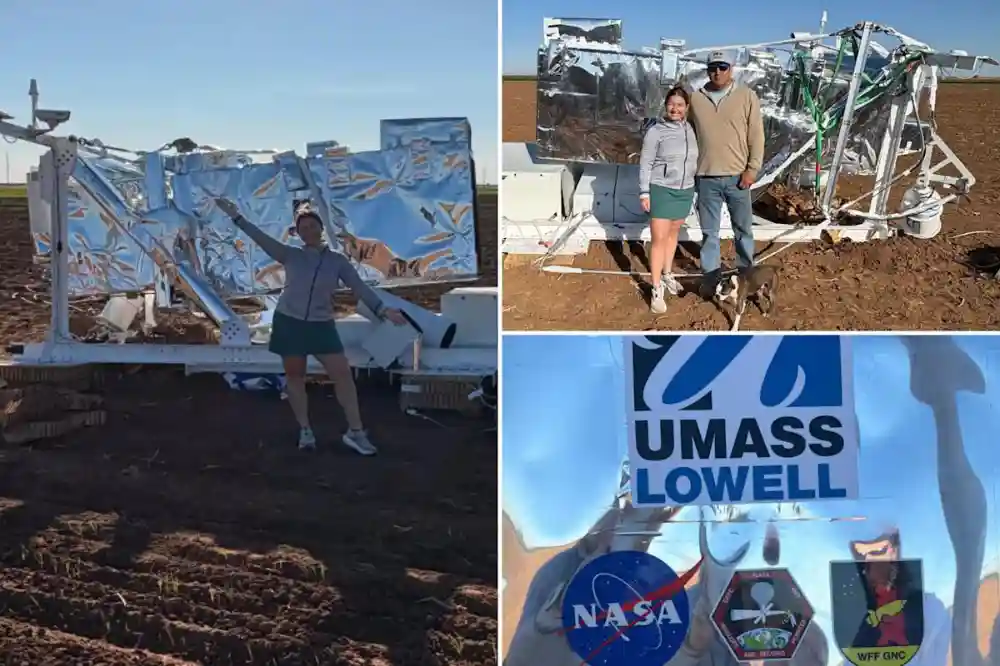
In the quiet, sun-drenched fields of rural Texas, a scene more befitting a science fiction epic unfolded in early October 2025. Ann Walter, a local resident, stood with her family in awe as a massive object suspended from a parachute glided through the sky before crashing into a neighbor’s wheat field. What she witnessed was not a meteor, drone, or classified military tech—but NASA scientific equipment, a physical echo of humanity’s push into the cosmos.
A Surreal Skyfall in the Lone Star State
On an otherwise uneventful afternoon, Walter noticed a large parachute cutting silently through the blue Texas sky. Beneath it hung a metallic behemoth, roughly the size of an SUV. With no prior warning or alerts from authorities, the Walter family could do nothing but watch in a mixture of shock and fascination as the object descended and landed with a muted thud in the nearby wheat field.
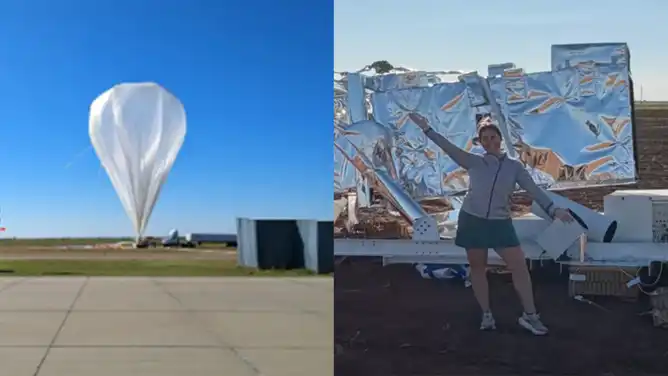
Upon approaching the site, what they found wasn’t a downed aircraft or lost hiker, but an unoccupied hulk of complex equipment, bristling with sensors, hardware panels, and scientific tagging. It was, unmistakably, something out of this world—both literally and metaphorically.
The Columbia Scientific Balloon Facility’s Forgotten Payload
Authorities later confirmed that the object belonged to the Columbia Scientific Balloon Facility (CSBF), a key NASA division based in Palestine, Texas. The CSBF operates high-altitude research balloons, designed to carry advanced astronomical instruments to the edges of Earth’s atmosphere. These balloons help scientists study distant stars, galaxies, black holes, and other celestial phenomena with clarity unachievable from the ground.
The equipment had been launched from Fort Sumner, New Mexico, just the day before, on a routine scientific mission. However, sometime during its atmospheric voyage, it detached from its balloon and began a controlled descent using a recovery parachute system—a process designed for remote terrains, but never foolproof.
No Warning, No Harm, But What If?
Walter described the event as “cool and surreal,” echoing the awe-struck wonder of those lucky enough to witness a literal piece of NASA fall from the sky. But the incident wasn’t without its ominous undertones. There had been no public warning or advisory from NASA or local authorities. The situation could have been far graver had the equipment landed near homes, schools, or roadways.
This brings to light a growing concern among scientists and aerospace experts: the rising threat of space debris and orbital returns.
Low Earth Orbit: The World’s Largest Garbage Dump
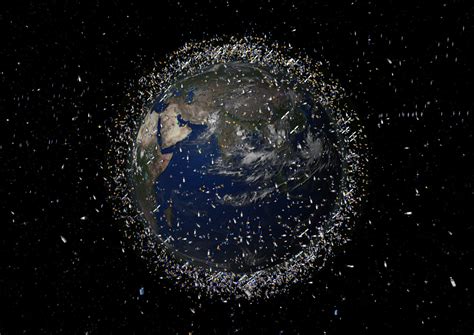
The atmosphere above Earth, especially Low Earth Orbit (LEO), has become a congested belt of defunct satellites, rocket boosters, and space junk. According to NASA, nearly 6,000 tons of space debris currently orbit the planet—much of it untrackable or unpredictable during re-entry. While most of this material disintegrates upon re-entering Earth’s atmosphere, larger fragments often survive and can pose a danger to life and property.
In 1997, for instance, an American woman named Lottie Williams became the first person known to be struck by space debris—a harmless metal fragment from a Delta II rocket. Fortunately, she wasn’t injured, but the risk was—and remains—real.
Scientific Balloons: Space Research from Earth’s Edge
Though not technically space debris, the CSBF’s payload adds to the conversation surrounding the return and recovery of aerial scientific instruments. These research balloons operate at altitudes of over 120,000 feet, collecting invaluable data before their controlled descent.
CSBF’s balloons serve not just NASA, but also universities and international space agencies. Missions range from cosmic microwave background studies to ultraviolet observations of distant galaxies. Each payload often contains millions of dollars’ worth of calibration equipment, sensors, computers, and communication arrays.
Once a balloon’s mission concludes, it is designed to detach, descend via parachute, and ideally land in remote, uninhabited areas. But factors such as wind shear, trajectory miscalculations, and parachute drift can result in unexpected landing sites—like the peaceful farmland outside Ann Walter’s home.
Risk Management in an Era of Expanding Space Ambitions
With more commercial satellites, space missions, and exploratory balloons launched each year, the potential for objects re-entering Earth’s surface—either by design or accident—grows considerably. Entities like SpaceX, Blue Origin, and the European Space Agency (ESA) are adding to this orbital traffic.
NASA and its counterparts are aware of the risks. Current strategies involve:
- Improved tracking systems for orbital debris and balloon payloads
- Remote de-orbiting protocols using AI and GPS modeling
- Advance public alert systems for potential atmospheric re-entries
- International agreements under frameworks like the Outer Space Treaty
Despite these, real-time tracking of descent locations remains a challenge. A key issue is predicting wind patterns and thermal currents that affect descent trajectory, especially in sparsely populated areas.
A Glimpse Into the Future: Cleaning Up the Cosmos
Recognizing the growing hazard, countries like Japan have proposed ambitious solutions. Japanese aerospace company Astroscale is pioneering technology aimed at capturing and de-orbiting space debris using magnetic arms and guided re-entry systems. Meanwhile, ESA’s ClearSpace-1 mission, scheduled for launch in the coming years, intends to be the first active debris removal satellite.
NASA itself has ramped up research into sustainable orbital practices, including designing spacecraft with shorter orbital lifespans, biodegradable components, and controlled disintegration mechanisms upon re-entry.
The crash landing in Texas serves as a potent reminder: the skies are no longer an infinite void. Human activity now touches every layer of our atmosphere, and with that influence comes responsibility.
Local Communities on the Frontlines of Space Incidents
While Ann Walter’s experience may seem like an oddity, rural communities across the globe are increasingly finding themselves on the receiving end of orbital equipment. From Australian sheep stations to mountain resorts in North Carolina, space hardware has reached more of Earth’s surface than most realize.
The Columbia Scientific Balloon Facility responded quickly to recover the equipment, assuring the community of its safety and non-hazardous payload. But the event ignited fresh debates around transparency, preparedness, and how much the public should be informed about aerial scientific missions above their homes.
Walter, reflecting on the incident, remains upbeat. “It was a cool experience,” she said, smiling. “But it does make you wonder how often this kind of thing happens and we don’t even know about it.”
Conclusion: Awe, Awareness, and the New Space Age
The surprise descent of NASA equipment in Texas is more than a curiosity—it’s a symbol of our age. As we expand our reach into the stars, the consequences of our presence above Earth become increasingly visible below. The intersection of science, technology, and daily life is no longer limited to news reports or telescope images—it can fall into our backyards.
What we witnessed in that quiet Texas field was not just a payload from the edge of space, but a message: humanity’s future is deeply entangled with the sky above, and we must learn to navigate it—ethically, safely, and transparently.
As for the Walter family, they’ll forever have a tale that blends rural Americana with high science—a reminder that the final frontier may not be so far away after all.