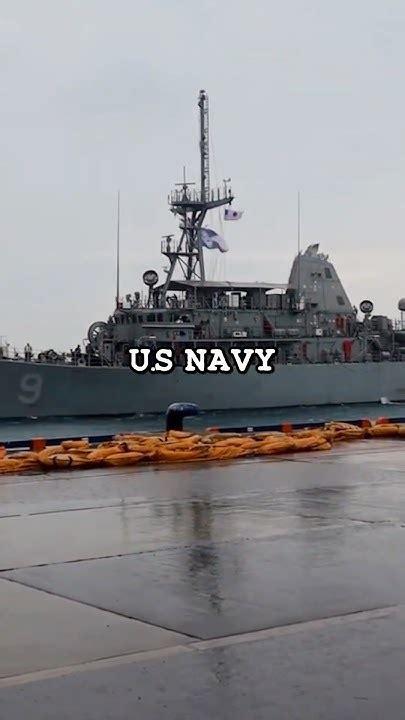
For a military defined by nuclear-powered aircraft carriers, stealth destroyers, and AI-enhanced surveillance, the continued use of wooden hull ships sounds almost mythic. Yet for decades, the U.S. Navy has deliberately deployed vessels built from materials more associated with ancient maritime empires than modern superpowers. This was not nostalgia. It was physics.
The story centers on the Avenger-class minesweepers, specialized warships introduced in the late 1980s to counter one of the most insidious threats at sea: magnetic naval mines. While naval warfare evolved toward digital targeting and satellite-guided precision, underwater mines quietly remained devastatingly effective. A single explosive device, properly placed, can deny access to critical waterways, choke supply chains, and cripple billion-dollar ships.
Modern naval mines are not crude contact bombs waiting for collision. Many are magnetic influence mines, designed to detect and respond to the magnetic signature of a steel vessel passing overhead. Steel hulls naturally generate a magnetic field. Even when degaussed — a process that reduces magnetic signatures — complete elimination is nearly impossible.
The U.S. Navy’s solution was both simple and brilliant: eliminate as much magnetic material as possible from the ship itself.
The Magnetic Mine Threat That Changed Naval Engineering
Magnetic mines date back to World War I, but their lethal sophistication expanded dramatically during World War II. German engineers refined influence mines capable of detonating purely from the magnetic field generated by passing ships. Instead of waiting for physical contact, these devices sensed the disturbance in Earth’s magnetic field caused by massive steel hulls.
Degaussing became standard procedure. Electrical cables installed around a ship’s hull generated counter-magnetic fields to neutralize its signature. While effective, degaussing required constant calibration and did not eliminate all magnetic influence. As mine technology advanced, detection sensitivity improved.
By the late Cold War era, navies confronted a strategic reality: the safest minesweeper is one that barely registers magnetically at all.
Avenger-Class Ships: Engineering for Invisibility
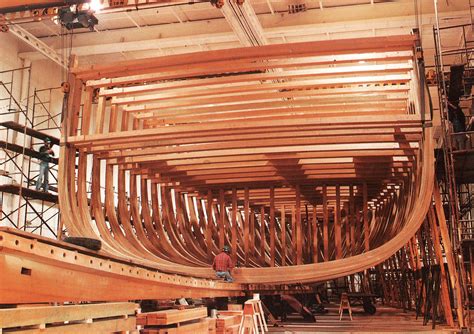
The Avenger-class minesweepers were built with hulls constructed primarily from wood laminated with fiberglass coatings. This was not decorative craftsmanship. Wood possesses negligible magnetic properties, dramatically reducing the vessel’s magnetic signature. Fiberglass reinforcement adds structural integrity without introducing ferrous metal.
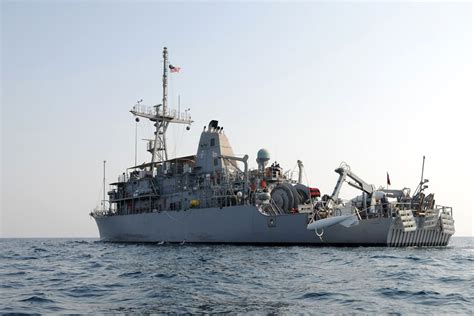
The result is a ship designed to operate directly within minefields while minimizing the likelihood of triggering influence mines. These vessels were equipped with advanced sonar systems to detect underwater threats and deploy remotely operated vehicles to neutralize them.
Unlike destroyers designed for open-ocean combat, Avenger-class ships operate slowly and deliberately. Their mission is surgical clearance. They are hunter-killers of submerged explosives, often working in contested or strategically vital waterways.
Why Wood Still Beats Steel in Mine Warfare
The persistence of wooden hulls in the late 20th and early 21st centuries highlights an important principle of military technology: innovation is not always about adding complexity. Sometimes superiority means subtracting risk.
Steel offers strength and durability, but it carries a magnetic signature. Aluminum reduces magnetism but introduces corrosion and structural trade-offs. Composite materials offer promise, yet during the Avenger-class development era, wood provided an ideal combination of low magnetism, manageable cost, and proven shipbuilding techniques.
Wood also absorbs vibrations differently than metal, slightly reducing acoustic signatures. While not stealth in the modern sense, every reduction in detectability increases survivability in mine-infested waters.
Strategic Deployment in the Pacific Theater
In recent years, the remaining Avenger-class vessels have operated primarily out of Japanese ports, underscoring the strategic importance of Pacific sea lanes. Narrow straits and high-traffic maritime corridors are prime environments for mine warfare. Ensuring these passages remain open is essential for both military mobility and global trade.
Reports indicate that only four Avenger-class ships remained active before scheduled decommissioning in 2026. Their retirement does not reflect failure but evolution. They are being replaced by next-generation mine countermeasure systems that integrate autonomous underwater vehicles, high-resolution sonar arrays, and advanced neutralization technologies.
The End of an Era, Not the End of the Principle
The retirement of wooden hull minesweepers marks a technological transition, yet the principle behind their existence remains instructive. The choice of wood was not sentimental or symbolic. It was a calculated response to physics and enemy capability.
In naval strategy, dominance is not achieved solely through size or firepower. It often depends on understanding invisible forces — magnetism, acoustics, pressure differentials — and designing platforms that exploit or evade them. The Avenger-class embodied that philosophy with elegant simplicity.
The continued service of wooden hull ships well into the 21st century stands as evidence that progress in warfare is rarely linear. Sometimes, the most advanced solution resembles something ancient. And sometimes, the smartest path forward is carved from timber.