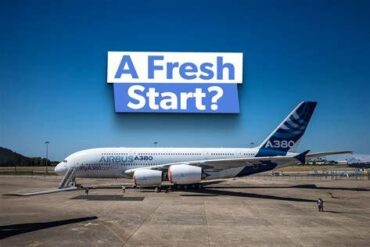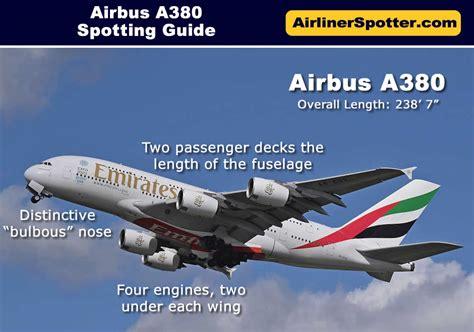
The Airbus A380, often hailed as the “King of the Skies,” remains one of aviation’s boldest engineering feats. Towering over other aircraft with its double-deck fuselage and immense wingspan, the A380 symbolized a future of high-capacity, long-haul travel. But behind this superjumbo’s grandeur lies a critical question: Why did Airbus design the A380 with four engines when twinjets were already proving more efficient?
The Unavoidable Physics of Lift and Thrust
At the heart of the decision to use four engines was simple physics. The A380-800 has a Maximum Takeoff Weight (MTOW) of 575 tonnes, dwarfing the MTOW of the highly successful Boeing 777-300ER, which maxes out at 351 tonnes. To lift and propel such a colossal aircraft required significantly more thrust than any two engines could deliver at the time.
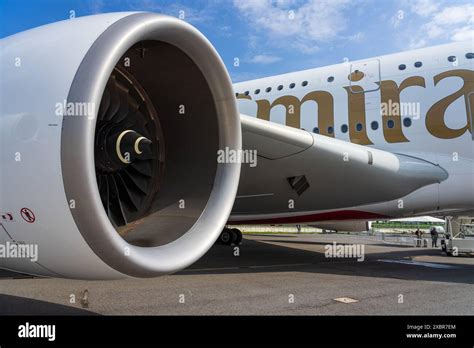
Twin-engine aircraft like the 777-300ER use General Electric GE90-115B engines, each producing 115,000 lbs of thrust—together just over 230,000 lbs. By contrast, the A380’s powerplants—the Engine Alliance GP7200 or the Rolls-Royce Trent 900—each output around 74,000–76,000 lbs of thrust. Four such engines combine to produce over 307,000 lbs, a requirement for the A380’s sheer mass and size.
At the time of its conception, no single turbofan engine could independently generate the amount of thrust needed for such a massive platform. Even today, no twin-engine configuration can match the power needed for a 575-ton aircraft. Thus, the four-engine configuration was not a luxury or legacy decision, but an aerodynamic and mechanical necessity.
The Era of the Twinjet and a Strategic Miscalculation
In the 1990s, the world of aviation was rapidly embracing the efficiency and simplicity of twinjets. The Airbus A330, Boeing 777, and later the 787 Dreamliner and Airbus A350, all demonstrated how two high-performance engines could safely and efficiently fly long-haul international routes.
However, Airbus approached the A380 with a different vision: not efficiency, but scale. The idea was to serve congested hub-to-hub routes with enormous capacity. John Leahy, then Chief Operating Officer of Airbus, strongly believed that airport congestion would drive demand for aircraft that could carry over 800 passengers at once. Thus, the A380 was born—designed around airport slot limitations rather than operational economy.
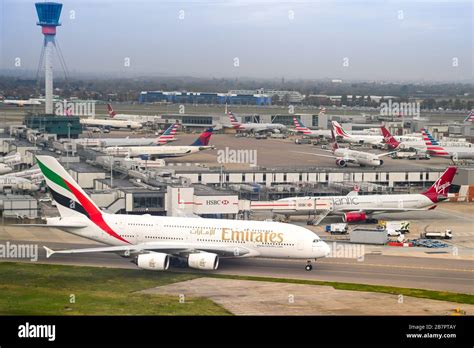
What Airbus failed to anticipate was how point-to-point travel would become dominant, enabled by the twinjet’s long-range capabilities. Instead of funneling passengers through mega-hubs, airlines increasingly opted for direct connectivity, a trend that rendered the A380’s size less relevant and more burdensome.
Orphan Engines: The A380’s Achilles Heel
While four engines were a design inevitability, the type and timing of those engines were critical mistakes. The A380’s powerplants—the Trent 900 and GP7200—were developed using a hybrid of 1990s and early-2000s technologies. This positioned them behind the generation of GEnx, Trent 1000, and Trent XWB engines that would later power the Boeing 787 and Airbus A350.
The GP7200, in particular, combined a scaled-down GE90 core with a PW4000 fan and low-pressure system, resulting in an engine that was efficient—but not cutting edge. Similarly, the Trent 900 adapted parts from earlier Trent models, making it less sophisticated than the Trent XWB used on the A350.
These engines were effectively orphan derivatives—powerplants with no other aircraft programs to spread development and maintenance costs. This made them expensive to operate and maintain, especially when compared to twinjets whose engines benefitted from economies of scale.
The Structural Design Optimized for a Larger Variant
Adding to the engine dilemma was the A380’s structural design philosophy. The A380-800, the only version ever built, was actually a shrink model of what Airbus originally envisioned: a larger, even more capacious A380-900.
This meant that the A380-800 inherited a heavier airframe, oversized stabilizers, and structural reinforcements intended for a stretch model that never materialized. The result was a smaller-than-planned aircraft bearing the weight and complexity of a much larger one.
Consequently, per-seat operational costs rose while the aircraft’s maximum potential went underutilized. In essence, Airbus sold the A330-200 equivalent of a flagship aircraft—smaller, yet heavier and less efficient.
Market Conditions and Strategic Misreading
Airbus’s timing with the A380 proved to be another critical challenge. The aircraft entered service in 2007, nestled between two engine generations and a changing airline industry. The A380 came just after the wave of 1990s widebody development but just before the high-efficiency revolution brought by the 787 Dreamliner (2011) and A350 (2015).
Meanwhile, the dominance of twinjets was cemented by the Boeing 777-300ER, which quickly became the aircraft of choice for long-haul carriers due to its fuel efficiency, cargo capacity, and flexibility. The 777 matched the A380 in range and offered comparable seat-mile economics on many routes without the scale risks and operational complexity.
The Cost of Complexity
The A380 was a marvel—but an expensive one. With four engines, 22 wheels, two decks, and unique airport handling needs, the aircraft required custom gates, specially trained crews, and additional turnaround time. Airlines found it difficult to justify these costs unless they could consistently fill every seat.
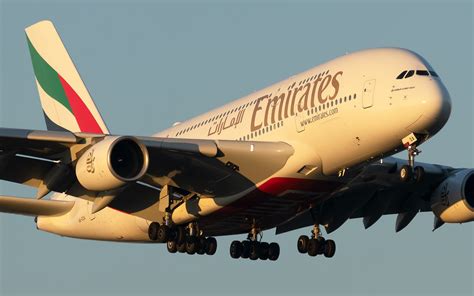
During downturns—like the COVID-19 pandemic—many carriers parked or retired their A380s due to high idle costs. Even now, those returning the aircraft to service must invest millions in cabin refurbishment, given the aging interiors and rising customer expectations.
Air France, for example, fully retired its A380 fleet by 2020, citing unprofitability and high retrofit costs. British Airways, despite being enthusiastic about the type, declined to acquire second-hand A380s due to similar concerns.
An Engineering Masterpiece That Arrived Too Late
The A380 is, without question, a technological marvel. Its quiet cabin, smoother ride, and premium space have made it a favorite among travelers. From showers in Emirates First Class to Singapore Airlines’ private suites, the A380 enabled products that transformed expectations for premium air travel.
But the market does not reward engineering alone. Aircraft must align with operational economics, fleet flexibility, and emerging travel patterns. The A380’s design was bold, but its vision was rooted in a 1980s understanding of 21st-century travel.
The Legacy of the Four-Engine Giant
Of the 251 Airbus A380s delivered, over 180 remain in service, primarily with Emirates, which operates the largest A380 fleet. While other carriers like Qatar Airways and British Airways have returned A380s to service, many others—Thai Airways, Malaysia Airlines, China Southern, and Hi Fly Malta—have exited the program.
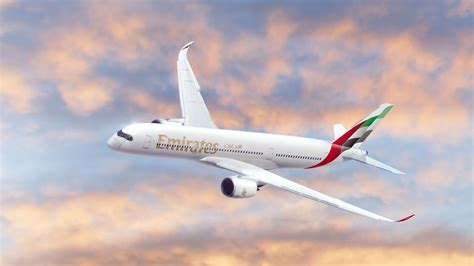
Airbus has no plans to resume production. The Boeing 777-9, though smaller, has become the A380’s unofficial successor. With comparable range, fewer engines, and modern fuel efficiency, it promises similar reach with lower risk.
Final Verdict: Why Airbus Built the A380 with Four Engines
Airbus built the A380 with four engines because physics and engineering demanded it. The aircraft’s immense size, design for future variants, and ambitious payload/range capabilities made a twin-engine configuration impossible with the engine technology of its era.
But in doing so, Airbus overestimated the market for ultra-large aircraft and underestimated the coming wave of high-efficiency twinjets. The engines chosen, though necessary, were not advanced enough to future-proof the platform. Combined with structural overbuild and a shrinking appetite for hub-based mega travel, the A380 became an icon that soared with passengers but struggled with profits.
Its legacy, however, is undeniable. The A380 stretched the limits of civil aviation and redefined what was possible in commercial airliner design. For now, and likely decades to come, it remains the largest passenger aircraft ever built—a flying tribute to ambition, even if the world moved on.