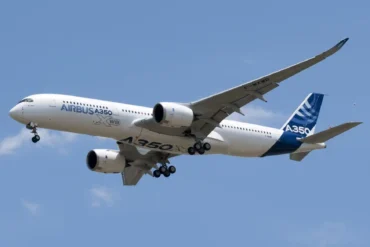
The sound of commercial aviation has transformed dramatically since the earliest jet age — the era when cabin interiors vibrated like drum chambers, engines screamed like distressed metal, and stepping off a long-haul flight meant ringing ears and sinus pressure. Those days are rapidly fading as next-generation airliners glide through the atmosphere with the composure of well-tuned instruments. Among them, the Airbus A350 stands out as one of the quietest passenger aircraft ever built, not just marginally quieter, but architecturally engineered for silence. This is no coincidence or marketing exaggeration. It is the result of clean-sheet design philosophy, composite acoustic behavior, next-generation Rolls-Royce propulsion, turbulence-dampening geometry, and internal cabin insulation that works like an orchestra pit tuned to suppress unwanted frequency.
Passengers stepping into an A350 for the first time often notice it immediately. Conversations feel calm, announcements remain soft without distortion, and even cruising flight noise takes on a gentle, low-frequency hum rather than the sharp mechanical resonance common in older aircraft. Sound here is managed, shaped, softened. It is engineered for perception as much as decibel measurement.
This article examines exactly why the A350 cabin is significantly quieter than most commercial aircraft, and why airlines, passengers, engineers, airport communities, and pilots continue to praise the type for its noise behavior both inside and outside the fuselage.
Clean-Sheet Design Gave Airbus A Blank Canvas For Silence
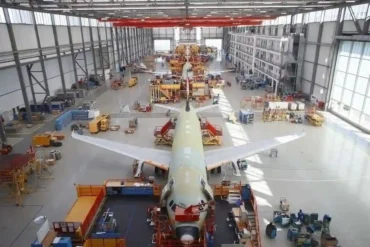
When Airbus launched the A350 program, it rejected the idea of modifying an existing architecture. Instead, it created what is known as a clean-sheet aircraft — built from scratch without legacy structural limitations. This gave the manufacturer freedom to introduce new construction materials, experiment with acoustic-centric fuselage layering, and integrate modern propulsion without being constrained by older aerodynamic or structural geometry.
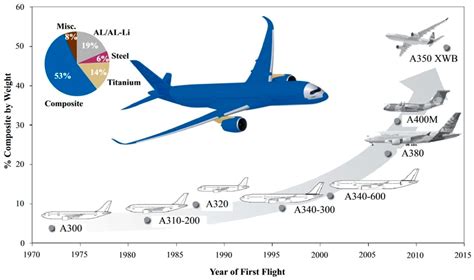
More than 70% of the A350 airframe is made from advanced materials, including 53% composite panels, with the remainder consisting of titanium, aluminum-lithium, and high-strength steel. Unlike metallic skin, which transmits vibration readily, composite fuselage shell naturally damps sound waves. What passengers hear is not simply reduced engine volume — it is structural silence, the absence of vibration transmission.
This level of quiet is not accidental. Airbus engineers studied how turbulence, airflow friction, and engine resonance propagate through fuselage walls. Their conclusion was simple: composites behave like noise absorbers, reducing mechanical vibration transfer into cabin air. This foundational design decision allows everything else — insulation, interior lining, and engine refinement — to work from a quieter baseline.
Composite Skin Absorbs Vibration Rather Than Amplifies It
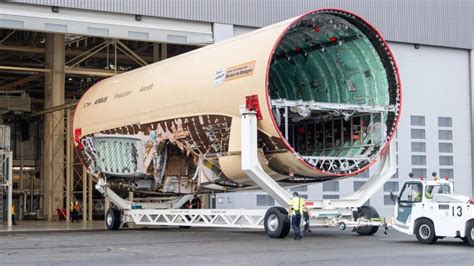
The A350’s sound signature begins with its carbon-fibre reinforced plastic (CFRP) construction. CFRP is inherently stiff yet vibration-resistant, meaning it doesn’t “ring” or conduct sound like aluminum. Inside this layered composite structure, resin binds fibres into panels that flex subtly under pressure changes rather than resonate.
Compared to aluminum, CFRP provides clear acoustic advantages:
- It lowers structural vibration transmission.
- It reduces the resonance of airflow and engine harmonics.
- It forms a quieter acoustic shell even before insulation is added.
- It supports higher humidity and lower cabin altitude, decreasing fatigue-related noise sensitivity.
On the A350, composite walls are matched with acoustic dampening liners, insulation inserts, and optimized side-wall padding engineered to suppress fan buzz, aerodynamic hissing, and fuselage vibration frequencies. No single component creates silence — rather, the entire aircraft behaves as a noise-attenuation ecosystem.
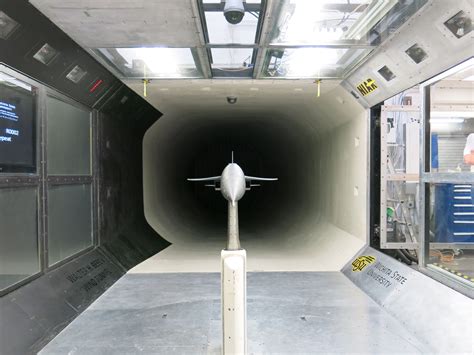
Airbus verified this behavior using full-scale cabin mock-ups and wind-tunnel noise mapping, adjusting interior density, liner thickness, and sound-absorbing ceiling geometry to target troublesome frequency bands. The result is a calm, low-frequency environment where background sound fades into near-silence beneath conversation level.
Rolls-Royce Trent XWB Engines: Quieter By Aerodynamic Intent
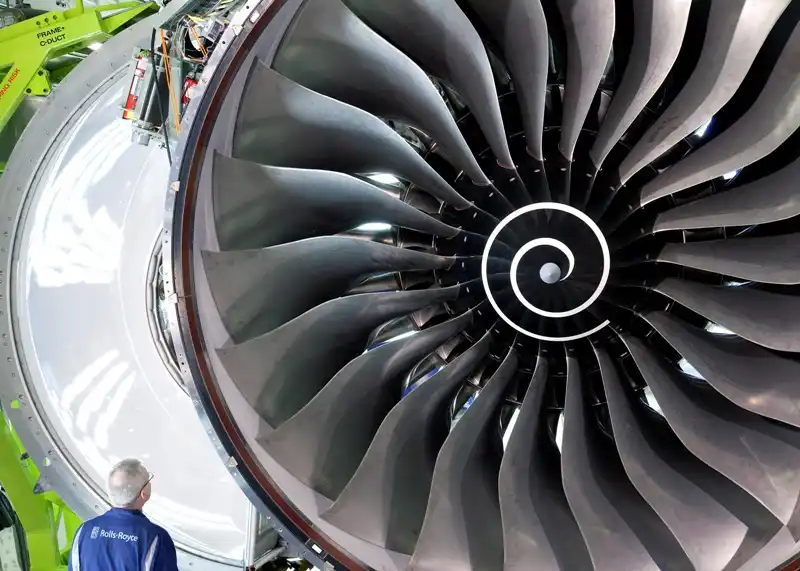
Powering every A350 is the Rolls-Royce Trent XWB, a high-bypass turbofan built specifically for efficiency, low vibration, and minimal acoustic output. Instead of pushing small volumes of air at violent speed (the method behind traditional jet scream), the XWB accelerates a large mass of air slowly and smoothly. This softer air acceleration dramatically reduces high-frequency engine noise.
Rolls-Royce spent years tuning the Trent XWB for refined airflow behavior. This includes:
- Swept-blade geometry to reduce vortex distortion.
- Stage-phasing technology to regulate internal pressure fluctuations.
- Chevrons on exhaust nacelles to smooth airflow mixing at the jet boundary layer.
- Optimized combustion paths to reduce turbulent resonance.
The nacelle interior is lined with acoustic-porous material — honeycomb structured, foam-damped, and full of micro-voids designed to absorb fan buzz before it escapes the engine case. This is not merely insulation — it functions like a tuned sound-trap, suppressing rotational frequencies that would otherwise ripple audibly through the fuselage.
Engineers even borrowed from nature. Like an owl wing that slices silently through air, the A350 nacelle geometry manipulates pressure gradients to avoid the sharp ripping sound that older engine designs produce.
Passengers hear the difference most during takeoff and climb-out. Instead of a piercing, metallic howl, the Trent XWB produces a deep, velvety thrust note — powerful, but controlled. Cabin noise remains conversational even at full climb thrust.
Interior Insulation, Sound-Absorbing Panels & Pressure Harmony
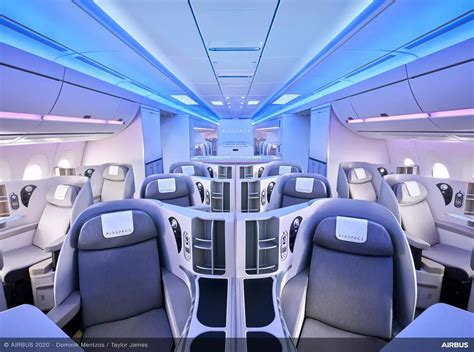
Noise reduction goes beyond engines and fuselage skin. Inside the A350 cabin, nearly every surface has been engineered to damp sound: overhead bins, sidewalls, floor panels, galley bulkheads, even door seals.
A350 noise control features include:
- Acoustic isolation membranes beneath floor panels.
- Absorptive ceiling composites that diffuse pressure waves.
- Sidewall insulation tuned to mid-frequency engine hum.
- Galley & lavatory seals to reduce airflow hiss.
- Door frame buffers to block aerodynamic leakage.
This produces a layered acoustic cocoon that prevents vibration from propagating like electrical current through fuselage frames. Even in turbulence or heavy weather, conversations remain normal-volume — something pilots praise frequently.
Cabin pressure also shapes noise perception. The A350 flies with an equivalent cabin altitude of around 6,000 ft, compared to ~8,000 ft in older widebodies. Lower altitude equals better oxygenation, lower fatigue, and reduced noise sensitivity. Pair this with cabin air humidity nearing double that of legacy aircraft, and passengers stay more relaxed, less stressed, and less acoustically irritated.
Why The A350 Often Feels Quieter Than It Measures
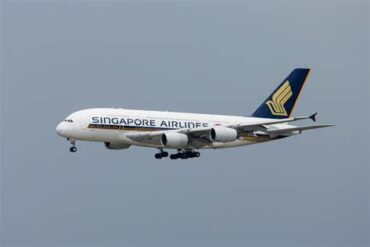
Some acoustic studies place the A350 behind the A380 and Boeing 787 in absolute decibel ranking. Yet the A350 is widely perceived by passengers to be quieter overall — especially in forward cabin zones. Perception matters more than raw numbers, because comfort, fatigue, lighting, pressurization, and humidity influence how sound registers in the brain.
The A350 reduces fatigue-linked noise sensitivity. Lighting is diffused, blue-weighted and non-glare. Humidity prevents throat dryness and sensory irritation. The fuselage eliminates high-frequency spikes that humans find most disturbing. Sound may still exist — but it does not intrude.
Passengers describe the A350’s cabin noise profile as deep, low-toned, and smooth. This texture of sound is easier to ignore than the sharp fan whine of earlier aircraft. Low frequency hum blends into background ambience; high-frequency buzz demands attention. The A350 eliminates the latter.
This explains why passengers frequently step off an A350 feeling less drained, less overstimulated, and more refreshed, even after long haul sectors exceeding 12 hours.
Quieter For Pilots, Quieter For Airports, Quieter For Communities
Cabin silence is only one part of the A350’s acoustic story. The aircraft is also quieter externally, reducing airport noise footprint by more than half when compared to older widebody aircraft like the Boeing 747-400.
Pilots report the same onboard. One Cathay Pacific flight deck officer remarked that landing through heavy turbulence and driving rain in the A350 allows conversation in normal speaking tone — a stark contrast to legacy jets where cockpit noise requires raised voices during adverse weather. Flight crew experience is calmer, concentration is higher, workload stress is lower, safety margins improve.
Communities around airports feel the benefit too. Virgin Atlantic highlights that the A350’s 52% smaller external sound footprint supports environmentally sensitive airport operations, important during an era where nighttime noise restrictions are increasing. Amsterdam Schiphol, for example, has introduced curfews and phase-outs targeting older, louder fleets — aircraft like the A350 are designed for this regulatory future.
The world is heading toward quieter aviation, and the A350 is already there.
Is The A350 The Quietest Aircraft In The World?
The definitive title remains debated. Some studies score the A380 at the top. Others place the A350 neck-to-neck with the Boeing 787, only differing by one to three decibels — barely perceptible to the human ear. In forward zones, the A350 often feels quietest. In mid cabin, the 787 sometimes wins. Per-seat acoustics fluctuate by row, deck level, airflow contour, and carrier interior specification.
But these distinctions miss the larger truth: The Airbus A350 belongs to the quietest fleet of commercial aircraft ever produced.
Its innovations have pushed industry expectation downward — from screaming jets to ambient acoustic flight. Silence, once a luxury, is becoming standard. And the A350 is the flagship example of how a long-haul cabin can sound like a calm hotel room at cruise altitude.
Future platforms will go further. Ultra-clean laminar flow wings may reduce aerodynamic hiss. Boundary-layer control may smooth fan resonance. Hybrid-electric propulsion may eliminate turbine howl entirely. For now, the A350 stands as a milestone: an aircraft where engineering, materials, aerodynamics and turbine physics converge to produce flight at whisper tone.
Quiet in aviation is no longer accidental. It is design. This is the reason so many travelers walk off an Airbus A350 wondering why their ears didn’t ring, why their sleep was less broken, why a 14-hour flight felt surprisingly peaceful. The aircraft didn’t just get quieter — it changed the idea of what flying should sound like.
With every departure, the A350 proves loud progress can be made silently.