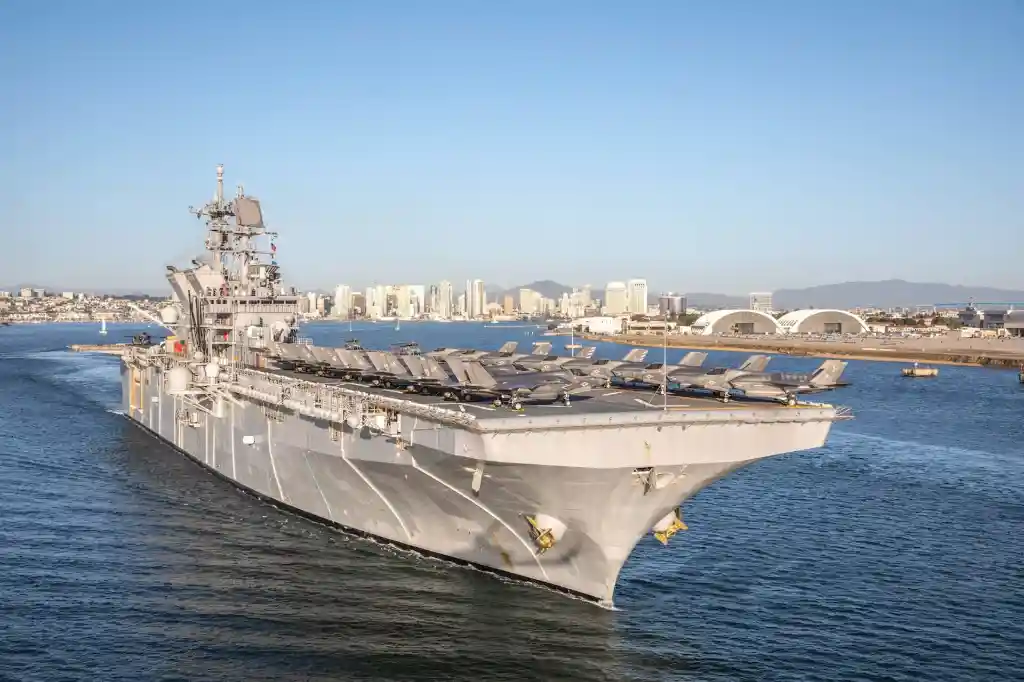
The United States is reinforcing its military posture in the Middle East with the deployment of approximately 2,500 Marines aboard amphibious warships moving from the Indo-Pacific toward the region. The decision reflects Washington’s effort to strengthen deterrence and crisis-response capabilities as confrontation with Iran enters a volatile phase following weeks of coordinated air and long-range strike operations conducted by the United States and Israel.
This additional Marine force will join a regional U.S. military footprint that already exceeds 50,000 personnel distributed across airbases, naval facilities, and forward operating locations throughout the Middle East. The deployment adds a flexible expeditionary force capable of launching operations directly from the sea, offering commanders a rapidly deployable option for deterrence patrols, evacuation missions, or limited strike support should the security environment deteriorate further.
American defense officials indicate that the Marine contingent is traveling aboard an amphibious ready group that departed the Indo-Pacific theater. The ships are believed to be operating with the forward-deployed Marine unit stationed near Okinawa, which routinely maintains a high readiness posture to respond to regional contingencies across Asia and beyond. The movement of these forces toward the Middle East underscores how the evolving crisis has begun to reshape global military priorities.
Strategic Reinforcement as the Regional Conflict Intensifies
The deployment arrives during a period of mounting uncertainty in the Persian Gulf. Nearly two weeks of air and missile strikes targeting Iranian military infrastructure have triggered heightened regional tensions and prompted concerns that the conflict could widen beyond its initial scope. While aerial bombardment remains the dominant form of military pressure, the introduction of an expeditionary Marine force signals preparation for a broader range of contingencies.
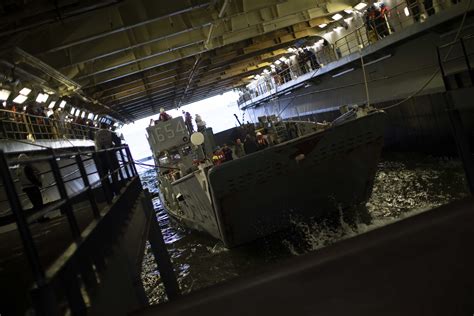
Amphibious units provide a unique strategic advantage: they allow military planners to position combat forces offshore while maintaining the ability to project power rapidly onto land. Unlike fixed bases, amphibious ships can reposition across thousands of miles of ocean, giving commanders operational flexibility while reducing vulnerability to missile strikes or sabotage operations against permanent installations.
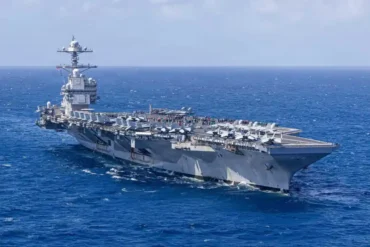
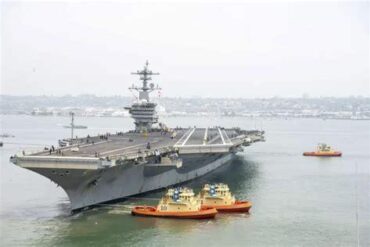
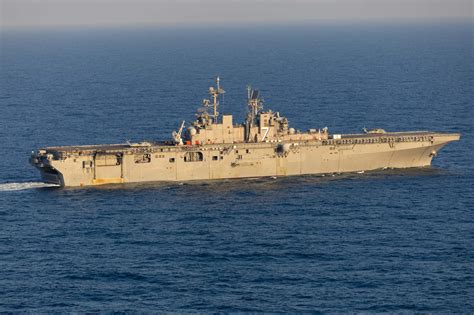
Within this naval formation, one of the most significant vessels associated with the deployment is the USS Tripoli (LHA-7), an America-class amphibious assault ship designed to function as the aviation centerpiece of a Marine expeditionary group. The massive warship displaces roughly 45,000 tons and features a full-length flight deck optimized for advanced short-takeoff aircraft and helicopters. Its design reflects the evolving doctrine of amphibious warfare, emphasizing air power and mobility rather than traditional landing craft capacity.
The America-Class Assault Ship as a Sea-Based Airpower Hub
The America-class warships represent a transformation in amphibious operations. Earlier amphibious assault ships were primarily designed to transport troops and deploy landing craft directly onto beaches. In contrast, vessels such as USS Tripoli prioritize aviation operations, effectively serving as small aircraft carriers capable of supporting modern fighter aircraft.
This aviation focus enables amphibious groups to deliver precision strike capability while remaining mobile at sea. Aircraft operating from these ships can conduct intelligence missions, close air support, reconnaissance flights, and targeted attacks without relying on regional airbases. In an environment where airfields may be vulnerable to missile strikes, such sea-based aviation provides an additional layer of resilience.
The aircraft complement aboard USS Tripoli typically includes the Lockheed Martin F-35B Lightning II, a fifth-generation stealth fighter capable of short takeoff and vertical landing operations. Developed by Lockheed Martin, the F-35B integrates advanced sensor fusion, stealth shaping, and powerful networking capabilities that allow pilots to gather and distribute battlefield information across multiple platforms.
Equipped with the AN/APG-81 active electronically scanned array radar and a distributed aperture system that provides full spherical infrared awareness, the aircraft can simultaneously detect threats, track targets, and coordinate precision strikes. When operating from amphibious assault ships, the F-35B effectively extends the reach of naval forces hundreds of nautical miles inland while maintaining the element of surprise associated with stealth platforms.
Tiltrotor Mobility: The MV-22 Osprey’s Role in Expeditionary Warfare
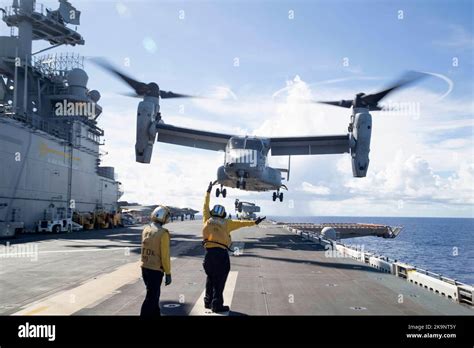
Another key component of the embarked air wing is the Bell Boeing MV-22B Osprey tiltrotor aircraft, produced through a partnership between Bell Textron and Boeing. The MV-22 combines the vertical lift capability of a helicopter with the speed and range of a turboprop airplane, creating one of the most versatile troop transport platforms in modern military service.
During takeoff and landing, the aircraft’s rotors face upward like a helicopter, allowing it to operate from the confined deck of an amphibious warship. Once airborne, the rotors rotate forward to function as propellers, enabling cruise speeds approaching 270 knots—more than twice as fast as many traditional helicopters. This hybrid capability dramatically expands the operational reach of Marine expeditionary units.
With a range exceeding 800 nautical miles and the capacity to carry around two dozen Marines or several tons of cargo, the Osprey allows forces to launch rapid troop insertions deep inland while remaining based safely offshore. This mobility is particularly valuable in scenarios involving hostage rescue operations, humanitarian evacuations, or quick reinforcement of allied installations under threat.
Strait of Hormuz Emerges as a Strategic Flashpoint
The evolving maritime situation around the Strait of Hormuz has become one of the central drivers behind the U.S. reinforcement. The narrow waterway, which links the Persian Gulf to the Arabian Sea, represents one of the world’s most important energy corridors. Roughly one-fifth of global oil shipments pass through this maritime chokepoint every day.
Iranian military activity near the strait has intensified as the conflict unfolds. Commercial shipping companies have reported increased harassment of tanker vessels and heightened radio communications from Iranian coastal authorities. In some cases, tanker traffic has slowed significantly due to security concerns, prompting volatility in global energy markets and pushing oil prices higher.
Reports from U.S. defense officials suggest that Iranian forces may also be laying naval mines in shipping lanes within the Persian Gulf. The potential presence of mines would pose a major challenge for maritime traffic and could require complex mine-clearing operations by Western naval forces before safe passage can be restored.
The strategic importance of the strait has made it a focal point of international concern. Any sustained disruption to shipping could ripple across global energy markets, affecting fuel prices and economic stability far beyond the Middle East.
Possible U.S. Naval Escort Missions for Commercial Shipping
In response to growing threats against tanker traffic, the U.S. government is evaluating additional protective measures for civilian vessels navigating the region. Donald Trump indicated that the United States could deploy naval escorts to accompany commercial ships through the Strait of Hormuz if attacks continue.
Such operations would echo similar missions conducted during the final stages of the Iran-Iraq War in the 1980s. During that conflict, U.S. naval forces escorted oil tankers through the Gulf in order to shield them from missile strikes and maritime attacks in what became known as the “Tanker War.” Those escort missions involved complex coordination between warships, surveillance aircraft, and mine-countermeasure vessels.
If escort operations are implemented again, the presence of amphibious warships and Marine aviation assets could provide valuable air cover and rapid response capability in the event of attacks on merchant vessels.
Expanding Regional Incidents and Military Risks
The ongoing confrontation has already produced several notable incidents across the region. A KC-135 Stratotanker aerial refueling aircraft operated by the U.S. Air Force crashed in western Iraq during operations related to the campaign. Investigations are ongoing to determine the cause of the accident, though the event highlights the operational intensity of sustained air missions in the theater.
Elsewhere, tensions have extended beyond the immediate combat zone. Authorities in Türkiye reported that air defense systems associated with NATO intercepted an Iranian missile that briefly entered Turkish airspace. The interception marked the third such incident within roughly ten days, illustrating how quickly the crisis could spill into neighboring regions.
In addition to physical confrontations, cybersecurity threats have also emerged as a parallel front in the conflict. A cyberattack recently targeted the U.S. medical equipment manufacturer Stryker Corporation, raising concerns among security analysts that Iranian-linked cyber groups may attempt to retaliate through digital disruptions against American infrastructure or corporations.
Amphibious Forces as a Flexible Instrument of Deterrence
The arrival of a Marine expeditionary force in the Middle East represents more than a symbolic show of strength. Marine Expeditionary Units are structured as self-contained combined-arms formations that integrate infantry, aviation, logistics, and armored capabilities into a single deployable package. This structure allows them to respond rapidly to a wide range of crises without requiring large supporting forces.
From amphibious warships positioned offshore, Marines can conduct helicopter-borne assaults, secure key coastal infrastructure, reinforce allied bases, or evacuate civilians caught in conflict zones. Their aviation components can also conduct surveillance missions, provide close air support, or assist in maritime security patrols.
In the current strategic environment, this flexibility gives U.S. commanders options that extend far beyond traditional airstrikes. The ability to project power quickly from the sea ensures that American forces can respond to sudden developments without relying solely on fixed installations that may be vulnerable to missile attacks.
A Conflict With Global Implications
Beyond the immediate military calculations, the deployment of amphibious forces carries significant geopolitical implications. Control of maritime trade routes, energy infrastructure, and regional security alliances remains central to the broader competition between Washington and Tehran.
If Iranian pressure on shipping intensifies and Western navies respond with escort operations or mine-clearing missions, the conflict could shift from an air-and-missile campaign into a wider maritime confrontation. Such a development would place the Strait of Hormuz at the center of a global security crisis with direct consequences for international trade, energy markets, and geopolitical stability.
The dispatch of 2,500 Marines aboard amphibious warships therefore represents both a tactical reinforcement and a strategic signal. By positioning mobile expeditionary forces near one of the world’s most critical waterways, the United States is demonstrating its readiness to safeguard maritime commerce and deter further escalation while maintaining the flexibility to respond rapidly if the situation deteriorates.