The United States has initiated one of its most significant military maneuvers in the Middle East in recent years, directing a major naval force toward Iranian waters as President Donald Trump openly signals that military options are firmly on the table. The deployment, confirmed by U.S. defense officials, represents a clear escalation in posture at a moment when tensions with Tehran are reaching a volatile peak.
The announcement came on January 22, 2026, as President Trump spoke to reporters aboard Air Force One. He framed the decision as a response to Iran’s internal repression, expanding nuclear activity, and increasingly hostile regional behavior. Behind the carefully measured language was an unmistakable message: Washington is prepared to move beyond diplomatic pressure if events continue to spiral.
This latest deployment does not occur in isolation. It follows weeks of intensifying unrest inside Iran, marked by widespread anti-government protests, mass arrests, and reports of public executions. U.S. officials view the regime’s internal instability as a dangerous accelerant, one that could drive Tehran toward external confrontation as a means of consolidating domestic control.
A Visible Shift in U.S. Military Posture
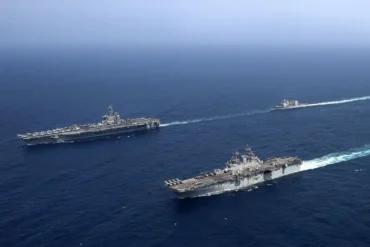
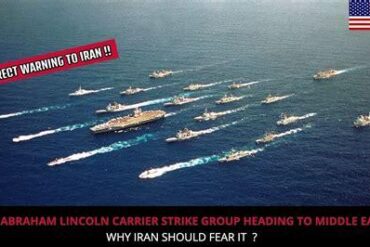
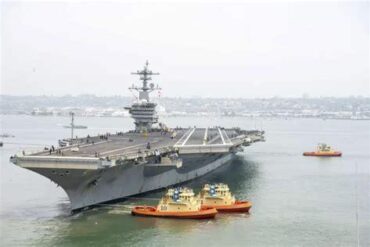
The centerpiece of the American response is the redirection of the USS Abraham Lincoln (CVN 72) carrier strike group from the Indo-Pacific toward the Middle East. Such a move is rare and costly, both logistically and strategically, and it underscores the seriousness with which the White House is treating the situation.
The Abraham Lincoln, a Nimitz-class nuclear-powered aircraft carrier, brings with it a floating airbase capable of sustained high-intensity combat operations. Carrier strike groups are not symbolic deployments; they are designed to project overwhelming force, establish air superiority, and conduct precision strikes deep into hostile territory if ordered.
According to Pentagon sources, the decision to redeploy was made after intelligence assessments concluded that Iran’s behavior had crossed several strategic thresholds simultaneously, including accelerated uranium enrichment and renewed missile testing near sensitive maritime corridors.
Expanding Naval Power Across Critical Sea Lanes
U.S. naval presence in the region has already reached formidable levels. In the Persian Gulf, Arleigh Burke-class guided missile destroyers USS Mitscher (DDG 57) and USS McFaul (DDG 74) are operating alongside the USNS Carl Brashear (T-AKE 7), a logistics vessel that ensures continuous resupply of ammunition, fuel, and spare parts.
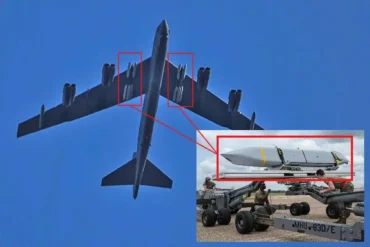
These surface combatants are equipped with Tomahawk land-attack cruise missiles, capable of striking hardened targets hundreds of miles inland with high precision. Their presence places critical Iranian military infrastructure well within reach, including missile launch facilities and command-and-control nodes.
Farther south, in the Arabian Sea, the Abraham Lincoln leads Carrier Strike Group Nine, supported by USS Frank E. Petersen Jr. (DDG 121), USS Spruance (DDG 111), and USS Michael Murphy (DDG 112). Together, these ships form a layered defensive and offensive network, integrating air defense, anti-submarine warfare, and long-range strike capabilities.
Air Power Ready for Sustained Combat Operations
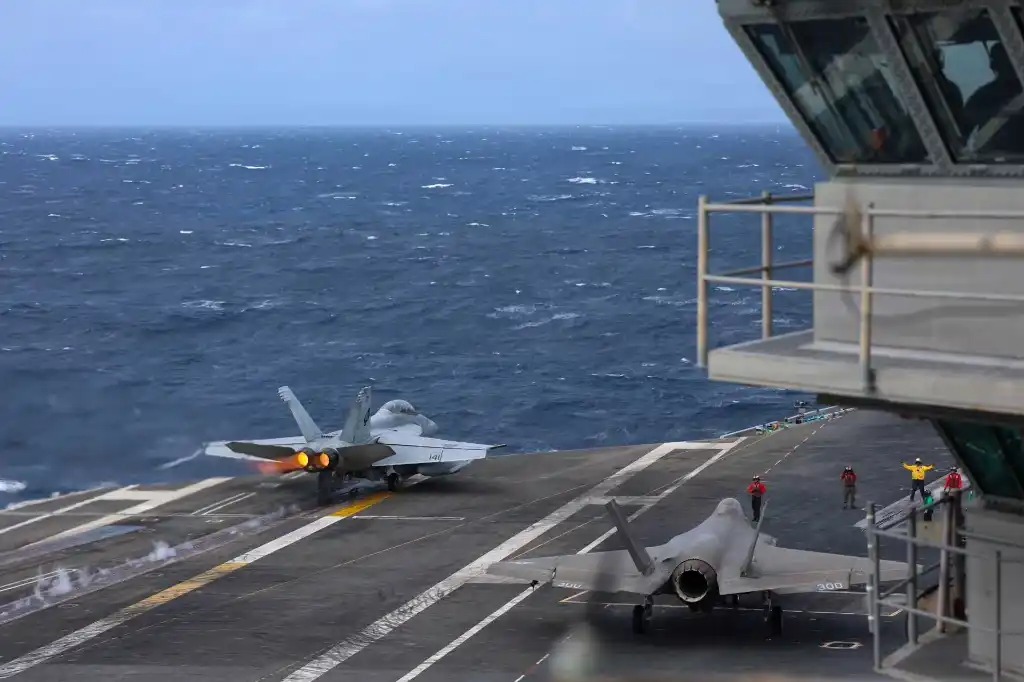
Embarked aboard the Abraham Lincoln is Carrier Air Wing Nine, a complex mix of advanced aviation assets designed for modern, multi-domain warfare. The air wing includes F-35C Lightning II stealth fighters, optimized for penetrating advanced air defenses, alongside F/A-18E and F/A-18F Super Hornets capable of delivering precision-guided munitions in large numbers.
Electronic warfare is provided by EA-18G Growlers, which play a critical role in suppressing enemy radar and communications. These aircraft would be central to any effort to degrade Iran’s integrated air defense system during the opening hours of a conflict.
Rotary-wing and support aircraft, including MH-60R and MH-60S Seahawk helicopters and the CMV-22B Osprey, ensure anti-submarine coverage, search-and-rescue capability, and rapid logistical flow. This combination allows the carrier group to remain operationally independent for extended periods.
U.S. Air Force Reinforcements Signal Joint Strike Readiness
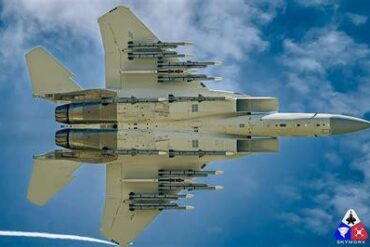
Complementing the naval deployment, the U.S. Air Force has quietly repositioned a dozen F-15E Strike Eagles to undisclosed bases in the region. The F-15E remains one of the most versatile strike platforms in the American arsenal, capable of carrying heavy payloads of bunker-busting and standoff weapons.
Defense planners emphasize that the integration of carrier-based aviation with land-based Air Force assets dramatically expands the range of potential strike options. This joint-force approach allows for simultaneous attacks from multiple vectors, complicating Iranian defensive planning and reducing reaction time.
While the White House has stopped short of confirming active strike plans, senior officials acknowledge that contingency options are being revised daily, reflecting the fluidity of the situation on the ground and at sea.
Strategic Coordination With Israel Intensifies
Behind the scenes, coordination between Washington and Tel Aviv has deepened markedly. Israeli defense sources indicate that consultations with U.S. Central Command have accelerated, focusing on response scenarios should Iran retaliate directly or through regional proxies.
The Israeli Air Force has reportedly placed several squadrons on heightened alert, including F-35I Adir stealth fighters, which are uniquely configured to penetrate heavily defended airspace. Israeli analysts note that any large-scale U.S. action would almost certainly trigger parallel or supportive Israeli operations, particularly if Hezbollah or other Iranian-aligned groups become active.
Concerns extend beyond Iran itself. U.S. and Israeli planners are closely monitoring Shiite militias in Iraq, Hezbollah forces in Lebanon, and Houthi units in Yemen, all of which possess increasingly sophisticated drones and guided munitions.
Iran’s Military Signals and Escalatory Messaging
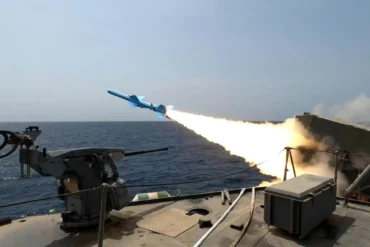
Tehran has responded to the American buildup with a mix of defiant rhetoric and calculated displays of military capability. Iranian state media has broadcast footage of underground missile facilities, mobile launchers, and air defense systems, including Russian-built S-300PMU2 batteries.
Senior commanders within the Islamic Revolutionary Guard Corps (IRGC) have warned that any attack would be met with immediate retaliation against U.S. bases in the Gulf and Israeli population centers. Intelligence assessments suggest that Iran has repositioned Qiam and Fateh-110 short-range ballistic missiles closer to its southern coastline, within striking distance of key maritime chokepoints.
The Strait of Hormuz, through which a significant portion of the world’s oil supply flows, remains a focal point of concern. Even limited disruption there could send shockwaves through global energy markets.
A Potential Turning Point for Regional Security
A direct U.S. strike on Iranian territory would represent a historic escalation, reshaping the Middle East security landscape. While both nations have engaged in indirect conflict for decades, open confrontation would introduce unprecedented risks and uncertainties.
Military analysts note that neutralizing Iran’s defenses would require simultaneous use of stealth aircraft, electronic warfare, cyber operations, and long-range precision munitions. Such an operation would likely unfold in carefully sequenced phases, designed to overwhelm Iranian response capacity before it could fully mobilize.
Diplomatic channels have not been formally closed, but the window for de-escalation appears to be narrowing. The presence of a fully equipped carrier strike group, reinforced air assets, and closely aligned allies sends a stark signal that Washington is prepared to enforce its red lines.
Whether this buildup culminates in open conflict or serves as a powerful deterrent remains uncertain. What is clear is that the United States has shifted from signaling concern to demonstrating capability, and Tehran is now facing a level of military pressure unmatched in recent years.