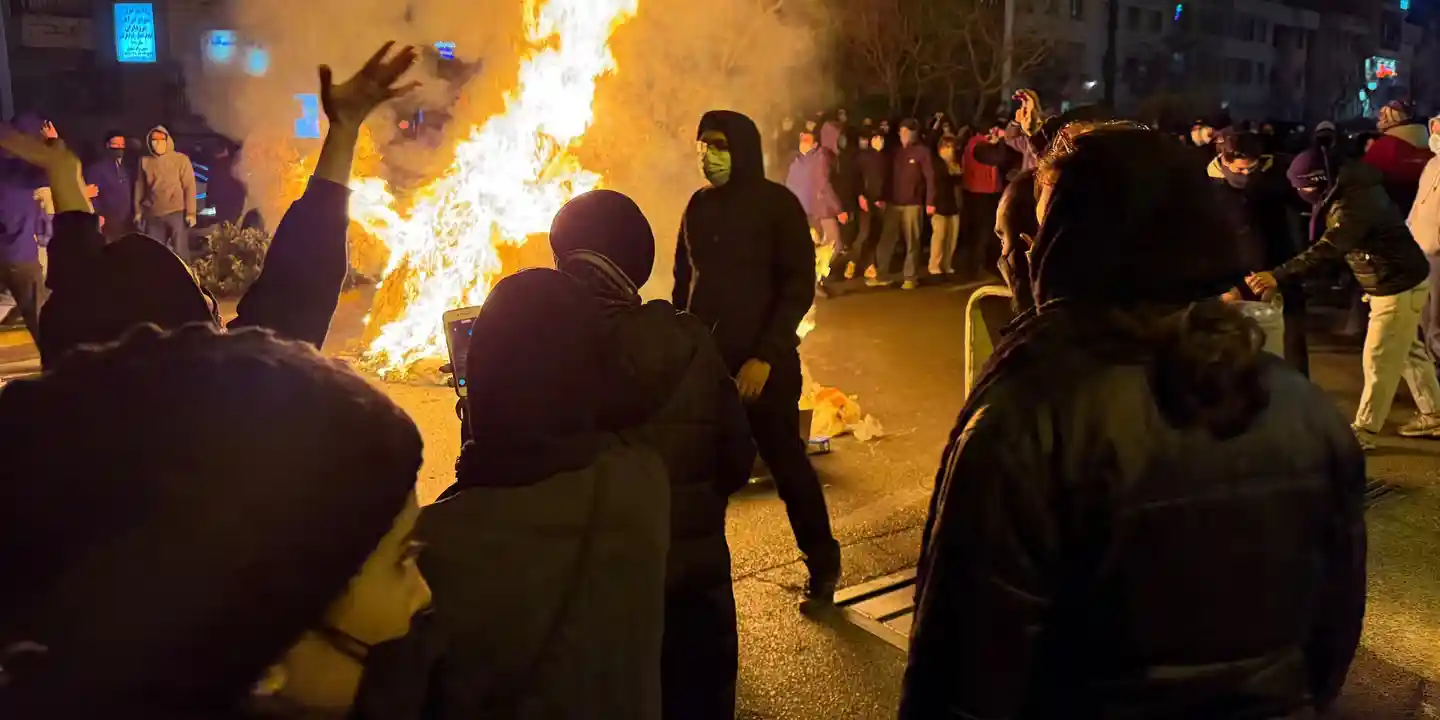
The phrase “War Against God” has returned to the center of global outrage as Iran’s ruling clerics accelerate executions amid the most severe nationwide uprising in years. What began as public anger over inflation and economic collapse has transformed into a direct challenge to the very foundations of the Islamic Republic. At the heart of this confrontation stands Erfan Soltani, a 26-year-old protester facing imminent execution without trial, lawyer, or mercy—an emblem of a system that now rules by fear alone.
Iran’s streets are once again echoing with chants that cross an irreversible line. Demonstrators are no longer asking for reform; they are demanding the removal of Supreme Leader Ayatollah Ali Khamenei and the end of clerical rule. The regime’s response has been immediate and brutal, invoking one of its most lethal legal weapons: moharebeh, or “waging war against God,” a charge that carries death as its most common sentence.
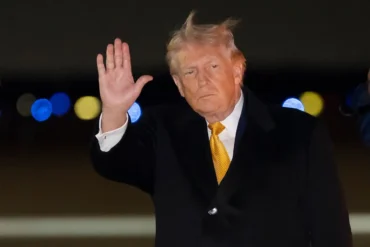
As gallows are prepared inside Iran’s prisons, the crisis has spilled far beyond its borders. Donald Trump, speaking as President of the United States, has issued a stark warning that Iran’s executions will provoke “very strong action.” His words have electrified protesters and infuriated Tehran’s leadership, raising the specter of an international confrontation layered atop a domestic rebellion.
By mid-January 2026, Iran stands at a crossroads where mass executions, global pressure, and revolutionary momentum collide, each pushing the country closer to an outcome no one can fully control.
A Nation Boiling Over: From Economic Collapse to Political Revolt
Iran’s current uprising did not erupt in a vacuum. Years of sanctions, mismanagement, and systemic corruption hollowed out the economy, leaving ordinary citizens crushed under runaway inflation and a collapsing currency. In late December 2025, protests ignited across working-class neighborhoods, initially focused on bread prices, fuel costs, and unpaid wages.
Within days, those grievances evolved into something far more dangerous for Tehran. Chants turned openly political. Protesters tore down images of Supreme Leader Khamenei and revived pre-1979 Iranian flags, symbols of defiance that strike at the ideological heart of the Islamic Republic. Despite a sweeping internet blackout, demonstrations spread to nearly every province, revealing a depth of anger that security forces could no longer contain quietly.
Security forces responded with live ammunition, mass arrests, and rooftop snipers in cities like Tehran and Karaj. According to human rights monitors, thousands were killed in a matter of weeks. Bodies bypassed hospitals entirely, sent directly to morgues to conceal the true scale of the bloodshed. What emerged was not merely a protest movement but a nationwide confrontation between an exhausted population and a regime fighting for survival.
The Case of Erfan Soltani: A Death Sentence Without a Trial
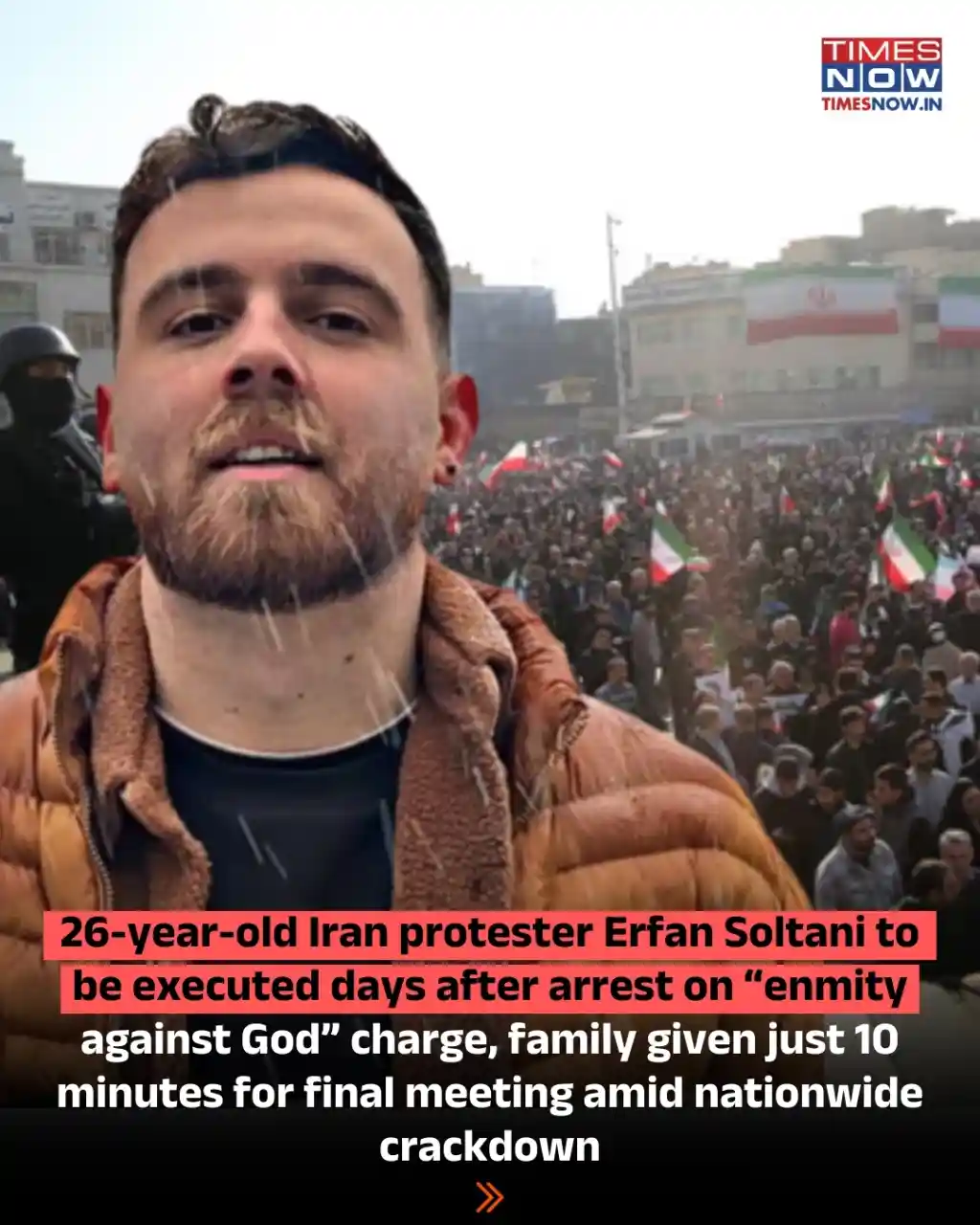
At the center of international alarm is Erfan Soltani, a 26-year-old from Karaj whose fate now symbolizes the regime’s scorched-earth strategy. Arrested during street protests, Soltani’s family was informed that his death sentence is final, irreversible, and imminent. There was no public trial, no independent judge, and no access to a defense lawyer.
Human rights groups report that Soltani was convicted under charges linked to moharebeh, despite no credible evidence that he carried a weapon or posed a lethal threat. Revolutionary courts, operating behind closed doors, reportedly relied on forced confessions and vague accusations of “disturbing public order.”
For his family, the process has been deliberately cruel. Visits are restricted, legal appeals blocked, and information tightly controlled. Authorities have reportedly told relatives to prepare for the execution at any moment. In modern Iran, this is not an anomaly—it is a message.
Moharebeh: How “War Against God” Became a Political Guillotine
The charge of moharebeh originates in classical Islamic jurisprudence, intended for violent bandits who terrorized communities. In theory, it was reserved for extreme threats to life and security. In today’s Iran, it has been transformed into a blunt instrument against dissent.
Under Article 279 of Iran’s Islamic Penal Code, anyone accused of creating fear, chaos, or insecurity can be labeled as someone who has declared “enmity against God.” The definition is elastic by design. Throwing stones, clashing with police, or even being present at a protest can be framed as moharebeh if the state chooses.
Once charged, defendants are dragged before revolutionary courts, institutions notorious for their secrecy and speed. Evidence standards are minimal. Confessions extracted under torture are admissible. Appeals are largely symbolic. When a sentence is issued, repentance rarely matters. Execution by hanging is the most common outcome, though harsher punishments exist in law.
In the current uprising, prosecutors have openly vowed “swift and harsh” punishment, signaling that executions are not excesses but policy.
Trump’s Warning: “Very Strong Action” and Global Shockwaves
Against this backdrop, President Donald Trump publicly warned Tehran that executing protesters would trigger “very strong action.” Speaking to CBS News, he left the specifics deliberately vague, amplifying the psychological pressure on Iran’s leadership.
Trump’s message was not limited to diplomatic channels. On his Truth Social platform, he urged Iranians to “KEEP PROTESTING” and announced the cancellation of all meetings with Iranian officials until executions stop. For protesters risking their lives, the words carried symbolic weight, reinforcing the sense that the world was finally paying attention.
Tehran’s reaction was swift and hostile. Iranian officials accused Washington of inciting unrest and preparing a pretext for military intervention. Hardline parliament speaker Mohammad Bagher Ghalibaf warned that any U.S. aggression would provoke a regional response targeting American forces and bases.
Iran’s UN mission dismissed Trump’s threats as recycled regime-change fantasies, insisting that U.S. pressure would “fail again.” Yet the regime’s fury betrayed unease. External pressure, layered atop internal rebellion, has historically proven destabilizing for authoritarian systems.
Blood on the Streets: Counting the Dead Amid Silence
The human cost of Iran’s crackdown is staggering. The Human Rights Activists News Agency (HRANA) has documented more than 2,400 protester deaths, a figure experts say is a conservative baseline. Other estimates range from 6,000 to 12,000, reflecting the regime’s near-total blackout on reliable data.
In Tehran alone, witnesses describe streets cleared by gunfire and snipers targeting crowds from rooftops. Norway-based Iran Human Rights (IHR) confirmed hundreds of deaths, including minors, while warning that information from most provinces remains inaccessible.
The strategy is deliberate. By obscuring numbers, the state seeks to blunt outrage and normalize mass killing. Yet the rumors, videos, and testimonies leaking out tell a different story: one of a government prepared to drown dissent in blood to preserve its rule.
Europe Responds as Iran’s Isolation Deepens
European governments have not remained silent. France, Germany, and the United Kingdom summoned Iranian ambassadors in protest, while the European Union condemned the killings as “horrifying.” EU Commission President Ursula von der Leyen pledged additional sanctions against officials responsible for the repression.
These diplomatic moves matter not because they immediately restrain Tehran, but because they deepen its isolation. Sanctions constrict an already failing economy, further eroding the social contract between the state and its citizens. Each execution, each crackdown, accelerates the cycle of resistance and repression.
Reza Pahlavi and the Return of a Forbidden Name
As the regime tightens its grip, a banned name has resurfaced with remarkable force: Reza Pahlavi, the son of Iran’s last shah. Protesters chant his name openly, framing him less as a monarchist symbol and more as a unifying alternative to clerical rule.
From exile, Pahlavi has urged Iranians to sustain the uprising, declaring that a “sea of blood” now separates the people from the regime. He has called on soldiers and security forces to remember their allegiance to the nation, not the Islamic Republic, warning that time is running out.

Is the Clerical System Facing Its Greatest Test?
Analysts caution against predicting immediate regime collapse. The Islamic Republic still commands formidable instruments of repression, particularly the Islamic Revolutionary Guard Corps (IRGC). Yet even seasoned observers acknowledge that this uprising is different.
The protests are broader, more politically explicit, and more relentless than previous waves. The use of mass executions as deterrence signals not confidence but fear. When a government must invoke divine war to justify killing its own citizens, it reveals a profound crisis of legitimacy.
As Erfan Soltani waits on death row and thousands more face similar fates, Iran’s rulers gamble that terror will succeed where ideology has failed. History suggests such gambles often end badly.
A Moment That Will Define Iran’s Future
Iran now stands at a defining moment. The charge of “War Against God” has become a mirror reflecting the regime’s own actions against its people. Executions without trial, bullets in the streets, and threats against the world are not signs of strength; they are the symptoms of a system under siege.
Whether through sustained protest, international pressure, or internal fracture, the forces unleashed in this uprising cannot easily be put back. The fate of Erfan Soltani may soon be sealed, but the verdict on the Islamic Republic remains unresolved—and the world is watching.