World War II forced nations into moral extremes. Armies demanded obedience under fire, discipline amid chaos, and courage when fear was rational. In that furnace, desertion became more than a crime; it was treated as a threat to collective survival. The Soviet Union executed deserters by the tens of thousands. Nazi Germany followed a similarly pitiless logic. The United States, by contrast, prosecuted desertion but almost never carried out the ultimate penalty. Almost.
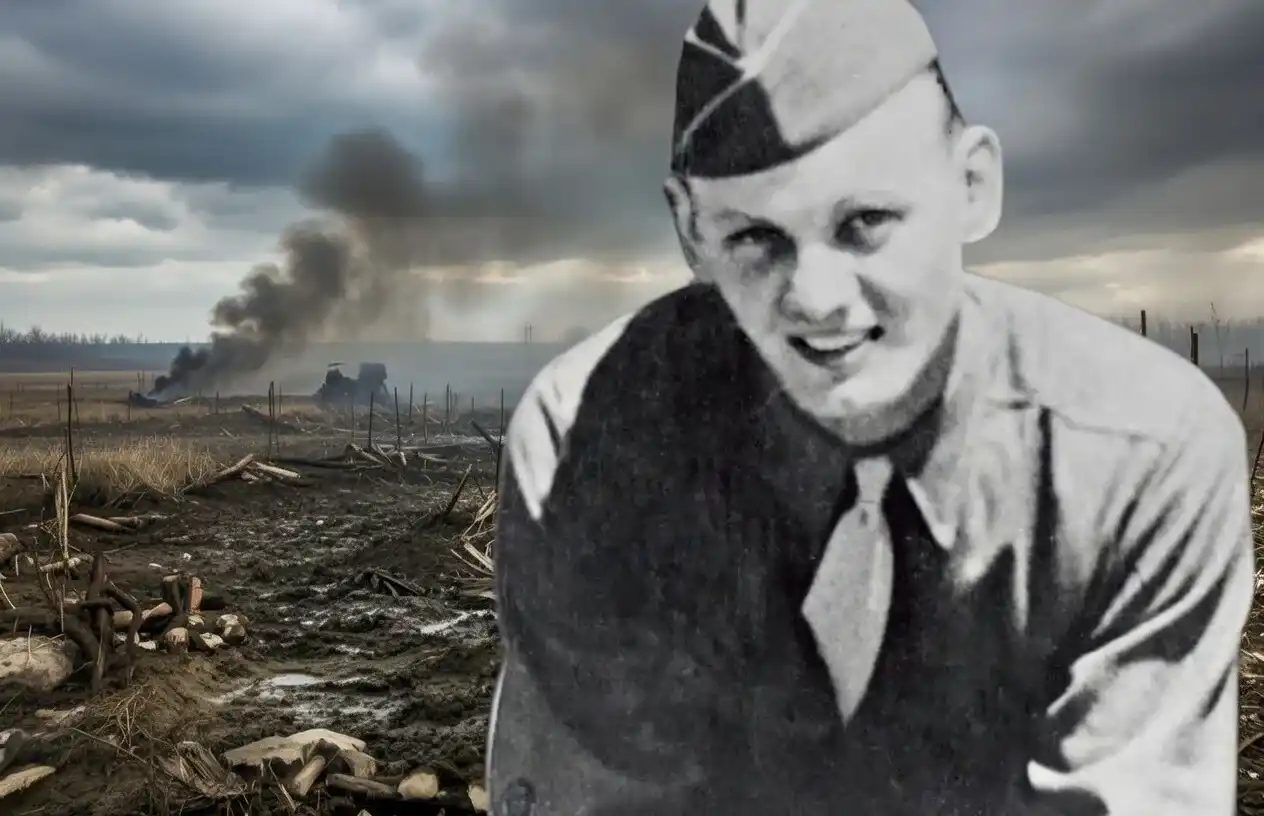
Edward Donald Slovik occupies a lonely place in American military history. At age twenty-four, he became the only U.S. soldier executed for desertion since the Civil War, and he remains the last to this day. His story is not one of battlefield treachery or espionage. It is a story of fear stated plainly, of bureaucratic momentum, and of timing so cruel that it feels designed by fate rather than policy.
The phrase “Bravest Coward” sounds like a contradiction, but it captures the strange gravity of Slovik’s case. According to veterans who knew him, including Nick Gozik, Slovik showed a kind of courage rare in war: the courage to admit terror in an institution built on suppressing it. That honesty, combined with a series of irrevocable decisions, placed him directly in the path of the firing squad.
Global Context: Desertion as a Capital Crime in Total War
World War II was an existential conflict, and total war devours nuance. The Soviet Red Army, facing annihilation under Hitler’s racial war in the East, enforced discipline with terror. Blocking detachments stood behind advancing units, authorized to shoot soldiers who fled. More than 150,000 Soviet troops were executed for desertion, a statistic that reads less like jurisprudence and more like industrialized fear.
Germany, haunted by myths of betrayal after World War I, embraced ruthless internal discipline. Military courts and field executions claimed 15,000 to 20,000 German soldiers, driven by a belief that leniency had cost the Kaiser’s army victory in 1918. Desertion, in this worldview, was not an individual failure but a contagious disease.
The United States took a different path. Over 20,000 American soldiers were convicted of desertion during the war. Forty-nine received death sentences. Forty-eight were spared. The lone exception was Eddie Slovik, and understanding why requires stepping into the machinery of war at its most impersonal.
From Detroit Streets to Army Uniform
Edward Donald Slovik was born in Detroit on February 18, 1920, to Polish-American parents, Josef Slowikowski and Anna Lutsky. His childhood unfolded along the rough edges of the Great Depression. At twelve, he committed his first theft, sneaking into a foundry to steal brass for resale. The pattern stuck. By adulthood, Slovik had been arrested five times for petty crimes and served two separate prison sentences.
This record branded him 4-F, morally unfit for military service, when the United States entered the war. In November 1942, he married Antoinette Wisniewski and took a steady job as a shipping clerk, seemingly set on a quieter life far from the front lines.
War, however, consumes margins. As casualties mounted and manpower needs intensified, standards fell. In January 1944, Slovik was drafted. He trained, donned the uniform, and shipped to France in August, assigned to Company G, 109th Infantry Regiment, 28th Infantry Division.
Lost, Then Found, Then Lost Again
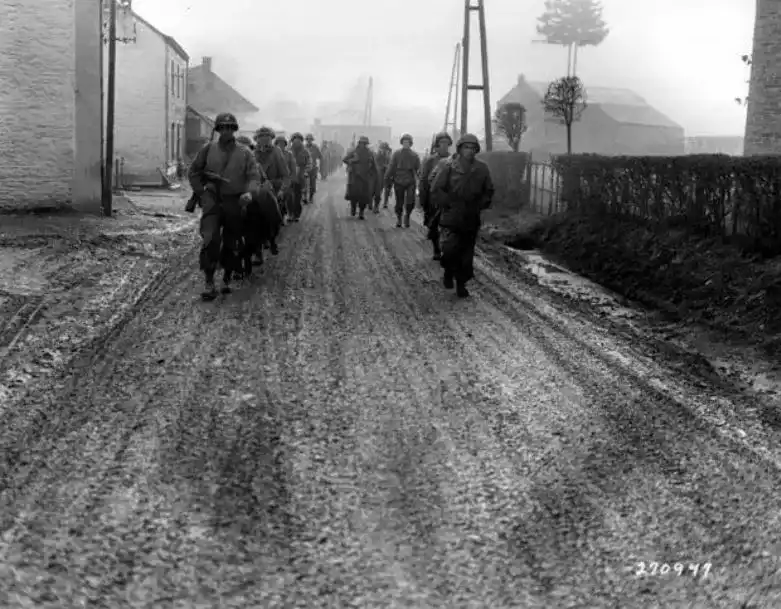
Within days of reaching the front, Slovik and Private John Tankey were separated from their unit during a German artillery barrage. Disorientation under shellfire was common, and the two men spent six weeks attached to a Canadian military police unit. They made no serious effort to rejoin their regiment, but such lapses were frequent enough that, when they finally returned in October, no charges were filed.
This moment mattered. It offered Slovik a quiet reset. Instead, the day after rejoining his unit, he approached Captain Ralph Grotte and confessed something that most soldiers buried deep: he was too scared to fight. He asked for reassignment to a rear unit. Grotte refused. Slovik then asked a question that would echo through history: if he left, would it count as desertion?
When told yes, Slovik walked away anyway.
Tankey tried to stop him. Slovik replied that his mind was made up. He walked several miles to the rear and presented himself to an enlisted cook at a military government detachment, handing over a handwritten confession that left no room for interpretation. It ended with a sentence as stark as a death warrant: “I’ll run away again if I have to go out there.”
The Confession No One Wanted
The system tried to save him. The company commander urged Slovik to destroy the note before formal custody. He refused. Lieutenant Colonel Ross Henbest offered him another chance, asking him to tear it up and return to his unit with no charges. Slovik refused again.
Henbest required him to add a statement acknowledging that the confession could be used against him in a court-martial. Slovik complied, sealing the document’s power. Confined to the division stockade, he was approached by Lieutenant Colonel Henry Sommer, the division judge advocate, who made repeated offers of clemency if Slovik would simply return to the front.
Sommer later wrote that Slovik believed prison would be his punishment, and prison was familiar territory. Combat, to him, was not. Even an offer to transfer him to a new unit where no one knew his past failed. Slovik’s response remained unchanged: he would take the court-martial.
Trial Amid Rising Casualties
On November 11, 1944, Slovik was court-martialed. Because the 28th Infantry Division’s officers were engaged at the front, the panel consisted of staff officers from other divisions. Even here, Slovik declined to mount a defense. He offered no assurances that he would not desert again.
The timing was lethal. American forces in France were absorbing heavy losses. Desertion rates were rising. Discipline, in the eyes of commanders, was no longer an abstract principle but a frontline necessity.
Slovik was sentenced to death. One of the judges, General Norman Cota, later explained his reasoning with painful clarity. Approving the sentence, he wrote, was a duty to the soldiers still facing enemy fire. Allowing Slovik to succeed, he believed, would have undermined morale among those who stayed.
Eisenhower’s Desk and the Battle of the Bulge
Slovik appealed for clemency. On December 9, 1944, he wrote directly to Supreme Allied Commander General Dwight D. Eisenhower, pleading for mercy. Days later, the German Ardennes offensive erupted into what would become the Battle of the Bulge, the largest and bloodiest engagement fought by U.S. forces in the war.
In that moment, desertion was not a legal curiosity. It was a perceived contagion. On December 23, Eisenhower confirmed the execution order, noting the necessity of discouraging further desertions. The decision stunned Slovik, who had believed imprisonment inevitable but execution impossible.
Final Words and Final Judgment
As the execution approached, Slovik’s understanding sharpened into bitterness. He argued that thousands had deserted without facing death. He believed he was chosen not for his crime alone, but for his past. “They’re shooting me for the bread and chewing gum I stole when I was 12 years old,” he said, framing his fate as a lifetime sentence finally collected.
On January 31, 1945, Eddie Slovik was executed by a firing squad. He had served barely a year in uniform, spent less than a week on the front lines, and been in France for just under five months. The war in Europe would end three months later.
Legacy of a Singular Execution
Slovik remains the last American soldier executed for desertion. During the Vietnam War and conflicts in Afghanistan and Iraq, desertions occurred, but none resulted in death sentences. His case stands as an anomaly shaped by fear, timing, and an inflexible honesty that collided with an inflexible system.
His story inspired a 1954 book and, after political resistance delayed its production, a 1974 television film that drew record audiences. The film portrayed not a villain but a man crushed by forces far larger than himself, trapped in a bureaucratic war machine that had lost the luxury of mercy.
The Paradox of the “Bravest Coward”
Calling Eddie Slovik the “Bravest Coward” is not an excuse for desertion, nor a condemnation of those who sentenced him. It is an acknowledgment of a paradox at the heart of war. Courage is usually measured by action under fire. Slovik’s courage, if it can be called that, lay in refusing to lie about his fear, even when the lie would have saved his life.
His execution did not end desertion. It did, however, leave a scar on American military history, a reminder that justice in wartime is often shaped less by principle than by pressure. Slovik’s name endures not because he fled, but because he was chosen to stand still when the machinery of war demanded motion at any cost.
In remembering Eddie Slovik, the question is not whether the sentence was legal. It was. The question is whether it was inevitable. History suggests it was not, and that uneasy space between legality and necessity is where his legacy still lives.