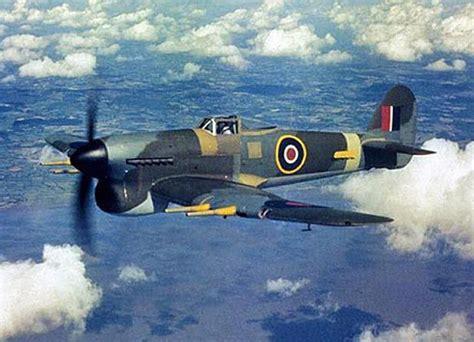
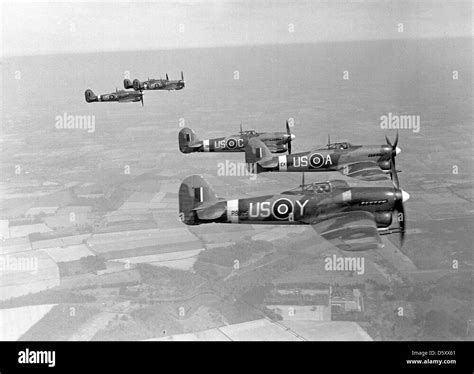
The Hawker Typhoon, often overshadowed by its more refined successor, the Hawker Tempest, stands as one of the most formidable ground attack aircraft of the Second World War. Designed initially as a high-speed interceptor, the Typhoon’s journey from a troubled beginning to a feared low-altitude strike aircraft is a testament to British engineering resilience. It became a crucial asset for the Royal Air Force (RAF) in the critical years of 1941 to 1945, earning its place as a workhorse of Allied tactical air support.
Origins and Development
The Typhoon’s origins trace back to 1937 when the Air Ministry issued specifications for a next-generation interceptor capable of surpassing 400 mph at 15,000 feet. This ambitious target led to the development of the Specification F.18/37, calling for an aircraft powered by the latest high-output engines like the Napier Sabre and the Rolls-Royce Vulture. The result was the birth of the Typhoon, which first took to the skies as the P5212 prototype on February 24, 1940. Initial designs incorporated a distinctive inverted gull wing, a robust tubular steel forward fuselage, and a semi-monocoque rear structure. These features, coupled with a thick NACA wing section, gave the Typhoon a rugged profile and substantial internal space for fuel and armaments.
Early Challenges and Breakthroughs
Despite its promising specifications, the Typhoon’s introduction was marred by technical setbacks. The early Napier Sabre engines, though powerful at 2,000 hp, suffered from reliability issues, including severe overheating and frequent mechanical failures. Compounding these problems, pilots reported dangerous levels of carbon monoxide seeping into the cockpit, a potentially fatal flaw addressed by Modification 239. Structural concerns also plagued the early models, with the tail assembly prone to high-speed flutter, which caused several catastrophic losses. This issue was partially resolved through the addition of external fishplates (Modification 286), strengthening the tail’s integrity.
Evolution of the Typhoon’s Armament and Role
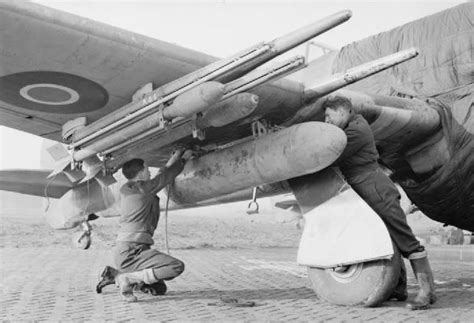
Originally armed with twelve .303 Browning machine guns, the Typhoon soon transitioned to a more fearsome armament of four 20 mm Hispano cannons, significantly enhancing its firepower against both air and ground targets. As its role shifted from interceptor to ground attack, the Typhoon adapted with various loadouts, including the capability to carry two 1,000-pound bombs (earning the nickname “Bombphoon”) and, later, the devastating RP-3 rockets, which became its signature weapon. These rockets, paired with the Typhoon’s tremendous low-altitude speed, allowed it to deliver crippling blows to enemy armor and transport columns.
Operational History and Notable Engagements
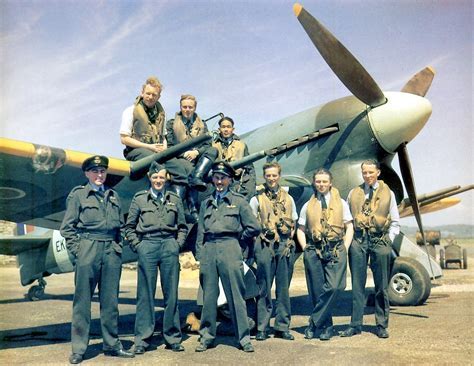
The Typhoon’s first significant operational use came in the defense against Luftwaffe ‘tip-and-run’ raids over southern England in late 1942. The aircraft excelled in this role, with 486 (NZ) Squadron claiming 20 kills between October 1942 and July 1943. One of the Typhoon’s most celebrated days came on January 20, 1943, when a small group intercepted and downed five German fighters over London. These early successes validated the Typhoon’s place as a frontline fighter, but its real legend would be forged over the fields of Normandy and beyond.
Role in the Normandy Invasion and Beyond
During the lead-up to D-Day and the subsequent Allied push through France, the Typhoon became a critical part of the 2nd Tactical Air Force (2TAF). Armed with its formidable RP-3 rockets, it played a decisive role in breaking German armored formations, including during Operation Goodwood, where Typhoons were credited with destroying or disabling 222 tanks, though later assessments reduced this figure significantly. In the pivotal Battle of Mortain on August 7, 1944, Typhoons delivered precise and overwhelming air strikes that contributed to halting the German counteroffensive, earning praise from General Dwight D. Eisenhower himself.
Legacy and Post-War Impact
By the time hostilities ceased, the Typhoon had earned a reputation as one of the deadliest tactical strike aircraft of the war. It claimed 246 confirmed air-to-air victories, including several Messerschmitt Me 210 fighters and a range of Focke-Wulf Fw 190s. Over 3,317 Typhoons were built, with the type being retired in October 1945. Although its service was brief, the Typhoon’s impact was profound, laying the groundwork for the more advanced Hawker Tempest and cementing its legacy as a symbol of Allied air power in the face of fierce German resistance.
Conclusion
The Hawker Typhoon’s story is one of adaptation and resilience. Despite early technical setbacks, it evolved into one of the most effective close-support aircraft of the Second World War, defining itself through its unmatched combination of speed, firepower, and versatility. It stands as a testament to the bravery of its pilots and the ingenuity of the engineers who transformed a troubled prototype into a war-winning machine.