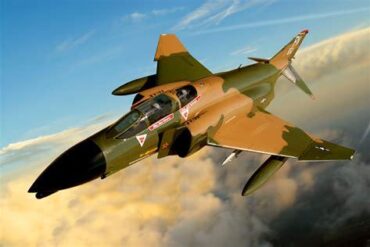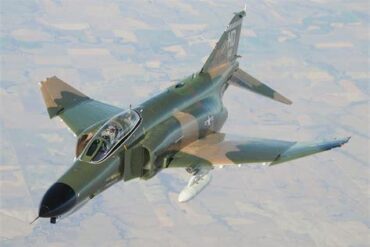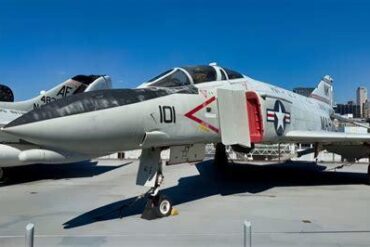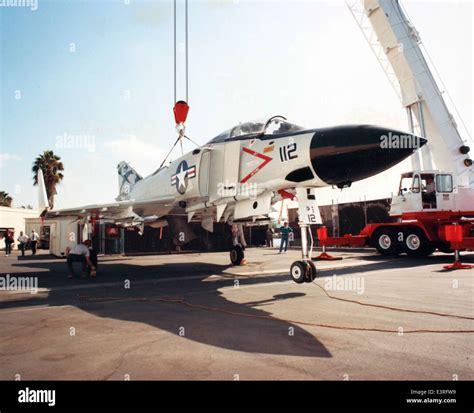
The McDonnell Douglas F-4 Phantom II occupies a peculiar, almost mythical place in aviation history. It is remembered as thunderously loud, brutally fast, and unapologetically industrial—an aircraft that looked less like a sleek duelist and more like a flying engine with wings bolted on as an afterthought. Yet behind that raw presence lies a precise question that still sparks debate among aviation historians and defense analysts alike: was the F-4 Phantom truly a long-range supersonic fighter, or is that reputation inflated by nostalgia and Cold War bravado?
To answer that, the Phantom has to be understood on its own terms, in the strategic environment that shaped it. Modern comparisons can be misleading. The standards of range, speed, and endurance in the 1960s were radically different from those of today, and the threats that defined fighter design were not stealth fighters or integrated air-defense networks, but high-altitude nuclear bombers racing toward carrier groups and continental targets.
What emerges is a clearer, more interesting truth. The F-4 Phantom was not merely fast, and it was not merely long-legged. It was a product of a doctrinal moment when speed and distance were weapons, and when interception at scale mattered more than elegance or agility.
The Phantom’s legacy lives at the intersection of those ideas.
Origins of the Phantom: Built for Distance and Speed, Not Dogfights
The Phantom’s story begins in the mid-1950s, when the U.S. Navy faced a nightmare scenario: Soviet long-range bombers approaching carrier groups at high altitude and high speed, armed with nuclear weapons. Defending against that threat required an aircraft that could launch quickly, climb aggressively, travel far from the carrier, and intercept at supersonic speed.
McDonnell Aircraft responded with a radical design philosophy. The F-4 was conceived not as a nimble dogfighter, but as a fleet defense interceptor. Its job was to get far from the carrier, stay on station, detect threats using powerful radar, and destroy them before they ever came close. That requirement alone demanded both range and speed, and it shaped every major design decision.
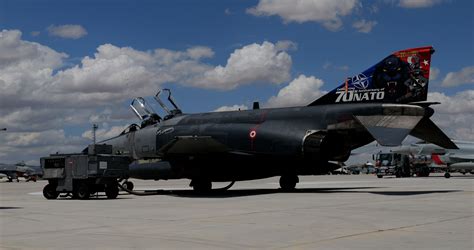
The result was an aircraft with a large airframe, twin engines, and cavernous internal fuel capacity for its era. It was also one of the first fighters built from the ground up to rely on air-to-air missiles rather than guns, a choice that reflected enormous confidence in emerging technology. Early Phantoms famously lacked an internal cannon, a decision that would later be reconsidered, but which made sense within the interceptor mindset.
This design logic explains why the Phantom looks the way it does. It was not chasing visual-range knife fights. It was built to cover space—big stretches of ocean and sky—and to do so at astonishing speed.
Defining “Long-Range” in a Cold War Context
Calling the F-4 Phantom a long-range fighter requires historical honesty. By modern standards, it does not qualify. By 1960s standards, it absolutely did.
When equipped with external fuel tanks, the F-4 could achieve a ferry range between roughly 1,750 and 2,300 miles, depending on configuration and conditions. That allowed it to deploy across oceans, reposition rapidly between theaters, and operate far from home bases. More important for combat operations was its combat radius, which hovered around 340 to 370 nautical miles.
In the early 1960s, that was exceptional.
Carrier-based fighters before the Phantom typically operated with far shorter reach. The F-4 allowed carrier strike groups to project air power hundreds of miles outward, expanding the defensive bubble around naval assets. This mattered enormously in an era when radar coverage was limited and reaction time could determine survival.
What often gets overlooked is that the Phantom could loiter. It wasn’t just about sprinting outward and back. The aircraft could patrol, hold altitude, and remain mission-capable for extended periods—an essential quality for interception missions where timing was uncertain.
Supersonic Performance: Speed as a Strategic Asset
If range gave the Phantom reach, speed gave it authority. Powered by two General Electric J79 turbojet engines, the F-4 was capable of exceeding Mach 2.2, placing it among the fastest operational fighters ever fielded by the United States.
This speed was not a vanity metric. It served several strategic purposes. First, it allowed rapid interception. A Phantom could be launched, climb aggressively, and close distance on incoming threats before those threats reached critical assets. Second, speed offered survivability. In a pre-stealth world, outrunning danger was often the only option.
However, supersonic flight came at a cost. At high speeds, the J79 engines produced thick black smoke, making the aircraft highly visible. Fuel consumption skyrocketed, and maneuverability suffered. In real combat conditions, particularly over Vietnam, pilots rarely stayed supersonic for long.
Still, the capability mattered. The Phantom could go supersonic when it needed to, and few aircraft of its time could match that combination of speed, payload, and endurance.
Missiles, Radar, and the Long-Range Intercept Mission
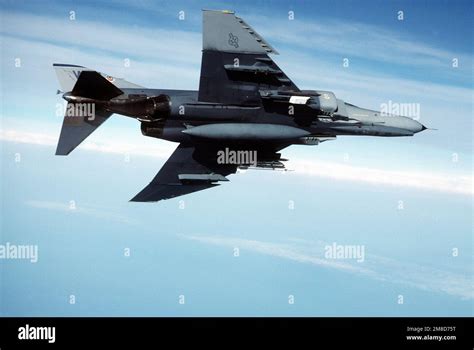
The F-4’s long-range credentials were inseparable from its sensors and weapons. Equipped with advanced radar for its time, the Phantom was designed to detect and engage targets beyond visual range, a revolutionary concept in the late 1950s.
Its primary air-to-air weapon, the AIM-7 Sparrow, could engage targets at ranges of up to 25 miles under optimal conditions. While primitive by modern standards, this capability transformed air combat doctrine. The Phantom was meant to kill enemies it never saw directly, guided by radar and missile logic rather than instinct and reflex.
This approach aligned perfectly with long-range interception. The aircraft could patrol distant airspace, detect threats early, and neutralize them without closing into dogfighting distance. That vision proved overly optimistic in Southeast Asia, where rules of engagement and unreliable missile performance forced pilots into close combat, but the underlying concept remained sound.
The Phantom’s size allowed it to carry a heavy missile load, external fuel tanks, and later, ground-attack ordnance. Few aircraft of its generation could match that flexibility across such distances.
Why the Phantom Felt Long-Range Even When It Wasn’t Infinite
One reason the F-4 gained a reputation for long range was that it was not constrained by stealth considerations. It could carry large external fuel tanks without penalty, trading aerodynamic drag for endurance. Modern fighters, by contrast, must often sacrifice external stores to preserve low observability.
In practical terms, a fully fueled F-4 with three external tanks could remain operationally relevant at distances that rival some modern fighters operating on internal fuel alone. That comparison is not entirely fair, but it underscores how mission design affects perceived range.
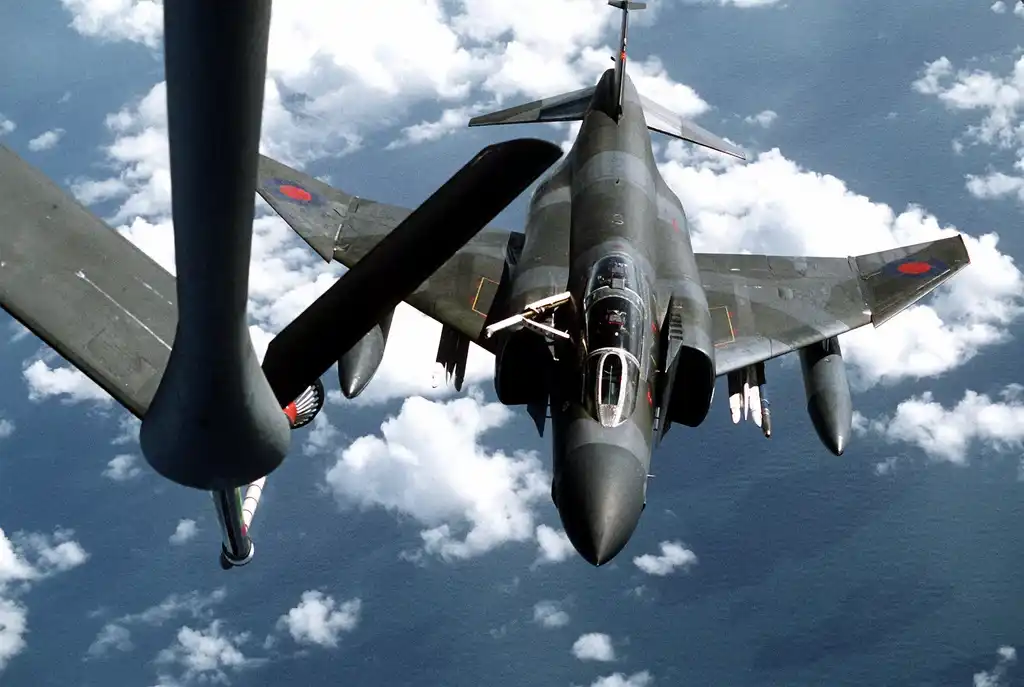
The Phantom also benefited from aerial refueling, which extended its reach dramatically. Tanker support allowed F-4s to operate across continents and oceans, reinforcing the perception that they were truly long-range assets.
Operational Reality: Vietnam and the Limits of Speed
Combat has a way of exposing theory. Over Vietnam, the Phantom’s strengths and weaknesses became painfully clear. While its speed and climb performance were impressive, air combat often occurred at lower altitudes and slower speeds than designers had anticipated.
Dogfighting demanded visibility, maneuverability, and reliable weapons. The Phantom had none of those in abundance. Its large frame made it less agile than smaller adversaries, and early missile systems proved unreliable. These lessons forced changes, including the addition of internal guns on Air Force variants and revised training doctrines.
Yet even in this environment, the Phantom’s range and endurance mattered. It could strike deep targets, provide escort over long distances, and return home when other aircraft might have struggled. Its ability to carry heavy bomb loads over extended ranges blurred the line between fighter and bomber, reinforcing its strategic value.
Replacement by the F-14: A Shift in Long-Range Thinking
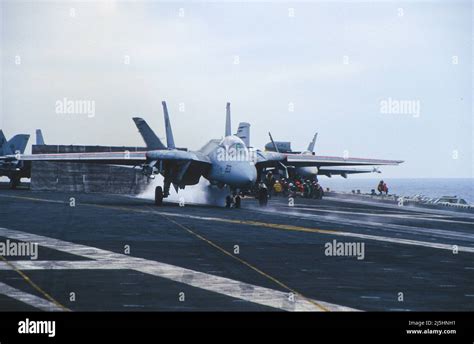
In U.S. Navy service, the Phantom was eventually replaced by the F-14 Tomcat, an aircraft explicitly designed to push the long-range interceptor concept even further. The Tomcat’s AWG-9 radar and AIM-54 Phoenix missiles allowed it to engage targets at over 100 miles, dwarfing the Phantom’s reach.
This transition highlights an important point. The F-4 was long-range by necessity, but it was not the end state. It was a stepping stone toward a more specialized, more capable fleet defense platform. The Tomcat refined what the Phantom pioneered, adding better visibility, longer missile range, and improved maneuverability.
The Phantom, by contrast, relied more heavily on speed and brute force. It could reach far and fast, but it lacked the sensor dominance that later aircraft would enjoy.
The End of the Speed Obsession
The Phantom emerged during an era obsessed with speed. Faster meant safer. Higher meant untouchable. That mindset produced extraordinary machines, from the F-4 to the XB-70 Valkyrie. Over time, experience proved that speed alone was not enough.
Modern fighters prioritize stealth, sensor fusion, and situational awareness over raw velocity. Aircraft like the F-35 are slower than the Phantom on paper, yet vastly more survivable and effective. They can penetrate defended airspace without needing to outrun threats.
This does not diminish the Phantom’s achievement. It contextualizes it. The F-4 represents the peak of a design philosophy that believed you could not hide, so you had to run.
So, Was the F-4 Phantom a Long-Range Supersonic Fighter?
The honest answer is yes—within its historical frame.
The F-4 Phantom II combined supersonic speed, substantial combat radius, and heavy payload capacity in a way that few aircraft of its time could match. It extended the reach of carrier air power, enabled deep strike missions, and reshaped interception doctrine. By the standards of the Cold War, it was absolutely a long-range supersonic fighter.
By modern definitions, it falls short. Its engines were inefficient, its avionics primitive, and its endurance limited without external tanks and refueling support. But judging it by today’s metrics misses the point.
The Phantom was built for a world where distance and speed were existential advantages. In that world, it excelled.
Legacy of a Machine That Redefined Reach
More than 5,000 F-4 Phantoms were built, serving with dozens of air forces across the globe. Few aircraft can claim such influence. Even today, modified Phantoms continue to fly in limited roles, a testament to the strength of the original design.
The Phantom’s true legacy is not just in numbers or records, but in how it changed expectations. It proved that a fighter could be big, fast, long-legged, and versatile all at once. It forced militaries to rethink how far and how fast air power could be projected.
In the end, the F-4 Phantom was not a compromise between range and speed. It was an audacious attempt to maximize both—and for its time, it succeeded brilliantly.