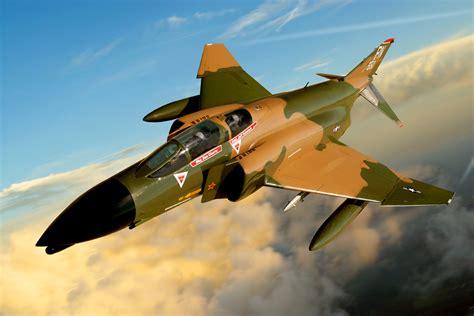
A Jet Born to Dominate the Skies
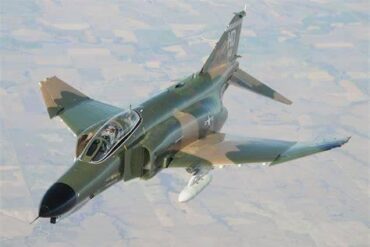
The McDonnell Douglas F-4 Phantom II emerged as one of the most iconic and versatile military aircraft of the Cold War. Developed initially for the U.S. Navy in the mid-1950s, it swiftly proved adaptable enough for service across the U.S. Marine Corps and U.S. Air Force, evolving into a multi-role platform that delivered unmatched firepower, speed, and endurance for its time. With over 5,000 units built, it remains the most-produced American supersonic military aircraft and a definitive symbol of Cold War air superiority.
Designed to be a tandem two-seat, twin-engine interceptor and fighter-bomber, the Phantom II was capable of executing all-weather, long-range missions with devastating efficiency. Sporting a top speed of Mach 2.2 and an arsenal capacity of more than 18,000 pounds of ordnance across nine external hardpoints, the F-4 was a game-changer. While early versions lacked an internal cannon, later models addressed this with the M61 Vulcan rotary gun, giving the aircraft close-range combat capabilities it initially lacked.
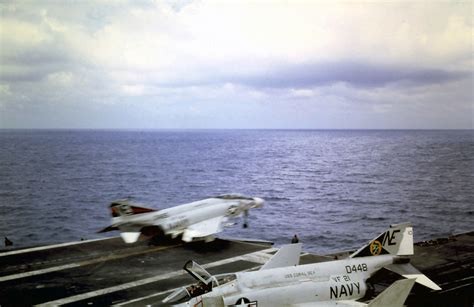
From Super Demon to Phantom: Evolution of a Legend
The Phantom’s roots trace back to 1952, when McDonnell Aircraft, under Dave Lewis, began reimagining the F3H Demon. Initially called the “Super Demon,” the concept rapidly evolved in response to the Navy’s shifting priorities. In 1955, the need for a fleet defense interceptor solidified the design’s two-seat configuration. The resulting XF4H-1 prototype was a radical departure: twin General Electric J79 engines, advanced aerodynamics like blown flaps and dogtooth leading edges, and an AN/APQ-50 radar for all-weather targeting.
Its maiden flight on 27 May 1958 marked the dawn of a new era. After outperforming competitors like the XF8U-3 Crusader III, the Phantom II secured its role as the Navy’s premier fighter. Carrier trials followed quickly, and by 1960, the aircraft entered active testing aboard the USS Independence. Originally dubbed “Satan” and “Mithras,” the aircraft’s final name—Phantom II—was a nod to McDonnell’s earlier FH-1 Phantom and a fitting title for a machine that would haunt enemy air defenses for decades.
Advanced Engineering and Cutting-Edge Design
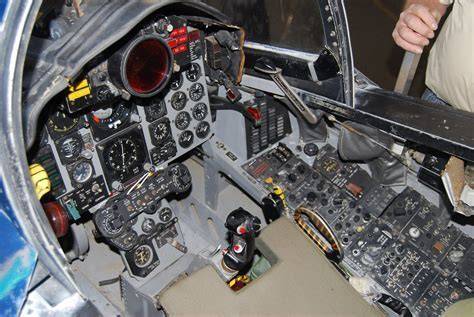
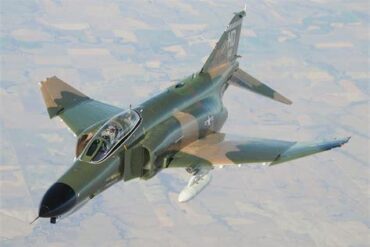
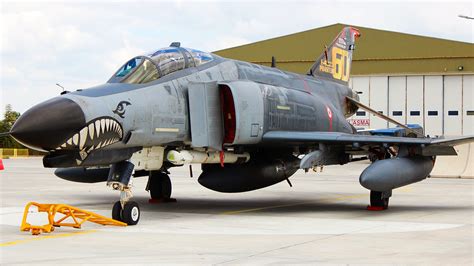
The F-4’s distinctive features stemmed from a commitment to blending raw power with battlefield adaptability. Its long fuselage housed pulse-Doppler radar, sophisticated avionics, and advanced fire-control systems. Later models featured enlarged noses to accommodate the AN/APQ-72 radar, creating the aircraft’s signature profile.
Nine external hardpoints enabled the F-4 to deliver a mix of AIM-7 Sparrows, AIM-9 Sidewinders, bombs, and nuclear weapons. The J79 turbojet engines, which initially produced visible smoke plumes, were refined over time to improve stealth and fuel efficiency. Leading-edge slats and dihedral wings further enhanced maneuverability, though the F-4 was never a tight-turning dogfighter.
Phantom Records: Shattering the Skies
Between 1959 and 1962, the F-4 Phantom II obliterated aviation records. It claimed 15 world records, five of which remained unbroken until the F-15 Eagle’s arrival in the mid-1970s.
- Operation Top Flight (1959): A zoom climb to 98,557 feet.
- Operation LANA (1961): A coast-to-coast U.S. flight in under three hours.
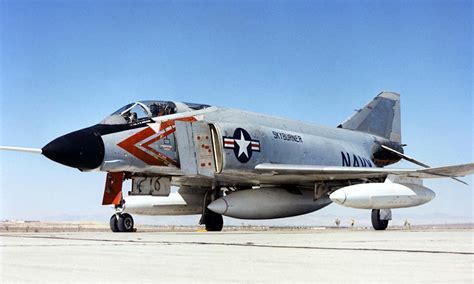
- Operation Sageburner (1961): Low-altitude speed record at 1,452.777 km/h.
- Operation Skyburner (1961): Speed record of 1,606.342 mph with water injection.
- Project High Jump (1962): A series of time-to-altitude benchmarks that cemented its climb performance.
These feats established the F-4 not only as a formidable combat aircraft but also as a technological marvel of its generation.
Operational Prowess in Global Conflicts
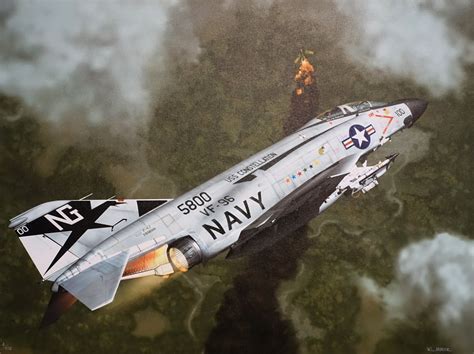
The F-4 was no hangar queen. It saw extensive combat in Vietnam, where it assumed a wide array of roles: air superiority, close air support, interdiction, and reconnaissance. The Phantom was responsible for producing all five American aces of the Vietnam War, including Captain Steve Ritchie and WSO Charles DeBellevue, the latter scoring six confirmed kills.
- U.S. Navy: From VF-121 to VF-74, Navy squadrons deployed Phantoms from carriers starting in 1962. With over 40 air-to-air victories, they proved lethal in dogfights. However, 73 aircraft were lost in combat, mostly to ground fire.
- U.S. Marine Corps: Starting with VMFA-314 in 1962, the Marines used Phantoms primarily for air defense and ground support. They lost 75 aircraft, again largely to AAA.
- U.S. Air Force: The USAF embraced the F-4C from 1964. With sophisticated radar and dual-role flexibility, USAF Phantoms scored over 100 MiG kills, notably during Operation Bolo, a tactical deception that devastated the North Vietnamese MiG-21 force.
Variant Legacy: Adaptation Over Decades
The Phantom family expanded with multiple variants optimized for specific missions:
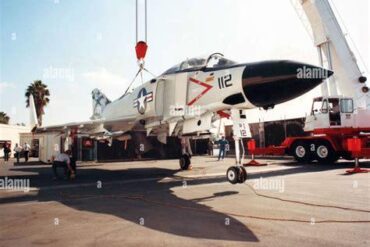
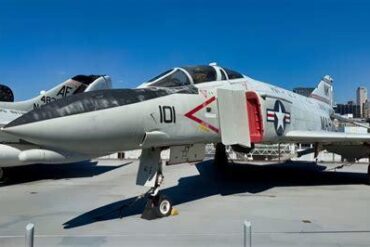
- F-4A/F-4B: Navy originals, the B introduced improved radar and engines.
- F-4C/D: Air Force models with ground-attack capabilities; the D added new avionics.
- F-4E: Introduced an internal M61 Vulcan cannon, a pivotal improvement.
- F-4J/S: Enhanced with smokeless engines, digitized radar, and advanced targeting systems.
- RF-4B/C: Dedicated unarmed reconnaissance platforms with sophisticated cameras.
- F-4G Wild Weasel: Electronic warfare variant specialized in Suppression of Enemy Air Defenses (SEAD).
By the end of its production in 1981, 5,195 units had been built, including 138 by Mitsubishi in Japan. Phantoms remained in front-line service with the U.S. until 1996, a remarkable tenure.
Enduring Impact and Global Service
The Phantom’s footprint extended far beyond the U.S. It was exported to 11 countries, including Israel, Iran, Turkey, Japan, South Korea, and Germany. In Israeli service, the F-4 proved invaluable during the Yom Kippur War. Iran continues to operate F-4s today, despite decades of sanctions.
The F-4 also served in demonstration teams—Blue Angels and Thunderbirds—and later transitioned to target drone duty under the QF-4 program. The final QF-4 mission flew in May 2015, capping a historic operational lifespan of nearly six decades.
Conclusion: The Eternal Phantom
The McDonnell Douglas F-4 Phantom II is more than a jet fighter; it’s a legacy of engineering innovation, battlefield dominance, and Cold War resilience. It bridged the era between guns and missiles, between visual dogfighting and beyond-visual-range warfare. Its design inspired a generation of aircraft, from the F-14 Tomcat to the F-15 Eagle, and its combat record remains unmatched by any other American fighter of the Vietnam era.
Even as fifth-generation fighters redefine air combat, the Phantom’s roar echoes in the corridors of aviation history—a sound that once meant death from above, and now stirs nostalgia for the jet age’s golden age.