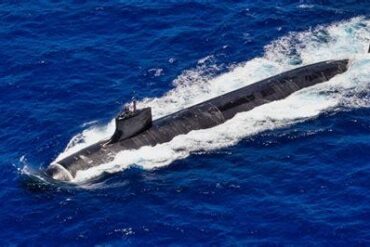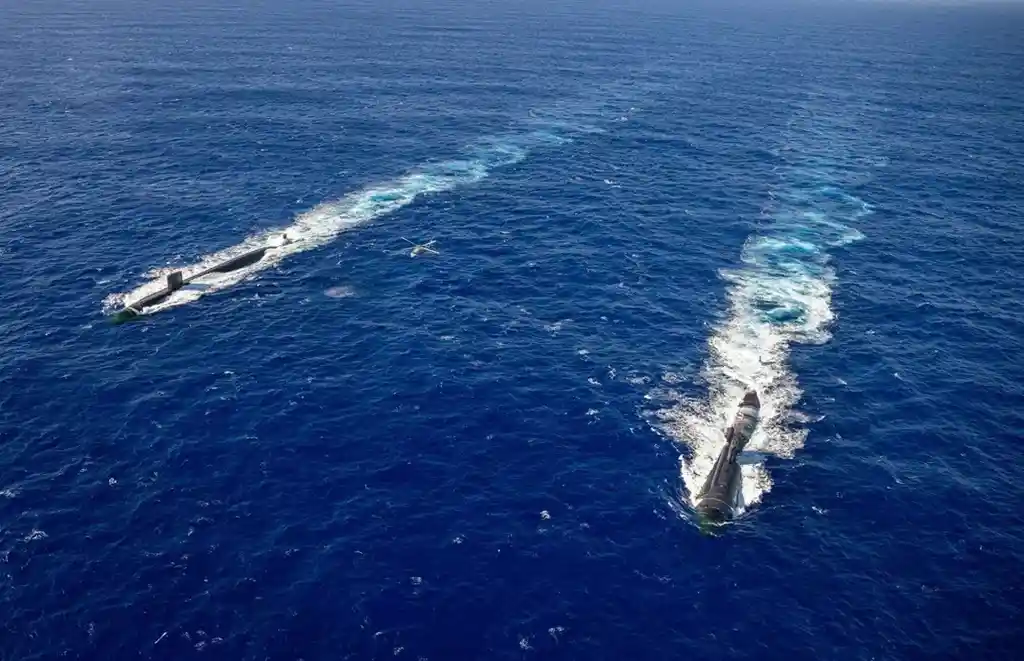
The deliberate surfacing of two U.S. Navy nuclear-powered attack submarines near Guam has sent a measured but unmistakable message across the Indo-Pacific. As regional tensions sharpen and warning times compress, the appearance of USS Asheville (SSN 758) and USS Annapolis (SSN 760) operating side by side underscores a forward posture built not on spectacle, but on capability.
The December 17, 2025 evolution, later detailed by Commander, Submarine Squadron 15, featured the two Los Angeles-class fast-attack submarines conducting a tightly controlled surfaced formation exercise supported by an MH-60S Sea Hawk from Helicopter Sea Combat Squadron 25. Submarines are engineered to remain unseen; when they surface together, particularly in formation, it is a calculated act. The event highlighted coordinated seamanship, safety oversight, and readiness in a theater where naval forces are increasingly expected to respond with speed and precision.
In the Indo-Pacific’s strategic geometry, Guam functions as a forward anchor for U.S. undersea power. The island’s proximity to key maritime corridors and contested waters allows submarines to deploy rapidly without the extended transit times associated with continental U.S. ports. Forward basing at Naval Base Guam and Polaris Point enables faster turnaround for maintenance, rearmament, and crew readiness, compressing operational timelines in a region defined by dynamic contingencies.
Forward-Deployed Submarine Power in the Western Pacific
The two submarines involved are late-production “improved 688” Los Angeles-class boats, refined for enhanced quieting and upgraded combat systems. Displacing roughly 6,900 tons submerged and stretching approximately 360 feet in length, these nuclear-powered vessels are capable of exceeding 25 knots and diving beyond 800 feet. Those figures are more than technical trivia. In the vast maritime expanse of the Western Pacific, speed and depth translate into tactical freedom — the ability to reposition swiftly, evade detection, and exploit fleeting opportunities.
The improved 688 variant integrated acoustic refinements and sensor upgrades over earlier boats in the class, reinforcing their relevance in an era increasingly defined by advanced sonar arrays and maritime surveillance networks. While newer Virginia-class submarines represent the next generation of U.S. undersea capability, the Los Angeles-class remains a formidable component of the fleet, particularly when forward deployed.
Submarine Squadron 15, headquartered in Guam, operates multiple attack submarines at the tip of the Pacific spear. Its mission extends beyond deterrence; it embodies rapid-response capacity. When two such vessels surface in proximity, the implication is not redundancy but depth — an ability to field multiple hulls in coordinated readiness.
Tomahawk Strike Reach from the Undersea Domain
Central to the strike relevance of these submarines is the Tomahawk cruise missile. The Los Angeles-class boats are equipped with 12 Vertical Launch System (VLS) tubes, enabling them to fire Tomahawks without drawing from torpedo-room storage. This design allows commanders to maintain a mixed payload of land-attack missiles, heavyweight torpedoes, and other munitions tailored to mission requirements.
Current fleet inventories include Tomahawk Block IV and Block V variants. With an operational range approaching 900 nautical miles, these subsonic, all-weather missiles rely on inertial navigation, GPS, and terrain-contour matching systems for precise targeting. Block IV introduced two-way satellite communications, enabling in-flight retargeting and loiter capabilities. The more recent Block V modernization incorporates navigation enhancements and is structured to integrate the Maritime Strike Tomahawk, extending effectiveness against moving naval targets.
From Guam, a submarine armed with Tomahawks can project power across significant swaths of the Western Pacific. This reach complicates adversary calculations by imposing uncertainty regarding launch platforms and timelines. A submerged submarine leaves no visible wake of logistics or deployment — yet its strike envelope can encompass distant land-based infrastructure and maritime formations.
Undersea Dominance: The Mk 48 ADCAP
While cruise missiles command headlines, the defining weapon of an attack submarine remains the Mk 48 Advanced Capability (ADCAP) heavyweight torpedo. Designed to defeat both fast, deep-diving submarines and high-performance surface ships, the Mk 48 can be wire-guided during midcourse and transition to active or passive acoustic homing in its terminal phase.
The significance lies in flexibility and lethality. Wire guidance enables a submarine commander to update targeting data in real time, preserving stealth while refining attack geometry. Should an initial run fail to neutralize the target, reattack capability enhances mission assurance. Against surface combatants, the torpedo’s under-keel detonation profile can inflict catastrophic structural damage.
In contested waters where adversaries field sophisticated countermeasures and layered defenses, such a weapon represents more than a legacy system. It remains the decisive instrument of sea denial — a reminder that beneath the visible fleet lies an unseen layer of deterrence.
Why Surface at All? Controlled Visibility as Strategy
Submarines thrive on invisibility. Operational doctrine emphasizes dispersion, stealth, and acoustic ambiguity. Close-formation steaming is inherently atypical for attack submarines and is generally confined to permissive environments. The Guam event therefore carried symbolic and practical weight.
The presence of an MH-60S Sea Hawk provided airborne oversight, communications relay, and immediate search-and-rescue coverage. While not primarily an anti-submarine warfare platform, the MH-60S supports safe maritime evolutions and emergency response. In busy sea lanes surrounding Guam, coordinated surface operations demand precision and layered safety protocols.
Surfacing two submarines together in a controlled exercise does not compromise long-term stealth posture. Instead, it offers a deliberate snapshot of readiness — an intentional demonstration that the undersea force is capable of coordinated maneuvering and procedural discipline even in visible posture. Once submerged, these platforms revert to the opacity that defines their strategic value.
Guam’s Strategic Centrality in a Contested Indo-Pacific
Guam occupies a critical node within the Indo-Pacific security architecture. Its location places it within operational reach of key maritime routes and potential flashpoints, while remaining sufficiently removed to sustain infrastructure and force protection. For the U.S. Navy, Guam is not merely a waypoint; it is a forward bastion.
Forward-deployed submarines reduce response times in crisis scenarios. Rather than transiting thousands of miles from West Coast ports, boats stationed at Guam can reposition rapidly. This compresses adversary decision cycles and reinforces deterrence by presence — even when that presence is largely unseen.
The Indo-Pacific environment is characterized by expanding missile arsenals, advanced surveillance systems, and accelerating military modernization among regional actors. In such a landscape, survivable strike platforms assume heightened importance. Nuclear-powered attack submarines, capable of extended submerged endurance and independent operation, remain among the most resilient assets available.
A Measured Signal Amid Rising Tensions
The joint surfacing of USS Asheville and USS Annapolis did not constitute an operational disclosure of intent. It was instead a carefully framed assertion of capability. In an era when gray-zone competition and rapid escalation risks dominate strategic planning, signaling through controlled transparency has become an instrument of statecraft.
The United States Navy’s forward undersea forces are already positioned within the theater. They are equipped with modernized weapons, supported by aviation assets, and integrated into a command structure optimized for rapid response. By briefly bringing two of these vessels into public view, the Navy illustrated depth and coordination without sacrificing long-term stealth advantages.
Deterrence in the Indo-Pacific rests on credible capability paired with disciplined posture. The rare image of two Los Angeles-class submarines riding the Pacific surface near Guam captured more than a moment of seamanship. It reflected a strategic reality: the undersea force remains forward, armed, and integrated — prepared to shift from visibility to invisibility at a commander’s discretion.