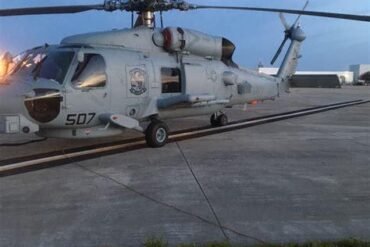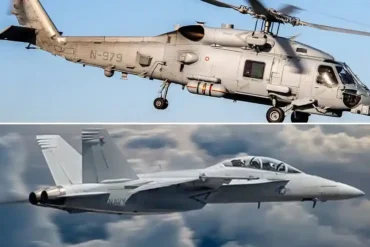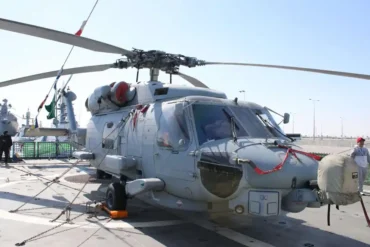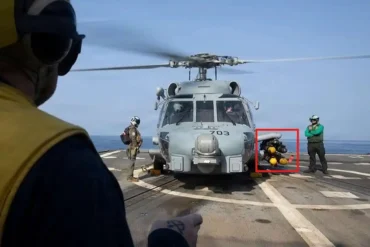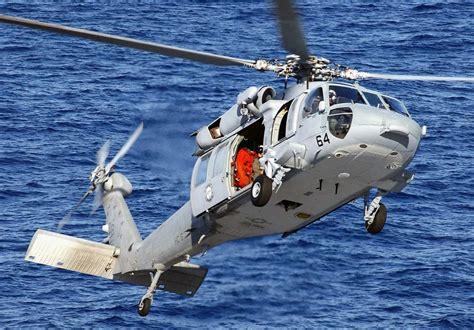
The U.S. Navy has formally accepted its 350th MH-60R Romeo Seahawk helicopter, marking a significant production and operational milestone at a moment when maritime security challenges across the Indo-Pacific are becoming more complex and persistent. The aircraft was handed over during a ceremony at Lockheed Martin’s Owego, New York production facility and transferred to Helicopter Maritime Strike Squadron 41 (HSM-41), the fleet replacement squadron responsible for preparing Pacific Fleet aircrews for frontline operations on the Romeo platform.
This latest delivery underscores the maturity of the MH-60R program and its central role in U.S. naval aviation strategy. More than a symbolic number, the 350th aircraft reflects over a decade of continuous operational use, combat deployments, and incremental modernization that have transformed the helicopter into one of the Navy’s most dependable maritime warfare assets. As regional navies expand submarine fleets and deploy more sophisticated surface and unmanned threats, the Romeo’s combination of sensors, weapons, and networked connectivity remains indispensable.
The acceptance ceremony brought together Navy aviation leadership, program managers, and industry representatives, emphasizing the long-standing partnership between the service and Lockheed Martin. Officials highlighted the aircraft’s reliability in deployed environments and its ability to adapt to evolving mission requirements without sacrificing availability or performance. For HSM-41, the transfer strengthens the squadron’s training pipeline at a time when demand for fully qualified MH-60R crews continues to rise.
A Multi-Mission Helicopter Built for Modern Naval Warfare
Developed by Sikorsky, now a Lockheed Martin company, the MH-60R Romeo entered operational service in 2010 as the U.S. Navy’s standard multi-mission maritime helicopter. Its introduction consolidated anti-submarine warfare, anti-surface warfare, and maritime security missions that had previously been spread across multiple helicopter variants, simplifying logistics while enhancing combat effectiveness.
The aircraft features a glass cockpit, advanced fly-by-wire flight controls, and an integrated mission system designed from the outset for network-centric naval operations. This architecture allows crews to process, fuse, and share sensor data in real time, extending the reach of surface combatants well beyond the horizon. Operating from destroyers, cruisers, frigates, and aircraft carriers, the MH-60R functions as an airborne extension of the ship’s combat system rather than a standalone platform.
Dominance in Anti-Submarine Warfare Operations
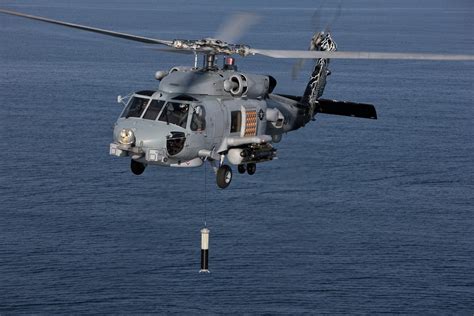
At the core of the MH-60R’s mission set is anti-submarine warfare (ASW), an area of renewed strategic focus as potential adversaries invest heavily in quieter diesel-electric submarines and advanced undersea technologies. The helicopter’s layered sensor suite includes the APS-153 multi-mode maritime radar, the AQS-22 airborne low-frequency dipping sonar, and a comprehensive Electronic Support Measures (ESM) system capable of detecting and classifying hostile emitters.
These sensors are fused by the mission computer to create a dynamic, real-time picture of the undersea and surface battlespace. The MH-60R can deploy Mk 54 lightweight torpedoes with an engagement range exceeding nine kilometers, giving surface combatants an organic submarine engagement capability that is both responsive and lethal. This ability has proven critical during forward deployments, where rapid localization and prosecution of undersea contacts can determine control of key sea lanes.
Precision and Flexibility in Anti-Surface Warfare
Beyond its undersea mission, the MH-60R is equally effective in anti-surface warfare (ASuW). The helicopter can be armed with AGM-114 Hellfire missiles and crew-served weapons such as the GAU-21 .50-caliber machine gun, enabling it to engage a wide range of surface threats from fast attack craft to irregular maritime targets.
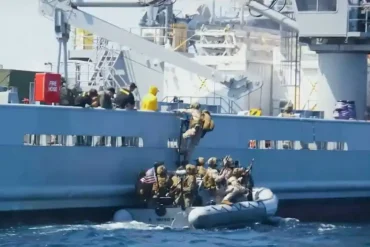
Its radar and electro-optical systems excel at detecting small, fast-moving contacts in congested waters, making the aircraft particularly valuable for maritime security patrols, escort missions, and interdiction operations. Recent deployments in the Red Sea and Gulf of Aden highlighted this versatility, as MH-60R crews tracked and countered hostile unmanned aerial systems and armed skiffs threatening commercial shipping, often operating in coordination with surface ships and allied forces.
HSM-41 and the Pacific Training Pipeline
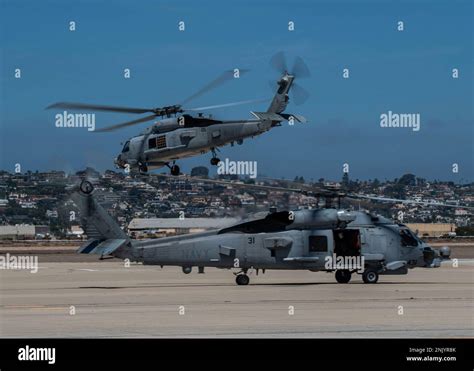
The transfer of the 350th MH-60R to HSM-41 carries special significance for the Pacific Fleet. As the Navy’s Helicopter Maritime Strike Fleet Replacement Squadron, HSM-41 is responsible not only for training new pilots and aircrewmen, but also for introducing updated tactics, software improvements, and sensor employment concepts into the fleet.
The squadron plays a critical role in ensuring that aircrews deploying to the Indo-Pacific are fully prepared for the region’s demanding operational environment. With submarine activity increasing and maritime competition intensifying, the steady flow of aircraft into the training pipeline directly supports readiness across forward-deployed naval forces.
An Open Architecture Designed for Long Service Life
One of the defining features of the MH-60R program is its open-architecture avionics framework, which allows incremental upgrades without major structural modifications. Lockheed Martin continues to assemble and modernize aircraft at the Owego facility, incorporating new capabilities as they mature. The helicopter is equipped with Link 16 Tactical Data Link and other secure communications systems, enabling seamless information sharing with surface combatants, maritime patrol aircraft, and allied platforms.
This design philosophy supports rapid integration of improved processors, advanced acoustic algorithms, and enhanced electronic protection measures. Navy officials expect the MH-60R to remain operational into the 2050s, supported by continuous modernization cycles that address emerging threats while preserving fleet commonality and cost efficiency.
A Growing International Fleet and Strategic Impact
The MH-60R’s value is reflected in its expanding international footprint. The platform has accumulated more than one million flight hours across multiple operators, with Australia, Denmark, Saudi Arabia, India, Greece, and South Korea already fielding the Romeo variant. Spain and Norway are scheduled to receive aircraft in the coming years, further expanding interoperability among allied navies operating in the Atlantic, Mediterranean, and Indo-Pacific regions.
For the U.S. Navy, the acceptance of the 350th MH-60R is both a milestone and a strategic signal. It confirms sustained investment in a proven maritime aviation capability at a time when undersea dominance, distributed operations, and forward presence are once again at the center of naval planning. As maritime threats continue to evolve, the MH-60R Romeo stands as a cornerstone of U.S. and allied sea power, delivering flexibility, persistence, and decisive reach across the world’s oceans.