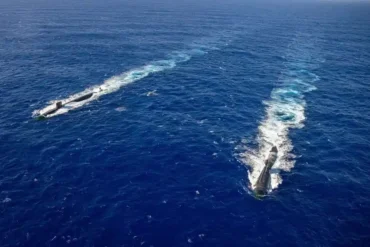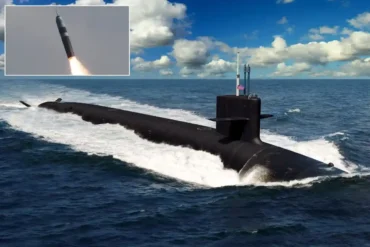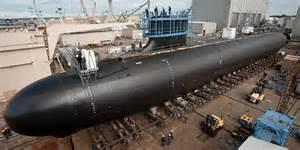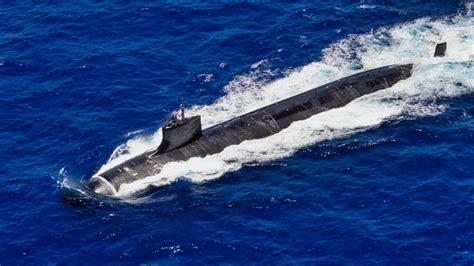
The Seawolf-class attack submarine was supposed to become the backbone of America’s underwater dominance after the Cold War. Instead, the United States Navy built only three of them before abruptly ending production. Despite being among the most sophisticated submarines ever created, the Seawolf program became a symbol of how rapidly changing geopolitics and soaring military costs can reshape even the most ambitious defense projects.
When the program began in the early 1980s, the U.S. Navy faced an increasingly capable Soviet submarine force. Soviet attack submarines were becoming faster, quieter, and more heavily armed, creating serious concerns inside the Pentagon. The Navy wanted a next-generation hunter-killer submarine capable of outperforming anything Moscow could deploy beneath the oceans. That vision became the Seawolf-class.
Designed during the height of Cold War tension, the Seawolf submarines were engineered for one mission above all others: dominate Soviet submarines in deep ocean combat. Everything about the design emphasized stealth, speed, survivability, and firepower. The Navy originally planned to build 29 Seawolf submarines to replace the aging Los Angeles-class fleet, but history intervened before the program could fully mature.
The collapse of the Soviet Union in 1991 dramatically changed the strategic landscape. Suddenly, the United States no longer faced the same existential naval threat beneath the Atlantic and Pacific Oceans. Congress began questioning why the Pentagon needed an extraordinarily expensive submarine designed for a superpower rivalry that had effectively ended.
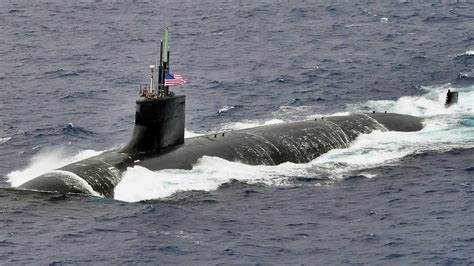
Each Seawolf-class submarine carried a staggering price tag of roughly $3.5 billion, equivalent to around $7.65 billion in 2026 dollars. That made it the most expensive attack submarine ever built by the United States. In an era when defense budgets were shrinking and policymakers demanded a peace dividend after the Cold War, the Seawolf program quickly became politically difficult to defend.
The Navy still recognized the submarine’s remarkable capabilities, but lawmakers viewed the program as excessive for the post-Cold War world. Instead of continuing with all 29 planned submarines, Congress authorized only three boats: USS Seawolf (SSN-21), USS Connecticut (SSN-22), and USS Jimmy Carter (SSN-23).
The Seawolf-Class Was Built for Underwater Supremacy
Even decades after their introduction, the Seawolf submarines remain among the most formidable underwater war machines ever constructed. Their performance specifications still command respect across global naval circles.
The submarines were designed to operate with extreme stealth. Their internal machinery was heavily isolated to reduce vibration and noise, while the hull design minimized acoustic signatures detectable by enemy sonar systems. In naval warfare, silence often determines survival, and the Seawolf-class excelled at disappearing beneath the ocean.
Many defense analysts have compared the Seawolf to the F-22 Raptor stealth fighter because both platforms prioritized survivability through near invisibility. Enemy submarines could struggle to detect a Seawolf until it was already within striking distance.
The class also delivered exceptional speed. The submarines could reportedly exceed 40 mph while submerged, making them among the fastest operational military submarines ever deployed. Combined with their stealth, this speed allowed Seawolf boats to rapidly reposition during combat operations or shadow enemy vessels without detection.
Their firepower was equally intimidating. Each submarine could carry up to 50 weapons, including:
- UGM-109 Tomahawk cruise missiles
- Mark 48 heavyweight torpedoes
- Harpoon anti-ship missiles
This arsenal allowed the Seawolf-class to engage enemy submarines, surface ships, and land targets with devastating effectiveness.
USS Jimmy Carter Became a Unique Special Operations Platform
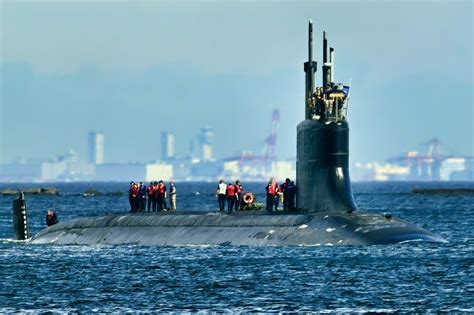
Among the three submarines, the USS Jimmy Carter stands apart. Unlike its sister ships, the submarine received a significant structural extension during construction. Engineers added a 100-foot hull section, increasing the vessel’s total length to roughly 453 feet and boosting submerged displacement to more than 12,000 tons.
This additional section, known as the Multi-Mission Platform, transformed Jimmy Carter into a highly specialized submarine capable of supporting classified operations. Analysts widely believe the vessel performs intelligence gathering, underwater surveillance, cable tapping, and special operations missions that remain largely undisclosed to the public.
The modification also made USS Jimmy Carter one of the most expensive and secretive submarines ever operated by the Navy.
Why the Virginia-Class Replaced the Seawolf
After terminating most of the Seawolf program, the Navy pursued a more practical solution: the Virginia-class attack submarine. While still extremely advanced, the Virginia-class emphasized affordability, versatility, and adaptability for modern missions rather than pure Cold War-era submarine combat.
Virginia-class boats cost slightly less while offering broader mission flexibility, including intelligence gathering, special operations support, and coastal strike capabilities. As a result, they became the Navy’s primary fast attack submarine platform, with roughly two dozen already in service by late 2025.
The Seawolf-class never achieved large-scale production, but its legacy remains extraordinary. These submarines represented the absolute peak of Cold War naval engineering — built for a conflict that vanished before the fleet could fully emerge. Even today, the three Seawolf submarines remain among the quietest, fastest, and deadliest attack submarines ever placed beneath the sea.