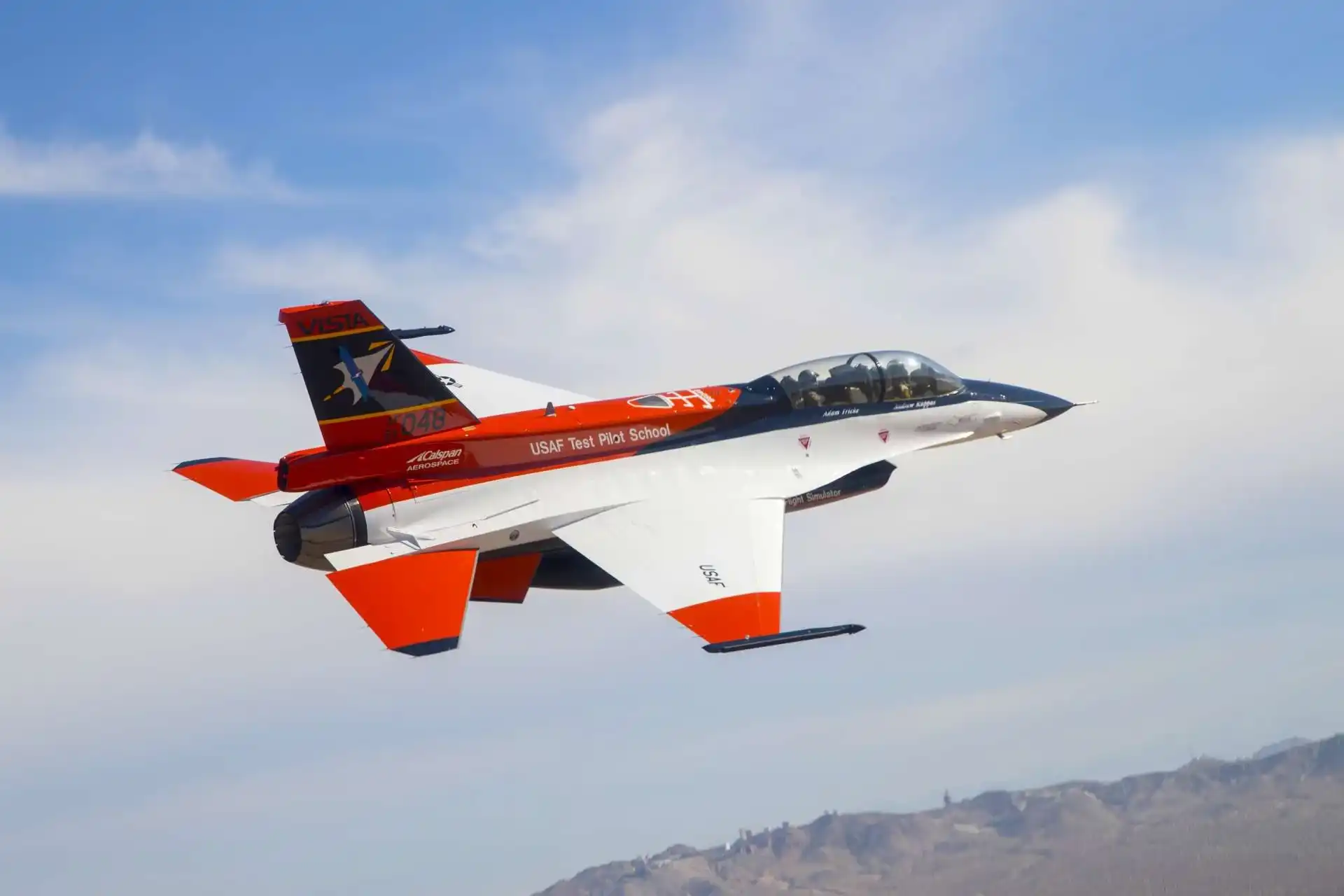
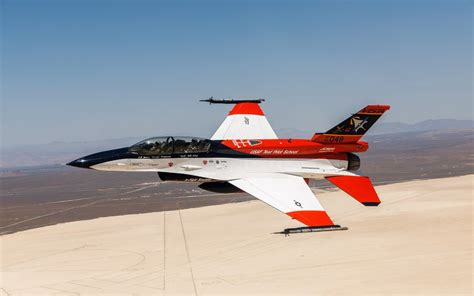
The U.S. Air Force’s X-62A VISTA has taken a decisive step from experimental autonomy toward operational relevance, hosting Lockheed Martin’s Skunk Works tactical AI agent in a series of live-flight missile-evasion tests that redefine the boundary between simulation and combat reality. Conducted in partnership with the U.S. Air Force Test Pilot School (TPS) at Edwards Air Force Base, the February 23, 2026 milestone demonstrated that an artificial intelligence system trained in massive synthetic environments can transition to a manned fighter-class aircraft and execute split-second defensive maneuvers without pilot input—while remaining fully supervised and overrideable.
This was not a laboratory demonstration staged in controlled, sterile conditions. The AI agent assumed direct control authority during high-threat scenarios, responding to simulated missile launches with aggressive three-dimensional maneuvers at the edge of the aircraft’s flight envelope. In practical terms, the system sensed a threat cue, calculated an escape solution, and flew the aircraft accordingly—all inside a time window where hesitation can mean destruction. The significance lies not simply in autonomy, but in validated, safety-critical autonomy operating inside a live tactical environment.
The program, conducted under the Have Remy Test Management Project, embedded TPS students directly into the AI development and evaluation loop. This integration ensured that operational insight shaped algorithm design from the outset. Instead of treating autonomy as a black box, future test leaders helped define threat parameters, evaluate decision logic, and interpret flight data. The result was a tightly integrated human-machine teaming architecture, where software and aircrew functioned as collaborative actors rather than competing authorities.
The X-62A VISTA: A Fighter Rewired for Autonomy
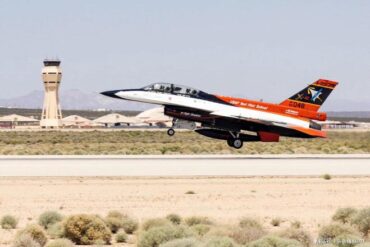
The X-62A Variable In-flight Simulator Test Aircraft (VISTA) is uniquely suited to host such experiments. Based on a two-seat F-16D, it incorporates programmable flight-control laws, enhanced onboard computing, and configurable sensor architectures that allow engineers to modify aircraft behavior in real time. This makes VISTA more than a test jet—it is a flying laboratory capable of emulating other aircraft characteristics while simultaneously integrating experimental autonomy stacks.
In the missile-evasion trials, the AI agent was embedded within the aircraft’s fly-by-wire control loop. Fly-by-wire systems replace mechanical linkages with electronic signals, meaning software translates pilot inputs into control surface movements. By inserting the AI directly into this architecture, engineers granted it the authority to command control surfaces and thrust settings during designated test points. The autonomy stack therefore did not merely suggest actions; it physically flew the aircraft within structural and aerodynamic limits.
Previous AI experiments aboard the VISTA, including DARPA and Air Force Research Laboratory programs, demonstrated autonomous dogfighting and within-visual-range maneuvering. The Have Remy campaign, however, shifted the emphasis toward missile survivability—a scenario that compresses perception, decision, and action into fractions of a second. Modern surface-to-air and air-to-air missiles operate at extreme velocities and are guided by sophisticated seekers, leaving minimal margin for delayed reaction.
From Billions of Simulations to Live Sky
Lockheed Martin’s development pipeline relied on its Supermassive simulation engine, which executed billions of synthetic mission iterations to train the tactical AI agent. Reinforcement learning—an AI technique where algorithms learn by receiving feedback from successes and failures—exposed the system to diverse engagement geometries, missile kinematics, and environmental variables. In simulation, the AI could fail millions of times without consequence. In live flight, it had to perform correctly on the first attempt.
A high-fidelity F-16 simulator, calibrated to mirror the modified aerodynamics and control laws of the X-62A, provided the bridge between virtual and physical environments. Engineers validated that behaviors observed in synthetic runs translated consistently to the hardware-in-the-loop environment. Only after extensive validation did the autonomy stack transition to live sorties.
More than one hundred test points were flown during the campaign. Each scenario assessed how accurately the AI’s decisions in real airspace matched its simulated training outcomes. This sim-to-real transfer remains one of the central challenges in tactical autonomy. Algorithms often behave differently when exposed to real-world noise, sensor imperfections, and aerodynamic variability. The Have Remy results demonstrated consistent behavioral transfer, reinforcing confidence that the AI’s decision logic was not brittle or overfitted to artificial conditions.
Missile Evasion at Machine Speed
Missile-evasion maneuvers demand precise management of energy, orientation, and timing. The aircraft must rapidly alter its aspect angle relative to the threat while managing G-forces, airspeed, and structural constraints. An optimal defensive move depends on the missile’s seeker type, closing velocity, and engagement geometry. Humans excel at pattern recognition, but under extreme time pressure the brain can become a bottleneck.
The AI agent functioned as a high-speed tactical decision engine. Upon detecting a simulated missile launch cue, it selected and executed a pre-authorized maneuver profile tailored to the threat envelope. The system generated control commands in milliseconds, adjusting continuously as simulated parameters evolved. Throughout each engagement, safety pilots remained ready to intervene, ensuring that experimental authority never compromised flight safety.
What makes this development strategically consequential is not that the AI can out-react a human in isolation. It is that the system integrates seamlessly with a human-in-command framework. The autonomy layer is bounded, transparent, and overrideable. In other words, the pilot remains sovereign, but gains access to machine-speed reflexes during critical moments.
Fly-Fix-Fly: Agile Autonomy Development
Traditional flight-test programs operate on long validation cycles, where modifications are implemented cautiously and evaluated over extended intervals. The Have Remy project introduced an agile fly-fix-fly model. After each sortie, engineers replayed recorded flight data in simulation, analyzed discrepancies between predicted and observed behaviors, updated the autonomy stack, and redeployed refined code to the aircraft—sometimes within hours.
This iterative loop mirrors modern software development practices while preserving aerospace certification rigor. TPS students contributed by developing monitoring algorithms capable of quantifying how closely in-flight performance matched simulated expectations. These metrics are essential if AI is to gain certification for broader operational use.
The approach signals a cultural shift within military aviation testing. Autonomy development is no longer confined to theoretical modeling; it is becoming an adaptive, data-driven cycle grounded in real-world performance.
Operational Implications for Contested Airspace
The operational environment driving these efforts is defined by integrated air defense systems (IADS) and advanced missile networks. Modern battlefields feature layered sensors, long-range surface-to-air missiles, and electronic warfare systems designed to compress reaction windows. Survival depends on rapid decision-making and precise execution.
In near-term applications, tactical AI architectures derived from this work could function as tightly bounded assistance modes in fourth- and fifth-generation fighters. Under predefined conditions, the system might autonomously execute a defensive maneuver when a threat envelope is confirmed, returning control immediately afterward. Such capability would not replace pilots; it would extend their cognitive bandwidth.
Longer-term, these autonomy stacks could form the self-protection core of Collaborative Combat Aircraft (CCA) concepts. Uncrewed escorts operating alongside crewed fighters would rely on onboard AI to manage survivability in contested zones. Machine-speed evasion logic could enhance resilience without demanding continuous remote oversight.
Beyond fighters, derivative implementations might enhance survivability for high-value assets such as tankers, ISR platforms, or electronic warfare aircraft. While these platforms are not designed for high-G maneuvers, AI-driven threat response systems could optimize escape vectors or coordinate defensive countermeasures under compressed timelines.
Human-Machine Teaming Redefined
The broader strategic theme underpinning the X-62A milestone is human-machine teaming. Autonomy is often framed as a binary choice between human control and algorithmic dominance. The Have Remy campaign illustrates a third path: collaborative cognition. The AI acts as a specialized reflex layer embedded within a pilot-led mission structure.
This architecture acknowledges both strengths and limitations. Algorithms excel at processing vast data sets and executing optimized control sequences rapidly. Humans retain contextual judgment, ethical oversight, and adaptive creativity. When integrated properly, the partnership becomes multiplicative rather than competitive.
The X-62A tests therefore represent more than an engineering success. They offer a tangible model for certifying, supervising, and iteratively improving tactical AI in live aircraft. As air combat grows increasingly networked and time-compressed, survivability may hinge on such machine-speed augmentation.
By transferring a missile-evasion AI agent from billions of simulated missions into over a hundred live test points on a manned fighter-class aircraft, Lockheed Martin and the U.S. Air Force have demonstrated that tactical autonomy is no longer confined to experimental theory. The Have Remy project shows that AI can perceive, decide, and act within the unforgiving physics of real flight—while remaining accountable to human command. In a battlespace defined by shrinking reaction windows and proliferating threats, that fusion of silicon reflexes and human judgment marks a pivotal evolution in airpower.