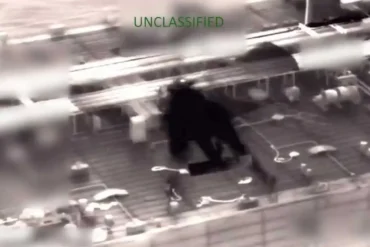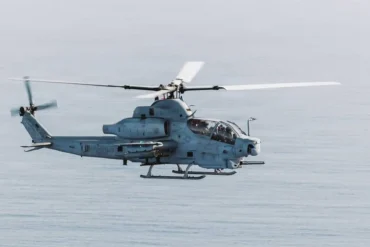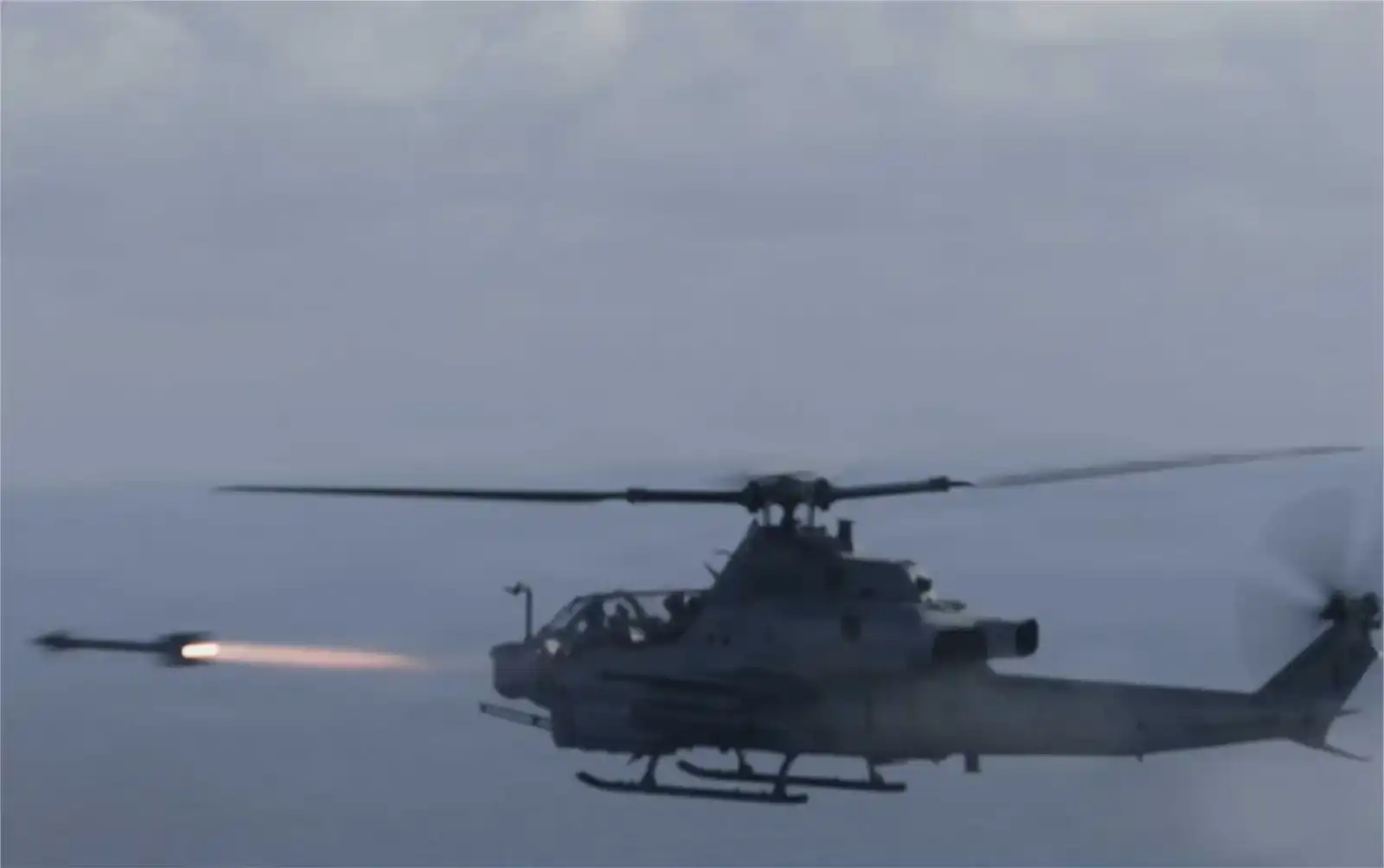
The U.S. Marine Corps demonstrated advanced air-to-air capability in late November 2025 when an AH-1Z Viper attack helicopter launched an AIM-9 Sidewinder missile during a controlled live-fire exercise over the Caribbean Sea. The event, carried out on November 25 as part of Operation Southern Spear, underscored a decisive shift in how Marine rotary-wing aviation is being employed in counter-narcotics and maritime interdiction missions. A U.S. Southern Command update on December 3 confirmed that the aircraft, assigned to the 22nd Marine Expeditionary Unit, executed the launch against a simulated aerial target designed to replicate the dynamic threats increasingly encountered across the region.
The Caribbean theater—long treated as a zone of low-intensity maritime operations—has seen a steady rise in aerial and surface threats linked to transnational criminal networks. The AH-1Z Viper’s involvement reflects a modernization of strategy: traffickers are no longer viewed as simple boat operators but as adaptive adversaries using fast, unpredictable platforms. By integrating the Sidewinder missile, a weapon classically associated with fighter jets, the Marine Corps is signaling a readiness to dominate the aerial dimension of these interdiction efforts.
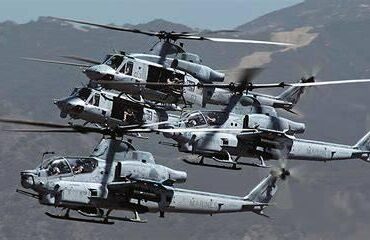
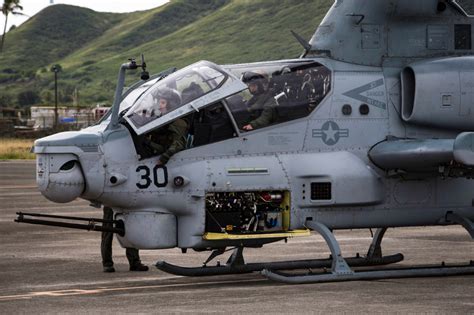
The Bell AH-1Z Viper, often called the Zulu Cobra, stands as the Marine Corps’ most capable attack helicopter, engineered for maritime environments and expeditionary deployments. Its four-blade composite rotor, digital cockpit, and suite of integrated sensors make it ideally suited for littoral operations where visibility, maneuverability, and immediate firepower are crucial. Traditionally used for close air support, anti-armor interdiction, and maritime strike operations, the Viper’s ability to deploy an AIM-9 Sidewinder extends its reach into the realm of air-superiority tasks.
While helicopter-mounted Sidewinders are rare, the system’s infrared-guidance, rapid target acquisition, and high agility offer decisive advantages. In contested zones where smugglers may employ drones, low-flying aircraft, or armed reconnaissance platforms, the Viper becomes a multidomain asset capable of responding in seconds. The missile’s performance in this exercise highlights a strategic message: U.S. forces intend to maintain unquestioned aerial dominance, even in missions traditionally centered on maritime law enforcement.
Operation Southern Spear: Intensifying Pressure on Illicit Maritime Networks
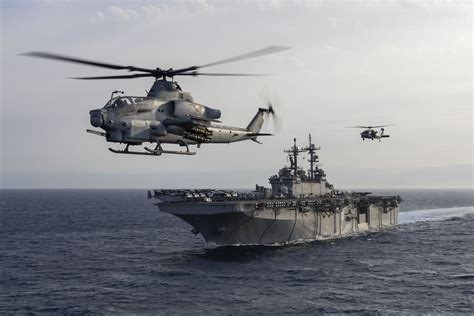
Operation Southern Spear represents a broader evolution in U.S. counter-narcotics posture, bringing together Navy amphibious units, Marine aviation elements, and joint interagency partners. While interception statistics remain undisclosed, the deployment of high-end platforms such as the AH-1Z, UH-1Y Venom, and MV-22B Osprey points to growing concern over cartel activity within the Caribbean corridor. According to Pentagon assessments tied to Joint Interagency Task Force South, criminal organizations have increased their reliance on fast-moving vessels and clandestine flights—both demanding a rapid-response capability beyond what traditional law enforcement assets can provide.
The 22nd MEU, operating from a U.S. Navy amphibious ready group, brings precisely that flexibility. During interdiction operations, the Viper functions as an overwatch platform, capable of monitoring surface and airspace simultaneously. Should a vessel ignore orders to halt or present a threat, the helicopter’s mix of 20mm cannon, Hellfire missiles, Hydra rockets, and now the Sidewinder ensures an unmatched escalation spectrum. The live-fire event was not an isolated demonstration but a signal of operational readiness, integrating Marine capabilities into a law enforcement–heavy mission profile.
Aerial Dominance and Deterrence in the Caribbean Battlespace
With traffickers increasingly employing fast boats, semi-submersibles, and unmanned aerial systems, the U.S. military’s decision to field air-to-air munitions aboard helicopters within this region reflects a new reality. Even though the Sidewinder launch was conducted against a simulated target, it serves as a clear message of escalation readiness. The Marines are prepared not merely to observe but to neutralize aerial threats associated with narcotics trafficking. The Caribbean Sea’s once low-threat environment has evolved into a competitive space requiring advanced sensors, precision fires, and adaptable platforms.
Military officials emphasize that integrating the MEU aviation combat element into Southern Command efforts represents a deeper interagency alignment. The result is a layered defense structure: law enforcement leads, while Marine aviation offers the rapid-response deterrent that criminal organizations cannot match. The AH-1Z’s demonstrated capability to employ a fighter-grade missile confirms its role as a cornerstone asset in securing maritime corridors increasingly exploited by transnational networks.
A Regional Shift in Maritime Security Strategy
The November 25 missile launch marks a pivotal moment in U.S. counter-narcotics and maritime security strategy. By embedding high-performance aviation assets within operations traditionally led by civilian agencies, the United States is acknowledging the escalating sophistication of cartel tactics. Marines now stand as a central component of Southern Command’s deterrent posture, capable of responding to fast-moving threats across air and sea with unprecedented precision.
As Operation Southern Spear continues, the presence of the AH-1Z Viper—with its expanded weapons suite and proven adaptability—signals that the Caribbean Sea is entering a new era of enforcement and surveillance. The missile release was not merely a training milestone; it was a declaration that the United States intends to stay several steps ahead of emerging airborne and maritime threats across the region.